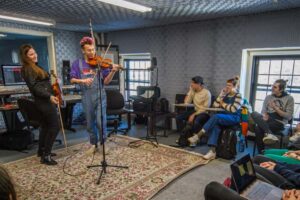
The music major requires completing core courses, ensemble performance, track-specific electives, and a capstone.
In your first two years, you build the foundation: core theory, history, and technology courses, alongside ensemble participation and private lessons. You explore Worcester’s music scene, consider study abroad options, and connect with performance faculty.
In your junior and senior years, you go deeper: intermediate and advanced courses within your chosen track, leadership roles in ensembles, professional preparation — résumé, recordings, website, audition materials — and the capstone, which brings everything together in a public-facing project or performance.
Core Requirements
Core requirements are designed to be completed by the first semester of junior year, giving you maximum flexibility in your upper-level work. All music majors take the same six foundation courses, regardless of track:
Exploring Music Historically and Critically (MUSC 100) — the intellectual foundation of the major
Theory I: Principles of Tonal Analysis (MUSC 121)
Tonal Analysis II: Form and Chromaticism (MUSC 122)
Computers and Music (MUSC 141)
Keyboard Skills (MUSC 001) and Sight Singing and Ear Training (MUSC 002) — half-credit courses that build essential musicianship skills
Students who test out of Keyboard Skills or Sight Singing substitute an additional workshop, ensemble credit, or semester of private instruction.
Whether you’re a composer, music producer, or performer, exposure to the theory and practice of improvisation, aleatory (random choice techniques), and open-form music can help you take your work to the next level.
D&IPOP
MUSC 235
Community Music and Social Action
Explore how music professionals and other artists can support and generate social change. You’ll work with at-risk youths in a free, local music program, and/or intern with a prominent local arts organization.
MUSC 242
Soundtracks
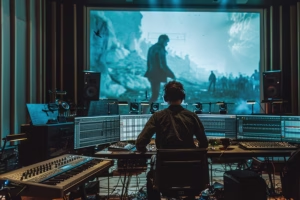
Experience how sounds and music work with (and against) moving images while you explore elements of narrative sound and audiovisual analysis, postproduction techniques, and historical sound and music conventions.
Beyond the core, students complete at least six additional courses, including a musicology course, at least one 200-level course, and a senior project or capstone. The shape of that upper-level work depends on your track:
Performance — private instruction, ensemble leadership, and a senior recital
Composition and Theory — composition seminars, music analysis workshops, and a creative capstone project
Musicology — music history courses, research seminars, and a scholarly capstone
Technology — recording practice, audio art, composing for new media, and a production-focused capstone
Minor requirements
The Music minor offers students a substantive grounding in musical history, theory, and technology — enough to develop real fluency without the full commitment of the major. Six and a half course units are required.
The minor begins with a core of four courses that all students complete by the first semester of junior year:
Exploring Music Historically and Critically, which establishes the intellectual foundation;
Theory I: Principles of Tonal Analysis;
Computers and Music;
and either Keyboard Skills or Sight Singing and Ear Training, depending on your background and goals.
Three additional course units are chosen from the music curriculum at the 100-level or above, allowing you to pursue the areas — performance, composition, music history, technology — that connect most naturally to your interests and primary field of study.
All courses contributing to the minor must be passed with a grade of C or better. Core courses should be completed by the first semester of junior year; exceptions require approval from the Music Program Director.
Yes. Students with strong academic records and faculty approval can pursue honors in music, culminating in a senior honors project — a recital, composition, or research project of significant scope — completed over one or two semesters of their senior year. Interest must be declared in junior year.
What awards are available to music students?
Three awards recognize outstanding work by Clark music students:
The Robert P. Manero Memorial Music Award is given to outstanding seniors in the music program. The Robert P. Manero Prize for Musical Scholarship recognizes an outstanding scholarly work addressing music written by a Clark undergraduate. The Robert P. Manero Prize for Musical Creativity recognizes an outstanding creative project involving music. All three are judged on depth, technical skill, and clarity of thought and presentation.
Music students are also eligible for the Patricia M. Plamondon Undergraduate Award in Visual and Performing Arts, given annually by faculty vote to juniors and seniors who have demonstrated talent and commitment to the arts.
Contact information
Visual and Performing Arts
Office location
Traina Center for the Arts 92 Downing Street Worcester, MA 01610