Organized by the School of Climate, Environment, and Society, a national panel discussion addressed how cities are grappling with the challenges of extreme weather.
Over two decades, Geography Professor Mark Davidson of Clark’s School of Climate, Environment, and Society has emerged as a leading expert on the municipal budgeting and fiscal health of cities grappling with shifting economic, demographic, and political realities.
Working in international finance in London and obtaining a Ph.D. from King’s College, Davidson observed the city’s exploding housing crisis and wealth inequities of the 2000s.
The urban geographer then turned his attention to the U.S. At Clark since 2010, he has examined U.S. “donut cities” like San Francisco and San José, with downtowns hollowed out by the global pandemic, growing homelessness, and fleeing businesses and customers; the gentrification of historically industrial cities like Detroit and Clark’s host city of Worcester, Massachusetts; municipalities’ Chapter 9 bankruptcies after the 2008 Great Recession; and local governments’ responses to ever-growing public pension liabilities.
Yet, Davidson says, cities now face an additional, unpredictable and daunting fiscal pressure layered onto all of these existing obligations: climate change.
“When I look at the obligations that cities have — the bonds they have outstanding, the pension promises they’ve made, the OPEBs [other post-employment benefits] that they carry, the deferred maintenance, there’s a big debt stack there,” said Davidson, whose current book project, “Red Ink Urbanism” (University of Minnesota Press), examines how accumulated fiscal obligations in Nashville, Buffalo, and San José shape urban governance and capacity.
“And climate is on top of that.”
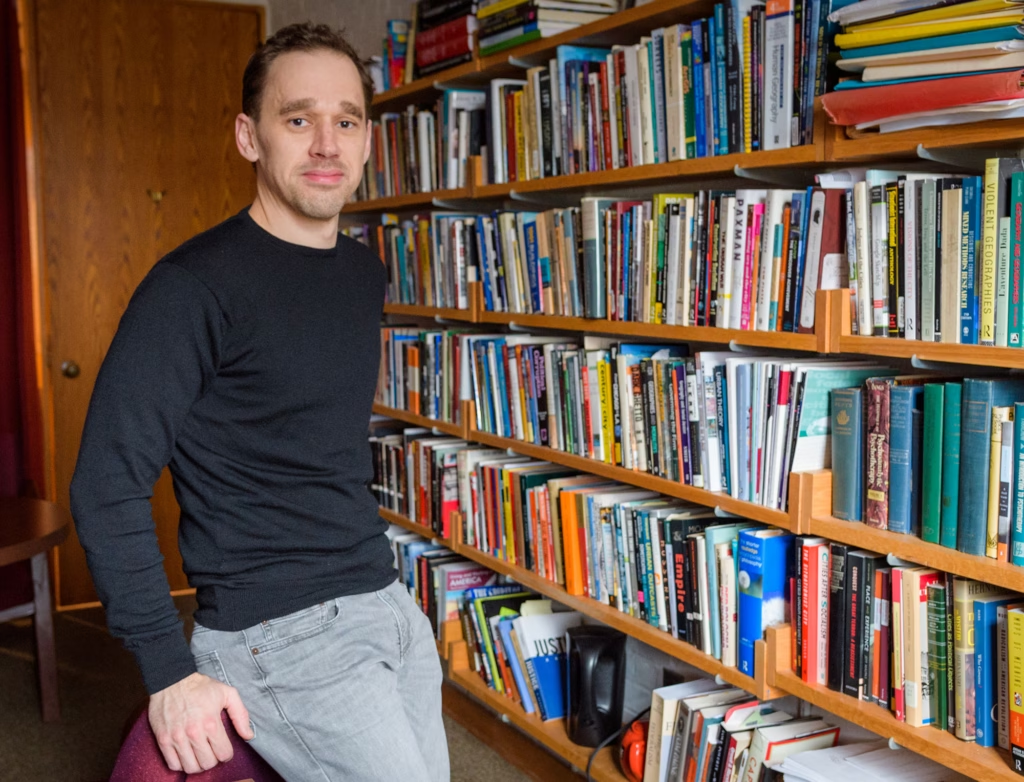
This week, Davidson opened a national panel discussion organized by the School of Climate, Environment, and Society by framing the issues facing cities under climate change. The virtual event, “The Resilience Imperative: How Cities Can Survive, and Thrive, in an Era of Extreme Weather,” brought together government and nonprofit leaders who shared how cities and states across the U.S. are improving their climate resilience.
His co-panelists included Melissa Hoffer, appointed by Gov. Maura Healey as Massachusetts’ first chief climate officer; Patricia Lock Dawson, mayor of Riverside, California; and Saharnaz Mirzazad, CEO of ICLEI, a global network of more than 2,500 local and regional governments committed to sustainable urban development.
To address climate-related heatwaves, flooding, and severe storms, U.S. cities have long relied on short-term federal funding and grants like the nearly $400 billion in investments allotted through the Biden administration’s 2022 Inflation Reduction Act (IRA) or disaster aid from the Federal Emergency Management Agency (FEMA).
However, Davidson pointed out, “it’s difficult to ask fiscally constrained cities to manage something like climate risk, which is now a permanent problem, using temporary funds.”
“I don’t think cities lack an awareness of climate risk,” he said. “They lack durable capacity. Through innovation, they can get some of the way there.”
The most successful local governments are embedding climate resiliency in their fiscal planning and daily decision making, according to Davidson.
“The economics are compelling. For the last 10 years, FEMA has been saying that for every one dollar you spend on hazard mitigation, you’re saving $6 in future costs,” he said. (The statistic comes from a 2018 National Institute of Building Sciences study.)
Cities also are partnering with universities like Clark, community organizations, private firms, regional bodies, and networks such as the ICLEI “to build that capacity, not just transfer knowledge,” Davidson said.
His co-panelists provided examples of the innovative ways in which cities and states are building climate resiliency.
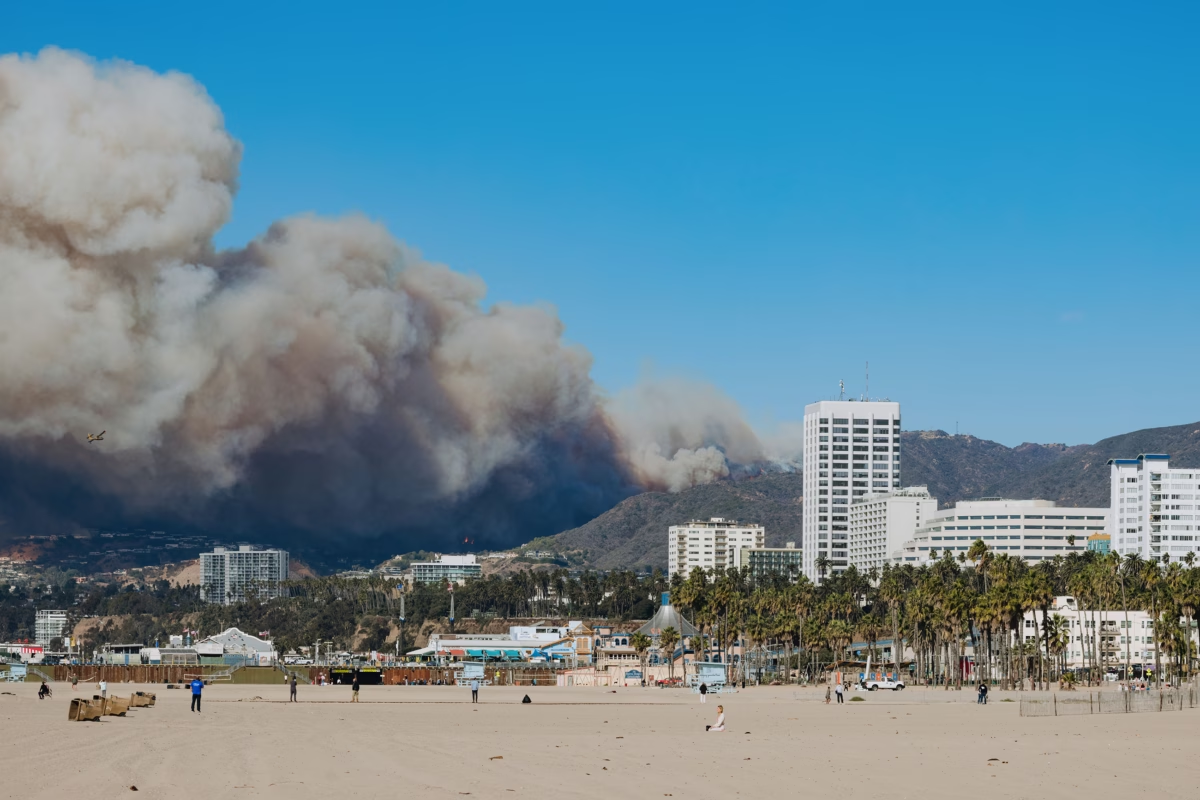
In Riverside, which this week faced extreme heat warnings and temperatures up to 110 degrees, the city has launched initiatives like Ready Riverside, which informs residents how to stay safe during heatwaves, wildfires like the one that destroyed Pacific Palisades in Los Angeles (above, a view of the wildfire from Santa Monica Pier), and other emergencies, Mayor Lock Dawson said. The city also hosted an Extreme Heat Summit and simulated emergency planning session and created a “tree plotter” program for residents to identify gaps where shade trees could be planted to cool neighborhoods.
Climate resilience benefits the city’s economy, she said. “For too long, we’ve pitted what’s good for the environment [against what’s] bad for the economy or vice versa. And that is such a false choice. … The two things absolutely complement and leverage each other.”
In Massachusetts, Hoffer said, the Healey administration identified $90 billion to $130 billion worth of investments needed to address extreme-climate-related issues, including improving culverts, dams, and other infrastructures and maintaining natural carbon sinks — trees and wetlands — to prevent coastal and inland flooding. The administration created the Massachusetts Community Climate Bank to preserve and retrofit affordable housing for energy efficiency.
“It’s now achieving 70 to 100 percent-modeled energy reduction, which is incredible because that means lifetime energy cost savings for the inhabitants of that housing,” she said.
Residents also can obtain low-interest loans from the Community Climate Bank to fortify or replace their roofs and add solar panels, as well as install energy-efficient heat pumps.
“There will never be enough public dollars. What we had previously in the IRA was a good accelerator. But now without that, we have to figure it out.”
— melissa hoffer, chief climate officer for massachusetts
The state also is partnering with cities and universities such as Clark’s School of Climate, Environment, and Society, according to Hoffer. After Worcester received a $400,000 municipal grant to create climate-resilient Miyawaki forests, Geography Professor John Rogan and his students helped plant two forests in 2025.
Hoffer championed the school’s Human-Environment Regional Observatory (HERO) program, led by Rogan and urban geography Professor Deborah Martin.
Over the past decade, the HERO program has partnered with the state Department of Conservation and Recreation’s Greening the Gateway Cities program to counteract the effects of urban “heat islands” in historic industrial cities, where central neighborhoods can be up to 20 degrees hotter than leafier suburban areas just a few miles away.
The heat-island project is a “visible” example of a successful academic-state-city partnership that “can teach folks about the value of coming together,” Hoffer said, providing everyone involved with “a sense of empowerment to address climate issues, and that is hugely important.
Likewise, ICLEI USA has worked with cities such as Boynton Beach, Florida, and Pittsburgh to plant trees. These natural solutions are proven to counteract the effects of heatwave emergencies, which cost $162 billion in the United States just last year and, over the past two decades, have killed 20,000 people, Mirzazad said.
Yet, there is little funding to address heatwave emergencies, she acknowledged. “FEMA funding and, frankly, any federal funding, is stretched thin. And in many cases heat resilience is not even treated as an emergency,” she said. “Many of the local governments across the country don’t have heat in their hazard mitigation plans.”
Local governments, therefore, are forming “cross-sector tables … on decision-making and bringing the private sector into the room,” Mirzazad said.
Hoffer acknowledged the lack of funding as well. “There will never be enough public dollars,” she said. “What we had previously in the IRA was a good accelerator. But now without that, we have to figure it out.”
The Aug. 25 panel discussion was moderated by Megan Houston, director of external partnerships and experiential learning for the School of Climate, Environment, and Society, who, before coming to Clark, led climate resilience and sustainability initiatives across the local government and nonprofit sectors for 15 years.