Record-breaking heat across Europe. Catastrophic flooding in Nepal. Wildfires stretching from North America to Southeast Asia. In recent months, the world has encountered stark reminders of the growing impacts of climate change and the urgent need for long-term solutions.

According to Lou Leonard, D.J.A. Spencer Dean of Clark University’s School of Climate, Environment, and Society (CES), universities have an increasingly important role to play in advancing those solutions.
“Effectively responding to the climate crisis is beyond the reach of any single discipline,” he notes. “Schools like ours bring together research and partnerships across key disciplines to transform knowledge into action.”
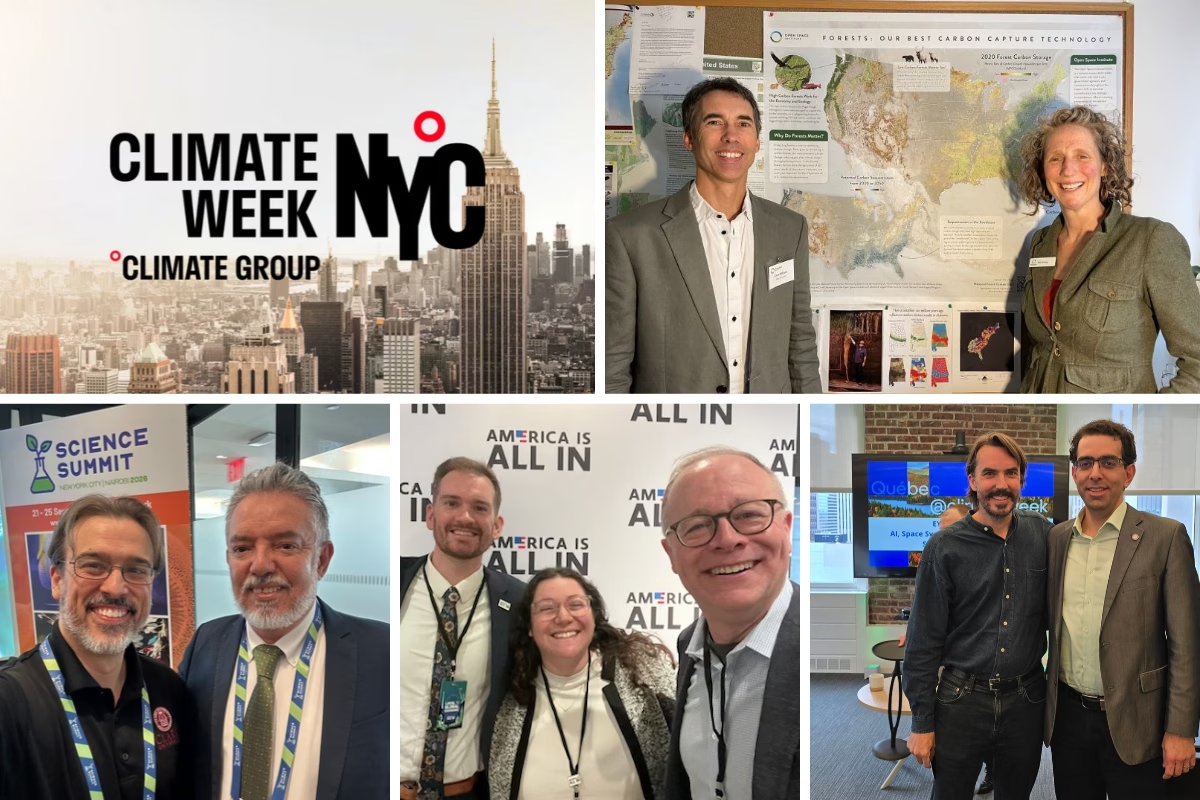
That collaborative approach was on display September 20–27 during Climate Week NYC, one of the world’s largest annual gatherings focused on climate change. The event brought together thousands of participants from around the world — including activists, nonprofit leaders, scientists, corporate executives, and government officials — to exchange ideas and accelerate progress. Scheduled alongside the annual meeting of the United Nations General Assembly, the week had a strong international dimension with nearly every head of state in the world also in New York.
Leonard and four faculty members joined and led Climate Week conversations on topics ranging from forest conservation and AI-enabled geospatial analysis to strengthening the role of local communities in shaping climate research and bridging the gap between innovation and scale. Their participation reflected the collaborative, interdisciplinary approach that has shaped the school’s first year and continues to guide its contributions to research, policy, and practice.
A school making its mark
Since its launch in September 2025, the School of Climate, Environment, and Society has emerged as a trusted partner for global climate negotiations, workforce development, state resilience initiatives, and community-driven priorities.
At COP30 in Belém, Brazil, Leonard and geography professors Florencia Sangermano and Abby Frazier contributed to global discussions on Indigenous-led climate resilience, emphasizing the critical role of Indigenous knowledge and leadership in addressing climate challenges across the Amazon and Pacific Islands, while also headlining efforts to represent U.S. leadership in the absence of an American government delegation.
In April, Clark hosted New York Times columnist Thomas Friedman and Mindy Lubber, president of the sustainability nonprofit Ceres, for the first CES Forum, grappling with mega-trends like global security, AI, and energy.
In July, Massachusetts Governor Maura Healey selected Clark University as the site for the announcement of the state’s first Heat Resilience Officer, making Massachusetts only the second state in the nation to establish a state-level position dedicated to extreme heat. The announcement followed a roundtable discussion with state, municipal, and nonprofit leaders focused on strengthening community resilience to extreme heat.
A few weeks later, the school expanded that conversation beyond Massachusetts by hosting “The Resilience Imperative: How Cities Can Survive, and Thrive, in an Era of Extreme Weather,” a virtual panel discussion with government and nonprofit leaders joining Clark faculty to explore how communities can build climate resilience amid growing fiscal and environmental pressures.
Together, these efforts and others during its first year underscore one of the school’s defining priorities: bridging the gap between understanding societal risks and responding to them effectively.
This blend of scholarship, public engagement, and real-world collaboration also shaped the CES presence at Climate Week.
Technology, data, and climate decision-making
Recognized internationally for its leadership in Geographic Information Science (GIS) and geospatial analysis, Clark was represented by two faculty members whose work explores how emerging technologies can help communities advance sustainable futures.

Christopher Williams, professor in the Graduate School of Geography and interim director of the George Perkins Marsh Institute, hosted a session with the Open Space Institute (OSI), a frequent collaborator on his forest conservation research. Together, they highlighted decision-support tools Williams helped develop for organizations working to address forest loss and related climate impacts. These resources combine satellite observations with climate data to help land managers, conservation organizations, and policymakers make more informed decisions about protecting and restoring forests.
Williams noted that his research group’s longstanding partnerships with conservation practitioners, such as The Nature Conservancy and The Trust for Public Lands, help shape the questions they investigate and the tools they develop.
“These relationships are helping us design research that responds to real-world needs, helping us create tools that support decision-making while advancing the science itself,” he said.
Hamed Alemohammad, associate professor in the Graduate School of Geography and director of Clark’s Center for Geospatial Analytics (Clark CGA), joined two Climate Week discussions examining how emerging technologies can accelerate climate action while ensuring the resulting data serves the communities that need it most.
During “Can AI Deliver? Balancing Impact, Investment and Infrastructure,” a roundtable discussion presented by Economist Enterprise, Alemohammad highlighted both the opportunities and limitations of AI in helping organizations scale climate solutions. The conversation centered on a tension facing every sector: AI capabilities are advancing rapidly, but so are the energy, water, and financial demands of the infrastructure behind them. Participants explored where AI is already delivering measurable value, why adoption — not technology itself — is often the real bottleneck, and who should pay for the infrastructure needed to support the AI economy.

A second panel, “Who Holds the Data the Planet Needs? Cooperative Institutions from Indigenous to Global Scale,” turned to questions of data governance and equity. Hosted by Radiant Earth and the Indigenous Engagement Institute, the session explored how environmental data can be shared globally while ensuring that local communities retain agency over information connected to their lands and knowledge, particularly in Indigenous contexts.
“Both themes sit at the heart of what we’re working on at the Clark Center for Geospatial Analytics and the School of Climate, Environment, and Society,” Alemohammad said. “We’re focused on how AI and Earth observation data can best serve people and the planet. That means co-developing solutions with the decision-makers who use them, and ensuring those communities have a say in how that data gets governed.”
Centering local expertise in climate solutions
Gustavo Oliveira, assistant professor in the Graduate School of Geography and member of the Science Panel for the Amazon (SPA), participated in the launch of “Supporting a Thriving, Integrated, and More Equitable Science Community Across the Amazon,” a new SPA white paper. The discussion focused on a question that receives far less attention than the rainforest itself: who gets to conduct research on the Amazon, and how can the global scientific community better support institutions and researchers based in the region?

As a panelist, Oliveira emphasized the importance of building more equitable research partnerships that direct resources, leadership opportunities, and decision-making authority to Amazonian institutions. He also highlighted the need for funding models that support long-term collaboration and strengthen connections across existing research networks.
“The future of Amazon science depends not only on what research is conducted, but on who has the resources to conduct it,” Oliveira said. “This is an opportunity to create a more equitable research environment by investing directly in Amazonian institutions and supporting the partnerships needed for long-term scientific collaboration.”
For Oliveira, this means rethinking the role of partners outside the region: “Universities like mine can contribute most by recruiting and funding Amazonian doctoral students, hosting researchers from the region, and putting our teaching, supervision, and peer review at the service of priorities defined there rather than here.”
Climate communications in a changing world
While many Climate Week events focused on environmental and technological solutions, Eman Lasheen, an assistant professor in the Department of Sustainability and Social Justice, explored a related challenge: how communities understand and engage with those changes.
During the Climate Narrative Summit, Lasheen joined filmmakers, journalists, scientists, and other creative leaders to examine the role of storytelling in shaping public understanding of climate change. Discussions explored how specific narrative choices complement scientific evidence by helping people connect with climate change on a personal level.

“One of the strongest themes was that effective climate communication requires many different voices and approaches,” Lasheen says. “There was broad recognition that journalism, film, and other forms of creative expression all have an important role to play in helping people understand and respond to climate change.”
Lasheen was particularly encouraged by conversations about collaboration across disciplines and sectors and elevating historically underrepresented perspectives within climate storytelling — insights that will directly inform the Climate Narratives course she’ll teach this spring.
“The closest thing to consensus was that none of us can do this work alone,” she says. “Partnerships emerged again and again as a way to reach new audiences, elevate new voices, and tell more inclusive climate stories.”
Looking ahead
Beyond the conference program, Climate Week NYC provided opportunities to reconnect with longtime collaborators, explore new research partnerships, and, perhaps most importantly, tap into the hope generated by the vast network of changemakers from around the globe who descended on America’s largest city for seven days.
“At a time when it is easy to feel discouraged about the possibility of building a better world,” Leonard said, “Climate Week provides the inspiration and the evidence that solutions are within reach.”
For Clark’s School of Climate, Environment, and Society, Climate Week NYC served as both a reflection of a successful first year and a launching point for the next — strengthening the relationships, expanding the opportunities, and building the momentum needed to advance sustainable futures for all.