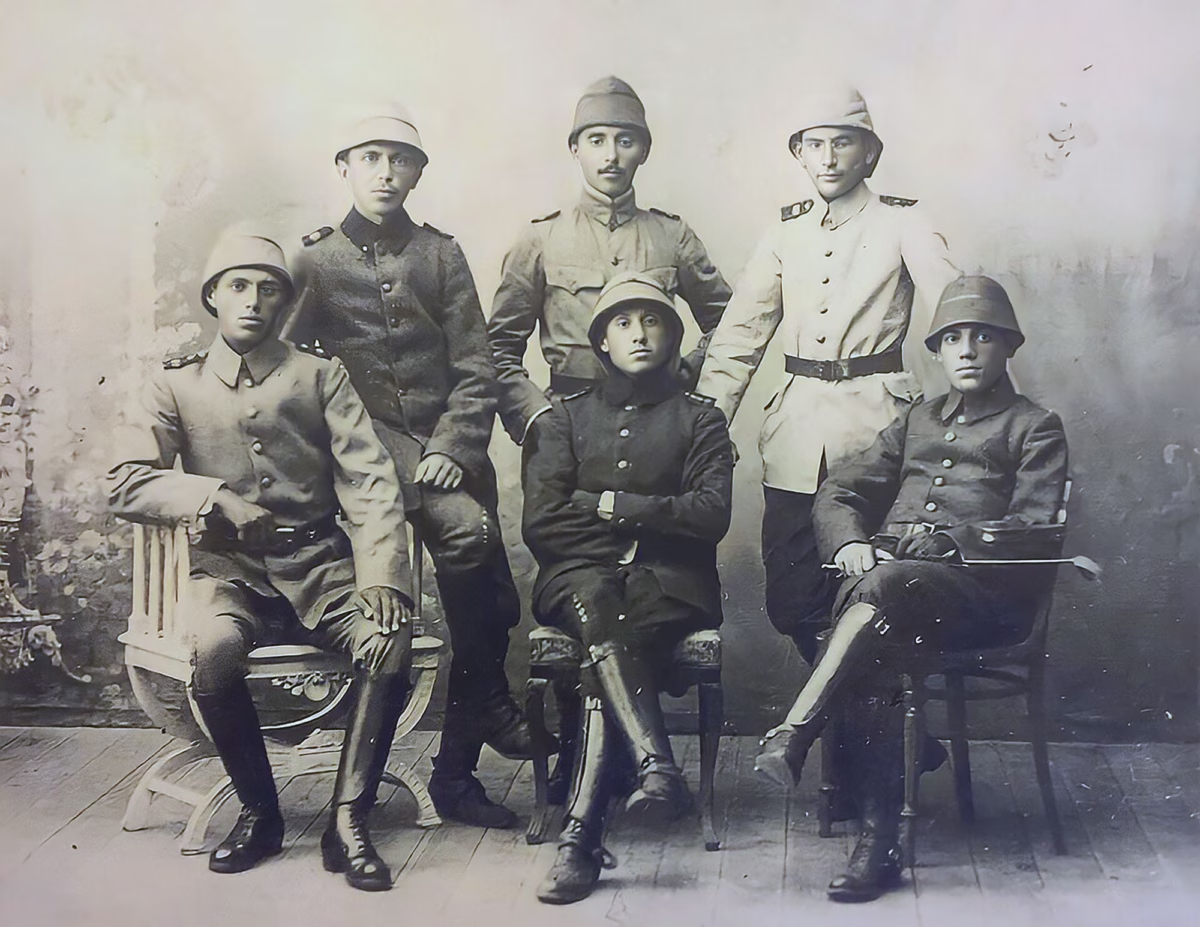
In 1918, amid World War I, Moshe Shertok, then a 23-year-old Jewish soldier serving in the Ottoman Army in Aleppo, desperately tried to predict the outcome of the conflict. Shertok (later Sharett) would go on to head the Jewish Agency’s political department, would lead efforts to establish a Jewish Brigade in the British Army to fight Nazi Germany, and would play a central role in the founding of the state of Israel in 1948, eventually becoming the nation’s second prime minister.
But back in the throes of World War I, the young lieutenant, who had immigrated to Palestine from the Russian Empire as a child, found himself on the cusp of a different — but no less consequential — historical moment, as the winds of global power began to shift. The Ottoman Empire’s control over the region was weakening, and Britain had recently issued the Balfour Declaration, stating its intention to help facilitate the creation of a Jewish national home in Palestine. Soon after, the British military took Jerusalem.
At this juncture, Shertok “thought anxiously about the uncertain course of the war and what it would mean for Jewish futures,” writes Associate Professor of History Elizabeth E. Imber in her award-winning book, “Uncertain Empire: Jews, Nationalism, and the Fate of British Imperialism.” Would Britain take control of Palestine? And if so, what would it mean not only for Jews in Palestine, but also for the increasingly imperiled Jews of Europe seeking exit and refuge?
Shertok (pictured above, standing at center, in his Ottoman uniform with fellow enlisted Herzliya Hebrew Gymnasium students in 1916) would become a key player during the early years of Israeli statehood after the British relinquished power in 1948. Yet, during the interwar years, amidst both the growing power of anticolonial nationalism across the British Empire and increasing Jewish vulnerability in Europe with the Nazi rise to power, he and other Jewish political leaders, activists, and communal elites experienced a “‘politics of uncertainty’ — a politics of trying to envision and navigate any number of undetermined futures that could produce drastically different consequences for the Jewish community,” Imber writes.
“Students are curious about how human beings have experienced the world differently across time and space. That’s really the goal of the historian.”
— elizabeth imber
Shertok and other Jewish leaders — such as the Labor Zionist official Chaim Arlosoroff; the British social worker and non-Zionist Helen Bentwich who helped organize the Kindertransport; the wealthy heiress and community leader Rachel Ezra, a member of the Sassoon family of India; and Hermann Kallenbach, a South African architect and associate of Mahatma Ghandi — did not share a single vision for Palestine or agree in their attitude toward, and commitment to, Zionism.
Instead, Imber writes, they shared a “commitment to a politics of improving the global Jewish condition and an accompanying conviction … that Palestine represented the best possible option — or at the very least, an essential part of the answer — to the tribulations of modern Jewish life.”
The 1917 Balfour Declaration proved to be the catalyst for Shertok and his contemporaries to step onto the global stage, according to Imber, the Michael and Lisa Leffell Chair in Modern Jewish History affiliated with Clark’s Strassler Center for Holocaust and Genocide Studies.
“The British Empire all of a sudden became central to Jewish politics,” she says. “Britain controlled Palestine, the territory at the heart of Jewish political, religious, and cultural aspirations, which meant that Jews across the British Empire — in India and South Africa, and, of course, also in Palestine — were thrust into the center of global Jewish political activity.”
Most historians of the modern Jewish experience have explored Jewish politics in relation to a “fixed political ideology” (for instance, socialism or liberalism) or in relation to a state or imperial culture, Imber points out. By contrast, her book offers a different account of modern Jewish politics.
As anticolonial movements grew in power across the empire and its future seemed unclear, Jewish elites adjusted their strategies, she explains. “They were trying to negotiate and anticipate what the outcome would be, and shape their decision-making based on that,” Imber says. “This created a kind of anticipatory future-looking politics that at times produced seemingly contradictory political behaviors and vocabularies and positions.”
“ ‘Uncertain Empire,’ ” in considering these shifting global politics, “reshapes our understanding of the British Empire’s central — often contradictory — role in shaping modern Jewish political identity,” wrote the judges in presenting Imber with the 2025 National Jewish Book Award for Writing Based on Archival Material JDC-Herbert Katzki Award, sponsored by the Jewish Book Council. Judges noted the book’s “scholarly ambition, methodological rigor, and lasting contribution to modern Jewish historiography.”
Imber also won the 2025 Salo Baron Book Prize for best first book in Jewish Studies, sponsored by the American Academy for Jewish Research, and this year co-won the Shapiro Award for Best Book in Israel Studies, sponsored by the Association for Israel Studies.
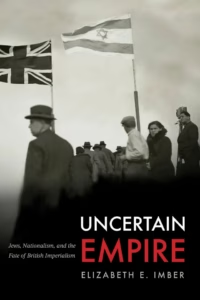
She spent 14 years researching “Uncertain Empire.” In focusing on the mix of Jewish leaders across the British Empire — from Eastern European Zionist activists and politicians in Palestine, to the wealthy, elite Sassoon family of India, to a small coterie of South African Jews with close ties to Gandhi — Imber draws from a wide range of archival sources, including personal correspondence, diaries and memoirs, government memos, newspapers, political pamphlets, and seating charts and menus from elite social gatherings.
“I stumbled into the topic through the sheer luck of good archival fortune,” says Imber, whose research for the book began in the Sassoon family archive at the National Library of Israel in Jerusalem. “I found a story in the archives that contradicted the public story these political leaders were telling about themselves. That contradiction became a question that shaped so much of the book, revealing a very different political and social world than official documents alone could show. Sometimes the most important discovery is the contradiction you weren’t expecting to find.”
Imber’s next book, the source reader “Jewish Women in Global Perspective: A Documentary History,” is under contract with Oxford University Press. She is a co-editor with Elissa Bemporad, Dina Danon, and Federica Francesconi. She is also working on a project on the Oscar Slater affair, a once-notorious early-20th-century miscarriage of justice known as the “Scottish Dreyfus Affair.”
At Clark since 2019, Imber teaches classes that span Jewish history and British imperial history, including Ancient and Medieval Jewish History, Jews in the City (focused primarily on New York), Jewish History after 1492, Modern Jewish Politics, Palestine Under Ottoman and British Rule, and The British Empire.
“Clark students are interested in what’s going on in the world, and they want to understand how what happened in the past has shaped our present moment,” Imber says. “Students are curious about how human beings have experienced the world differently across time and space. That’s really the goal of the historian.”