Seventy-five undergraduate science majors at Clark spent the summer working closely with faculty mentors and diving deep into research. Their projects ranged from black holes in outer space to the ubiquitin protein system, whose dysregulation can lead to the development of cancer and other serious diseases.
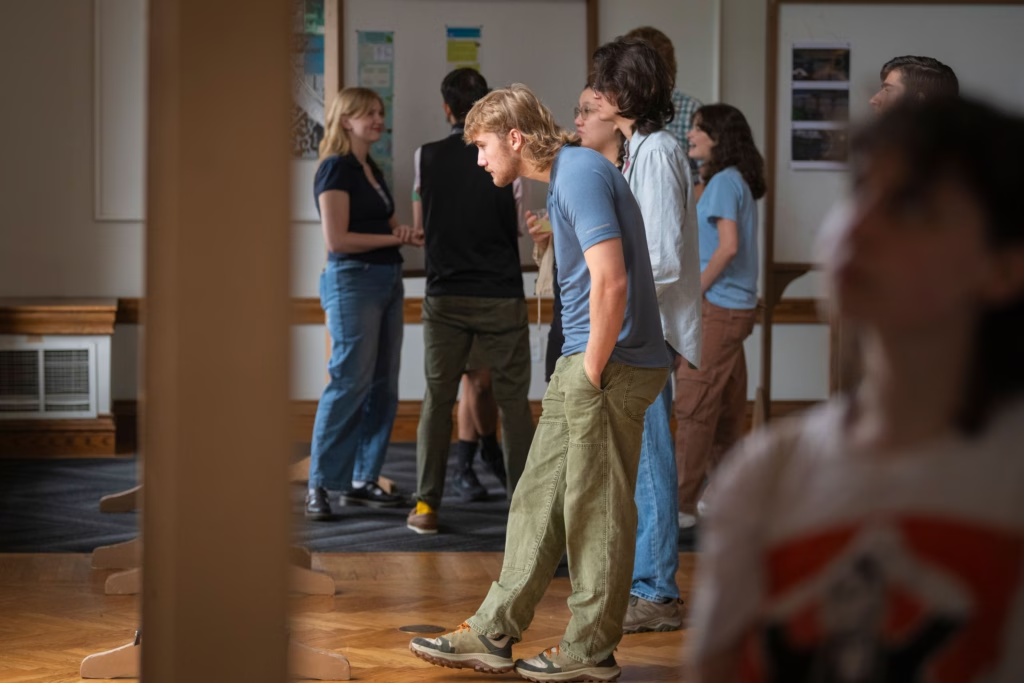
On July 30, students participating in Clark’s “Summer of Science” celebrated with a lunch and research poster presentation in Tilton Hall, which drew faculty and staff from campus.
“Summer research is a powerful example of the hands-on, experiential learning at the heart of the Clark experience,” said Don Spratt, chair and professor in the Gustaf H. Carlson School of Chemistry and Biochemistry, who organized Clark’s STEM Summer Undergraduate Research Opportunities program. “Students work closely with faculty mentors, ask real questions, troubleshoot when things don’t go as planned, and learn what it means to contribute to an active research project.”
Through a series of professional development workshops, students learned soft skills, like how to communicate about their research, plan and apply for graduate school and jobs, and — in a session titled “Ready or Not: The Science Student’s Guide to Almost Adulthood” — face the realities of post-college life and work.
“By the end of the summer,” Spratt added, “they have developed a clearer sense of what they can accomplish at Clark and beyond.”
Students received research fellowships and other funding, allowing them to live in Worcester for the summer, he said.
Below, meet a few student researchers and learn about their experiences.
Applying math to study black holes
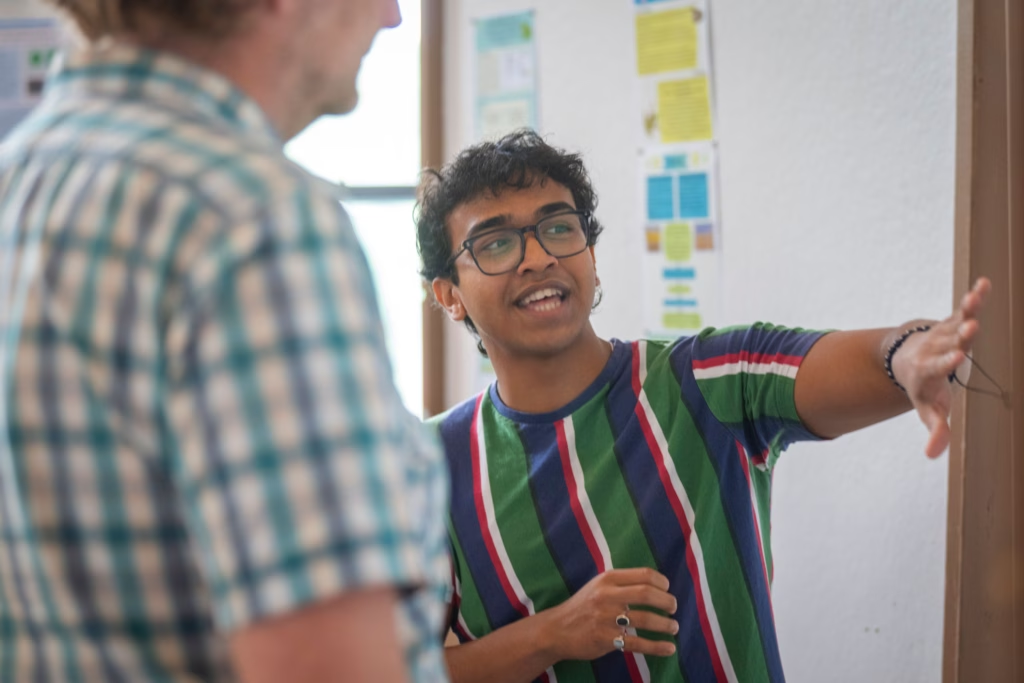
Student researchers: Reevu Majumdar ’27, mathematics major; Rahban Yoftahe ’27, double major in mathematics and computer science
Faculty mentor: Professor Aghil Alaee Khangha
Funding: Erickson Research Award; Khangha’s National Science Foundation (NSF) LEAPS-MPS grant
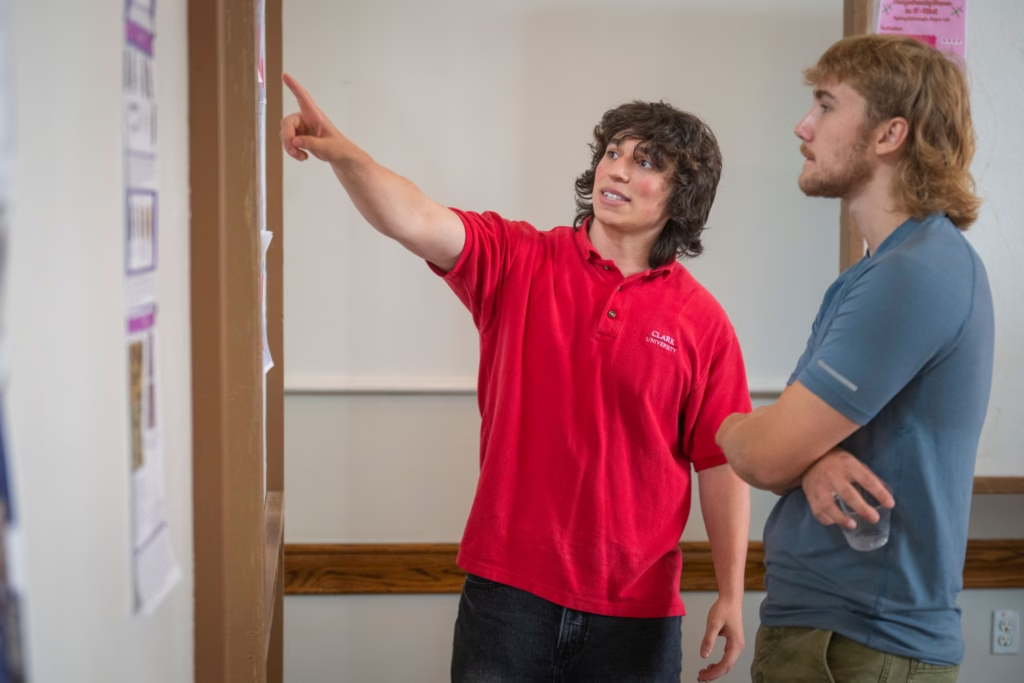
Working with Professor Alaee, Majumdar (above) and Yoftahe are applying advanced mathematics and differential geometry to study black holes and Einstein’s theory of general relativity, the idea that mass curves spacetime.
Relativity, according to Yoftahe, is “like a trampoline, and then you put a bowling ball at the middle. You see how it stretches it out? That’s basically what it is.”
The researchers are trying to understand a fundamental question: How does spacetime bend around an object of enormous mass, and what can the geometry of that curvature tell researchers about the object’s mass and other properties?
“The language of the universe is basically defined through math,” Majumdar said.
Last spring, in preparation for their research and to build their foundation in mathematics, they took a directed study with Alaee on differential geometry, which Majumdar described as “the hardest thing ever” and “truly, truly mind-bending.” Once they began studying geometric analysis and tackling black-hole computations, they better understood the material.
“It’s very nice to see the math that we’re doing has a tangible application,” he added. “We can see how it’s working, and it makes sense.”
The movement of mighty, magnetic microorganisms
Student researcher: Finn Baker ’27, physics major
Faculty mentor: Professor Alexander Petroff
Funding: Petroff’s NSF CAREER grant
Working with Petroff and his research team, Baker studied magnetotactic multicellular bacteria (MMBs) — saltwater microorganisms containing iron crystals that, like the needle on a compass, allow them to detect the Earth’s magnetic field.
The organisms use their sensitivity to remain — and survive — at the right depth of the water. They avoid moving too close to the water’s surface, where they would encounter too much oxygen, or sinking too deep, where there is too little O2.
The study aims to “elucidate the physical mechanisms underlying the evolution of multicellular life,” according to Petroff’s NSF proposal. “These aggregates are unique in their ability to coordinate the growth and collective motion of their constituent cells. Understanding this ability will contribute to the design of biomimetic micro-systems.”
“It’s really helpful to know more people at the school who can help you and direct you to what you might want to do in the future.”
— Rue Savoie ’27, biochemistry and molecular biology major
This summer, the research team collected the organisms near Falmouth, Baker said. They constructed a special box with chambers, through which they subjected the organism to controlled magnetic fields and tracked how they moved.
“It’s extraordinarily and genuinely fascinating to look at a living organism with a type of intelligence,” Baker said. “It’s evolved to almost ‘understand’ and work with a natural force on Earth that we tend to ignore.”
Building a bigger, better crystal to conduct experiments
Student researcher: Mali Flint ’29, chemistry major
Faculty mentor: Professor Luis Smith
Funding: Frederick M. and Alice Murdock Summer Science Internship
Flint worked on a materials-chemistry project involving rubidium potassium bismuth niobium oxide, a type of crystalline material known as a perovskite.
In the lab, researchers have produced such crystals that are only 2 to 20 microns across. Because they are so small, they are more difficult to study and use in experiments.
But this summer, “we were able to get them to be around 200 microns, and so that unlocks a lot of potential” for experiments, Flint said.
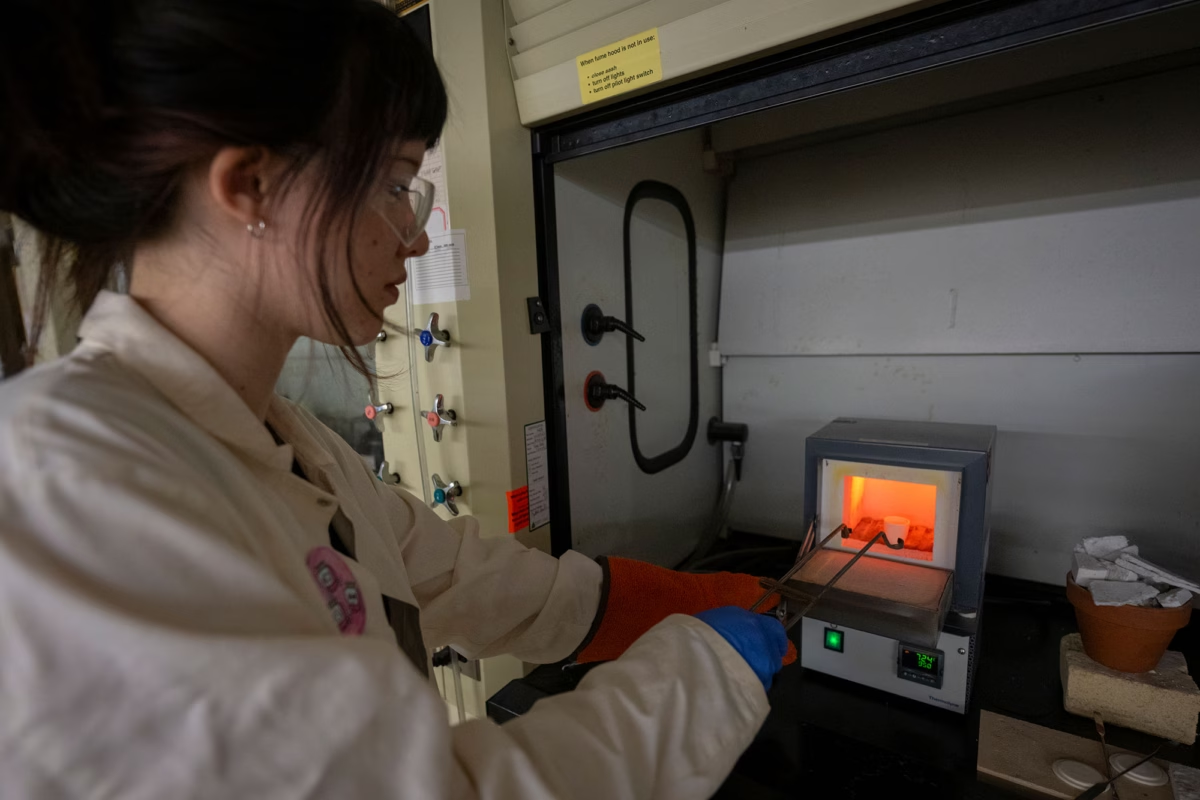
Seeking to reproduce these large crystals, she changed two variables: how long the material spent in a furnace at about 950 degrees Celsius, and the proportion of molten rubidium chloride used in the synthesis (in the lead photo at top, Flint places materials in the furnace). The longer heating times and higher ratios of rubidium chloride produced larger crystalline plates more consistently, she found.
Perovskites have applications in solar cells and semiconductors, although Flint said her materials research is “very foundational.”
Studying proteins to fight disease
Student researcher: Rue Savoie ’27, biochemistry and molecular biology major
Faculty mentor: Professor Don Spratt
Funding: Maurine H. Milburn Summer Research Fellowship
Savoie studied ubiquitin, a protein that attaches to other proteins and can regulate their activity, direct them to different parts of the cell, or mark unwanted or misfolded proteins for destruction.
In particular, she studied E3 ubiquitin ligases, the enzymes involved in transferring ubiquitin from one protein to another. Mutations disrupt the functionality of E3 ubiquitin ligases, leading to cancers as well as neurodevelopmental and neurodegenerative disorders, according to Savoie.
Her ongoing project uses a technique to measure how quickly ubiquitin is transferred between proteins. Researchers use fluorescent tags that, depending on how close the molecules are to one another, change the color of emitted light. That allows them to measure the kinetics of ubiquitin transfer in real time.
By introducing small molecules to see whether they speed up or slow down the process, researchers could identify compounds to be used in drug development.
Building on work by previous students, Savoie produced and purified proteins needed for experiments and refined the experimental methods to make the measurements more precise.
Savoie, who plans to continue working in Spratt’s lab for the next two years, has valued her experience with the summer STEM program, especially mixing and mingling with more faculty researchers.
“It’s really helpful to know more people at the school who can help you and direct you to what you might want to do in the future,” she said.
‘I’m super-interested in everything virology’
Student researcher: Abigail Jensen ’28, biochemistry and molecular biology major
Faculty mentor: Professor Nathan Ahlgren
Funding: Edwin A. Weiller Summer Science Fellowship
Part of Ahlgren’s NSF CAREER grant-funded research team, Jensen is studying the complex relationship between marine cyanobacteria and the viruses that infect them. Synechococcus — tiny photosynthetic marine bacteria — play an important role at the base of ocean food webs.
Jensen’s project focuses on a Synechococcus culture known as 11R, which coexists with a virus called Rim34.
Bacteria living with the Rim34 virus appear more resistant to infection by other viruses. Jensen is trying to determine whether that resistance results from the fact that 11R and Rim34 coexist.
To do so, she’s trying to create a virus-free version of the 11R culture. By removing Rim34 and then exposing the bacteria to other viruses, the researchers could determine whether the bacteria lose their heightened resistance.
Synechococcus bacteria account for a significant portion of ocean primary productivity, but the viruses can kill them. By examining this bacteria-virus relationship, scientists can better understand marine ecosystems and the ocean food web, according to Jensen.
“I’m super-interested in everything virology. I’m hoping to go into immunology or pathogenesis in the future, so being able to look at these microbe interactions is fascinating to me,” she said. “I feel very fortunate that I’m able to do such a cool project that I’m really passionate about.”
Joining Ahlgren’s lab, she added, “is probably the most meaningful experience I’ve had to have here at Clark.”
This summer, Jensen began to understand what it’s like to work in a professional research lab. “It’s interesting to kind of see what like a real 9-to-5 looks like.”
She had this advice for incoming students: “If you want to do research, Clark is the perfect place to do it, and you should just take that initiative and go for it.”