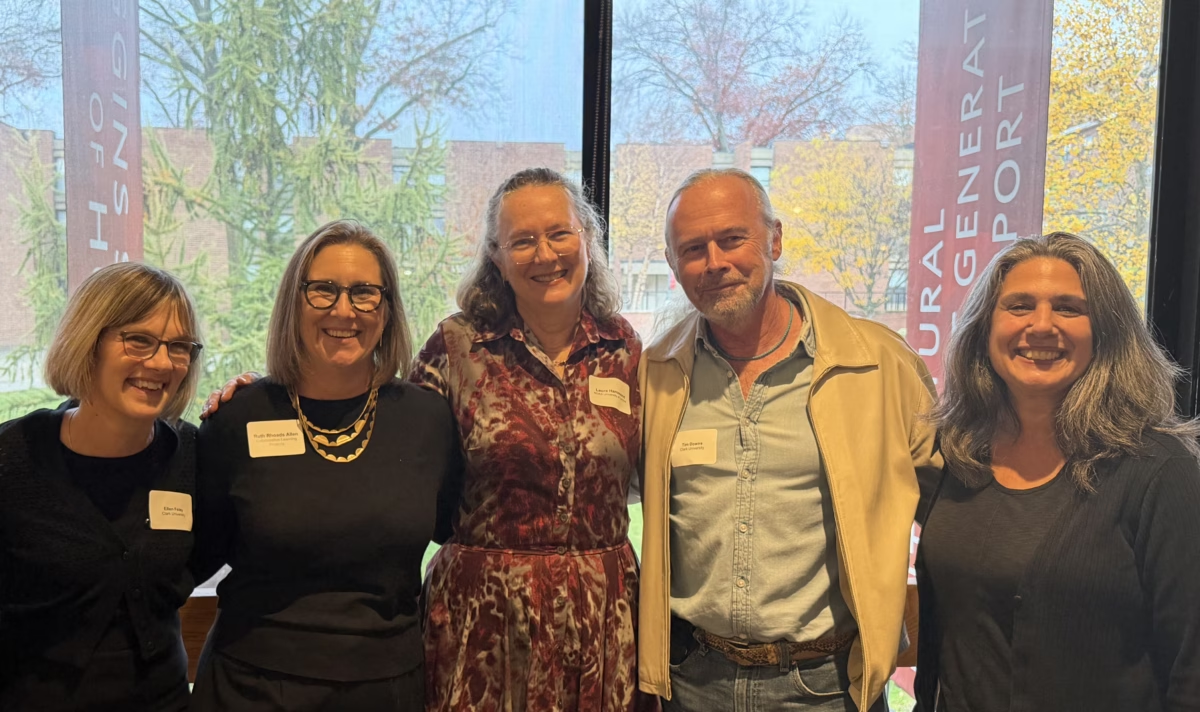
Keynote speaker — and former Clark professor — Laura Hammond (center) reunited with former student Ruth Rhoads Allen, M.A.-IDSC ’03 (second from left) and current Department of Sustainability and Social Justice faculty members (from left) Ellen Foley, Tim Downs, and Laurie Ross, during the “Reclaiming International Development” event.
Clark symposium explores how shifting global realities are challenging long-held assumptions — and shaping new approaches
The world that shaped the field of international development looks very different from the world it serves today.
Established in the aftermath of World War II amid postwar reconstruction, decolonization, and Cold War geopolitics, international development was formed by the defining challenges of its time. It now operates in a vastly different landscape, where food insecurity, forced migration, climate change, and complex social, economic, and environmental pressures transcend national boundaries.
These evolving realities were at the center of “Reclaiming International Development,” a day-long symposium hosted by Clark University’s School of Climate, Environment, and Society and Department of Sustainability and Social Justice. The Nov. 7 event in the Higgins Lounge at Dana Commons brought together scholars, practitioners, alumni, and students — both in person and virtually — to examine long-held assumptions that have shaped development and explore more equitable, collaborative approaches grounded in local expertise and shared decision-making.
‘There has never been a more important time’
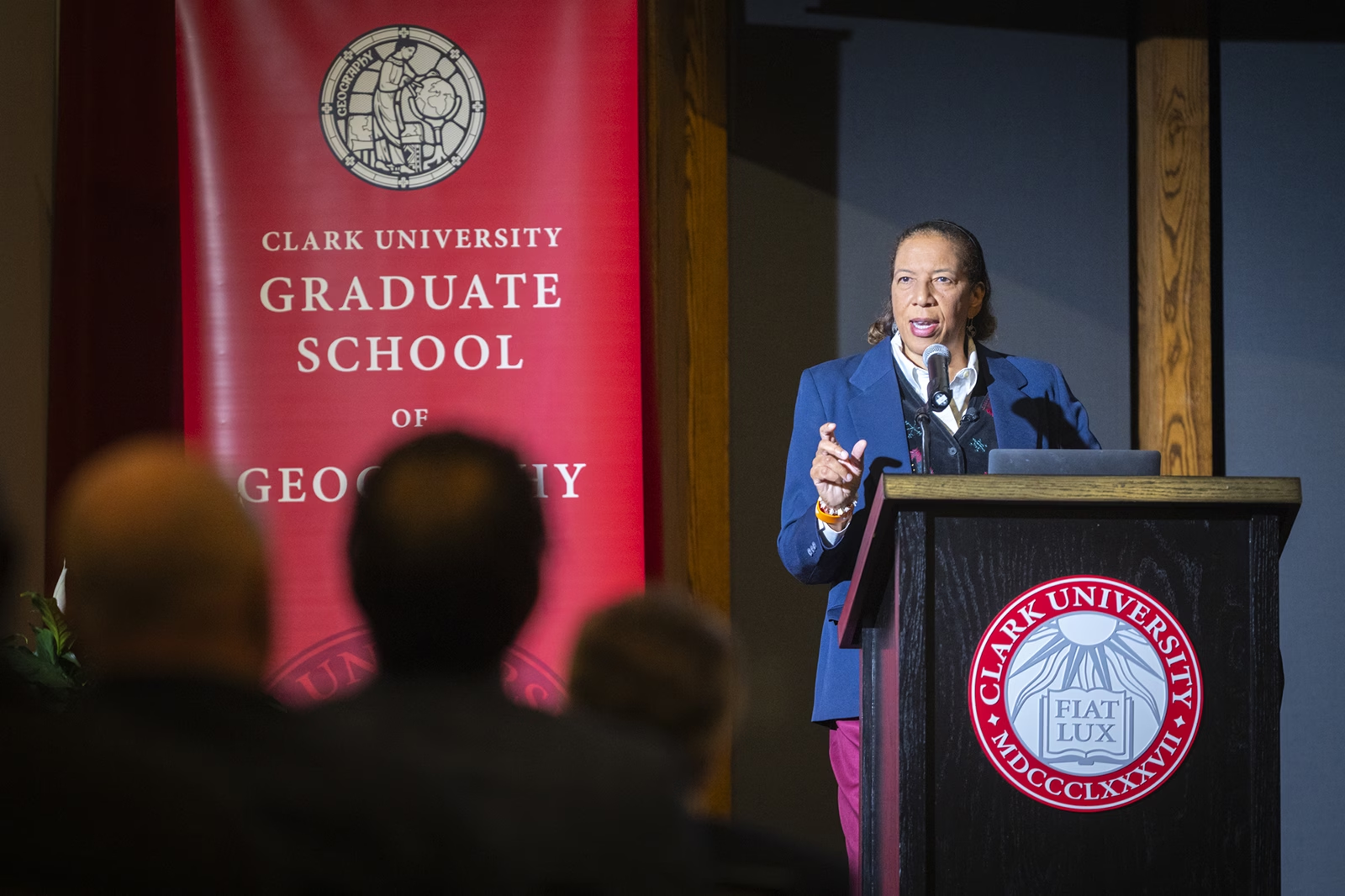
For Laura Hammond, who began her teaching career at Clark 25 years ago, the current moment represents both a profound challenge and an opportunity to reconsider the foundations of international development. Now deputy vice-chancellor of research and knowledge and a professor of development studies at SOAS University of London, Hammond returned to campus to deliver the event’s keynote address.
The field is facing unprecedented disruption, Hammond said, pointing to the closure of USAID, reductions in foreign assistance and research funding, and broader political shifts that have affected global commitments to climate action, human rights, and sustainable development. But rather than signaling a reason to step away from the field, she asserted, these changes make studying and understanding development more important than ever.
“There has never been a more important time to study and research these dynamics,” Hammond said. “The social, political, and economic challenges that we are experiencing now will transform what we understand as developmental processes: how they happen, who controls them, and who benefits from them.”
For decades, Hammond explained, development operated around an informal funding structure: the United States was expected to provide roughly one-third of global humanitarian assistance, with another third coming from the European Union and its member states, and the remaining third from other countries. The erosion of that implicit arrangement has prompted broader questions about how power and priorities shape the distribution of resources.
Building more equitable partnerships
The questions raised by Hammond’s keynote carried into the two panel discussions that followed. Participants expanded on her call to rethink development’s underlying assumptions by examining how knowledge is created and whose expertise is valued.
Manisha Desai, executive director of the Center for Changing Systems of Power and a professor of global citizenship at SUNY-Stony Brook, challenged the idea that development can be approached through universal solutions. “You can’t have a one-size-fits-all approach,” she said, noting that many existing models are rooted in capitalist, neoliberal ideologies and remain “extractive,” drawing upon a community’s knowledge or resources without sharing power or decision-making.
Instead, Desai emphasized the importance of creating equitable partnerships with communities and elevating their systems of knowledge. But building those relationships requires intentionality and patience, she cautioned, as they “progress at the speed of trust, not in accordance with funding deadlines.”
These sentiments were echoed by Peg Spitzer, an interdisciplinary research professor at SUNY-Stony Brook and founder of the nonprofit Climate Knowledge Collective. “People who may be described by development institutions as vulnerable or disadvantaged are also knowledge holders, innovators, and leaders,” she said. Effective development work will require approaching communities “as partners and not as problems we need to solve” and acknowledging the capacity for “knowledge to move in multiple directions.”
Tyrone Hall M.A.-IDSC ’11, head of research and innovation at George Brown Polytechnic’s Brookfield Sustainability Institute, challenged participants to consider whether current approaches create lasting change or simply help people cope with the conditions they face. For him, recognizing resilience is not enough if underlying systems of inequality remain unchanged. “We need more honesty about what we’re putting on the table as development interventions,” he explained. “Resilience is not justice.”
Connecting research, teaching, and practice
While much of the day’s discussion focused on how development practice must evolve, participants also reflected on the role universities play in preparing the next generation of practitioners and researchers. As Cindy Caron ’90, chair of the Department of Sustainability and Social Justice, noted in her welcome remarks, moments of disruption are also opportunities to reflect on what the field has learned — and how it must continue to evolve.
Caron, who earned her undergraduate degree in international development at Clark, emphasized the University’s longstanding commitment to connecting research, teaching, and practice to respond to changing global realities. From the creation of the Center for Technology, Environment, and Development (CENTED) in 1978 to later initiatives focused on feminist political ecology and social justice, Clark has examined not only the challenges communities face, but also the ways knowledge is created, shared, and applied.
For first-year student Joey Mucha ’30, who aspires to a career in international development, the symposium provided an opportunity to connect classroom learning with the broader community of scholars and practitioners. “I’ve always wanted to meet and speak to professionals working in the field,” he said.
The day’s discussions broadened his understanding of the challenges facing humanitarian work and highlighted the importance of engaging with complex global issues. “If I could go to an event like this every day, I would,” Mucha said. “I feel like I could learn something new every time.”