‘It motivates me to think about the person I’ll be once the novel is done’
For many, writing a book feels like an immense undertaking, but creative writing Professor Mandy Gutmann-Gonzalez walks students through the process in an aptly titled course, Writing the Novel.
“Many people are going to open your book and only read the first page, even agents. It has to be good,” says Gutmann-Gonzalez.
Throughout the course, Gutmann-Gonzalez analyzes one novel with the class. The spring selection was “To the Lighthouse” by Virginia Woolf, chosen because it breaks from the typical constraints of storytelling.
“Each week is dedicated to a different fiction element through which we look at the novel: characterization, narrative structure, or something as simple as the sentence,” says Gutmann-Gonzalez.
Meeting with students, watching their stories evolve, and giving them a space to celebrate each other is the most rewarding part of the experience, says the professor, a published novelist who is currently working on a novella about a drunken beggar who believes he’s King Tut.
“Students submit one thousand words per week, and I’ve been holding myself to that deadline as well. We’re all in the same boat and helping each other sail the ship. It’s important to have this community.”
By semester’s end, students were required to submit 10,000 words of their own novel. Three students spoke with ClarkU News about their projects.
Django Accardi ’28
Accardi originally came to Clark to study biology but was quickly drawn to the School of Climate, Environment, and Society, and has a passion for writing. His working novel is a blend of his creative writing major and climate, environment and society minor: it follows a nameless, genderless protagonist who begins to experience other people’s memories, triggered by their sense of smell.
“The way our brains process smell is different than any other sense,” Accardi explains. “It hits the hippocampus faster — memory and smell are linked.” The sensation is one Accardi experienced during a recent visit to his hometown.
“The smell of home triggered all these memories for me; it was almost like the memories were attacking me,” he says. “I’m trying to experiment with how someone has a relationship with their environment through an emotional, spiritual lens, and how trauma can impact our memory.”
The main character’s narrative begins with the death of their friend. By recalling memories through the perspectives of others, Accardi found himself incorporating poetry with prose.
“I have been working at a Live Action Roleplay camp for years, and I went there as a child,” he says. “Before structured storytelling, I was practicing improv, playing video games or writing poetry. I didn’t see things in a ‘first page, last page’ way. I’m a poet first and foremost.”
When he writes, Accardi likes to listen to ambient video game tracks and jots down ideas in small bursts.
“Every couple of days I’ll write 500-700 words, but I make sure to put it aside to avoid burnout,” he says. Keeping himself motivated is easy. “I’ve chosen themes that I’m super passionate about for this piece. It’s so emotionally tied to me at this point and so cathartic that it would almost feel like a betrayal if I stopped working on it.”
Meeting weekly writing deadlines for class has helped Accardi, who says a group of students made a pact to keep working on their novels after class ends.
The workshop process is something that Accardi has been getting used to during his college career.
“I love critique now,” he says. “When it’s coming from this class — people who are involved, who care — it’s wonderful. I’m used to sending people in my life a finished product, but it’s nice to have eyes on it in this class because they have a point of reference in the writing world. The class gaze is softened because we’re all in the same boat.”
Leah Bibula ’26

Bibula balances her pursuit of psychology — she presented her research at the Eastern Psychological Association’s annual conference — and a love for writing. In her junior year, she took a course with Gutmann-Gonzalez, who encouraged her to take Writing the Novel and expand the 2,000-word manuscript she was writing.
Her story is uniquely personal: a fictionalized retelling of growing up in a rigid Christian household underneath strict family rules. It follows a young girl named Maggie through disjointed memories, then slowly transforms into a story of reconciliation with one’s truth.
“In the beginning, Maggie is in denial. She lies to herself that everything is fine, or that certain things never happened,” Bibula explains. “It’s not just her perspective, but also her grappling with these events that have been justified through ‘God and his will.’”
This novel has helped Bibula process her trauma, she says, but because it’s so intense, creating it often required her to take breaks. Workshopping the project, by extension, left her feeling extra vulnerable. She says that having Gutmann-Gonzalez’s encouragement and previous understanding of her work was very helpful.
When it comes to writing a book, Bibula says the only person standing in your way is yourself.
“If you want to write, you have to just commit. Only you can know your novel, your ideas, what you want from it,” she says. “It’s important to have something to work toward, to know where you want your project to go, to keep yourself motivated.”
Ketshaly Philome ’26
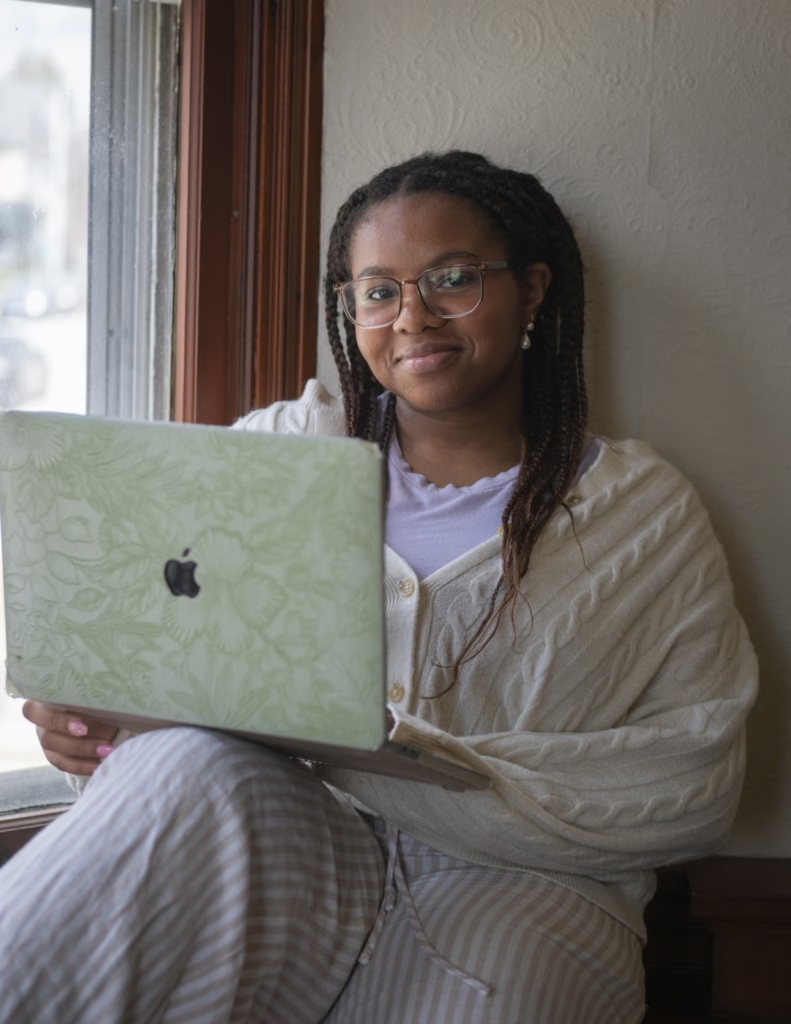
Philome, a political science major with a minor in creative writing, was also in charge of community outreach for the Black Student Union, a dancer for the campus African Diaspora Dance Association, and an intern at the Worcester Poetry Association. She brings this multi-faceted approach to her novel, which combines magical realism, a friends-to-lovers story, and mental health commentary into one narrative.
Philome’s story centers on two best friends growing up in Boston: Alo, an African American city kid, and Amari, a child of an immigrant mother from Trinidad. When Amari goes missing, Alo begins to have supernatural experiences caused by a “soul tie” while trying to find his friend.
“In a lot of romances [the writing industry] will have a typical structure of ‘this person comes in and changes everything.’ I wanted to focus on the nooks and crannies of a romance dynamic. I’m confronting limerence, and the point is that each of these characters has to find themselves before coming back together,” she says.
Getting feedback can a little scary, Philome notes, but hearing other people’s opinions and perspectives helps her think critically.
“I have a section where I describe Amari’s hair in-depth because depending on the demographic, people might not know about various hair textures, so I asked about that directly. It was so helpful to get a sense of what a future reader might know beforehand.”
She describes her writing process as intensive.
“I once heard great advice from a professor who said to ground ourselves to keep us motivated. It can be a prayer, reading a book, just a small ritual for yourself,” she says. “It’s hard to be inspired all the time, but I like to stay anchored to my characters. Getting to know them is a lot of work! I feel so attached; it starts to feel like something your best friend is going through.”
Philome wants to break out of traditional stereotypes in her work, challenging tropes and experimenting with different styles.
“I think about when I was a young reader and would read something outside of the school curriculum that actually talked about things that were taboo — I loved it,” she says. “I want to create that for my readers.”
Writing a novel for her isn’t just about using her creative muscles — which she says as a poet comes naturally — but also an opportunity to grow.
“It motivates me to think about the person I’ll be once the novel is done,” she says. “I love to see how my characters grow. I don’t know them fully yet and I’m so excited to see them change.”