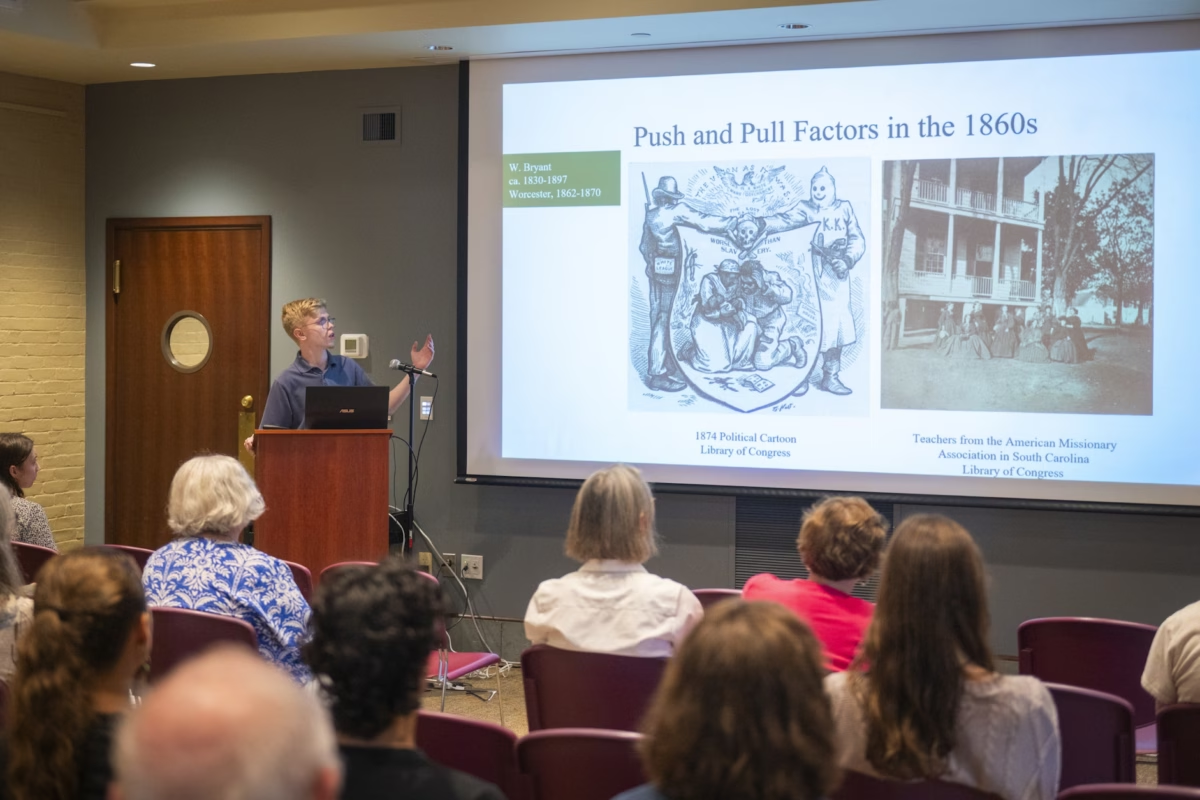
During a summer internship at Preservation Worcester, Connor Dunham ’27 and Jenny Marks ’27 pored through archives to unravel forgotten history.
Preservation Worcester is a nonprofit organization that protects neighborhoods and sites that are significant to the city’s diverse culture.
Dunham’s research project, “Black Migration to Worcester, 1860-1900: 4 Profiles,” centered on four unique stories. Marks’ project, “The Oread Institute: The Castle That Once Was,” was inspired by a 2014 presentation that stayed with her.
Connor Dunham’s project
Dunham (shown at top presenting his research), a history and political science major, says the internship made him appreciate sites he had previously driven past without a second thought. “On the first day, we did a walking tour of Worcester Common, and I realized there are all these historic buildings that have interesting histories that I hadn’t actually looked at before,” he says.
In his project, Dunham researched William Bryant, D.W. Bell, Rose Perkins, and Arries Ann Ward.
Bryant came to Worcester in 1862 and was a boat pilot for the Union Army. Dunham chose to focus on Bryant after reading about him in “First Fruits of Freedom: The Migration of Former Slaves and Their Search for Equality in Worcester, Massachusetts, 1862-1900” by Janette Greenwood, Clark professor emerita of history.
“She identified William Bryant as the first Black migrant who kicked off this large wave of Civil War-era migration,” Dunham says.
Ward is “a big name in Worcester Black history,” Dunham says. She was born into slavery and at the turn of the 19thcentury she moved to Worcester, where she had 18 children. She was heavily involved in the community and lived in Worcester until she died. She still has descendants living in the city today.
Having access to the Worcester Telegram & Gazette archives through Clark was a very useful source for Dunham. “I could search online for these people’s names and find articles about them, which formed the bulk of my presentation,” he says.
A common thread throughout Dunham’s research was the history of black communities being destroyed in the name of development. Marginalized neighborhoods were targeted because those communities lacked the financial and political resources needed to fight back. When the corporations came in to demolish the residents’ homes, they often had no choice but to leave, she says.
Interning at Preservation Worcester provided Dunham with an opportunity to conduct his own research, gain experience in going through archives, and appreciate the stories that Worcester holds. Gaining work experience in a nonprofit setting was very rewarding for Dunham, who was supported by opportunity funding from the Career Connections Center.
Dunham plans to pursue the 4+1 Accelerated Master’s in Business Administration and work in the public history field, ideally as a museum administrator in Massachuseetts. “The state holds so much history about the American Revolution — which is the bulk of research I do,” he says.
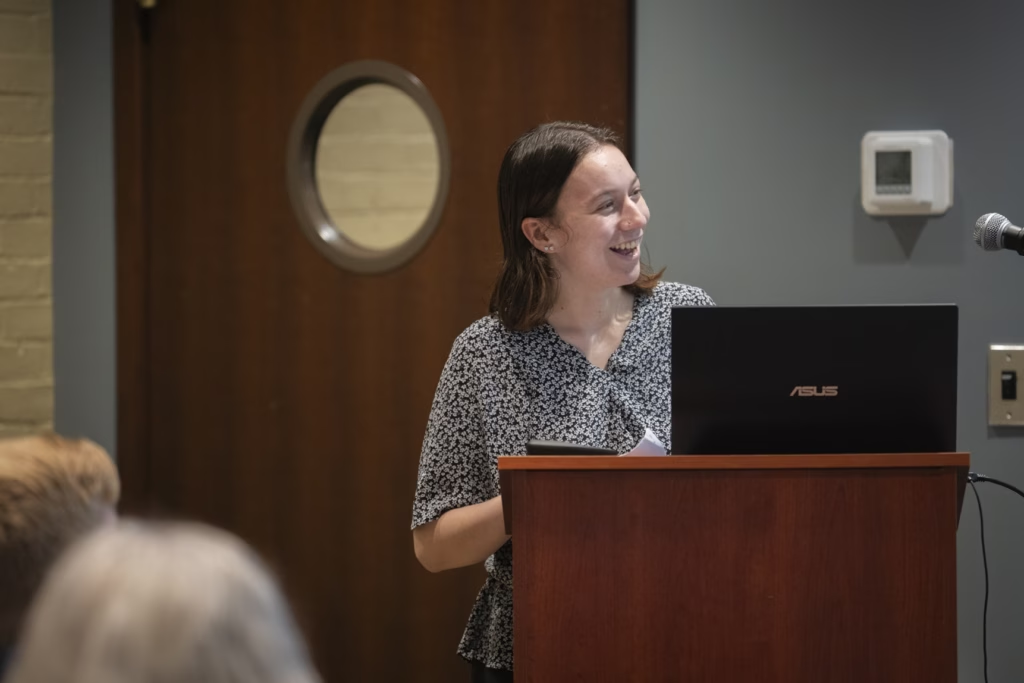
Marks’ research
A double major in history and women and gender studies, Marks was encouraged to seek her internship by her advisor, History Professor Melinda Marchand.
“I love getting to share what I have researched with an audience. It’s one of the best parts about history,” she says.
The Oread Institute was founded in 1849 by Eli Thayer and was the first all-women’s collegiate institute in the United States (Oberlin College was accepting women at the time, but it wasn’t an all-women school). Marks got the chance to speak to Thayer’s great-granddaughter over Zoom. “It was sweet getting to talk to her, and I also sent her my research,” says Marks.
The Oread Institute was a huge castle. “Thayer modeled it after Brown University because that’s where he went,” Marks explains. The institute closed in 1890, but Thayer lived there until his death in 1899, when Henry D. Perkins bought it and turned it into the School of Domestic Science. Eventually, the facility fell into disrepair, and it was demolished around 1930. Today, that space is a playground.
The research presentation was a dive into “what the curriculum looked like, the day-to-day life of the women who attended, how rigorous it was,” says Marks.
Marks then chose to research three women who stayed in the city after graduating from Oread and made an impact on Worcester. Marks chose her subjects from a list published in 1901 by the Oread Alumni Association.
Reading through the book, Marks noticed that “many women would go to the Oread for one to two years but never actually graduate. This was because at that time, not all women were lucky enough to even gain access to higher education, so a year was enough before they would go on to do what society expected them to do.”
Marks focused on:
- Eliza Draper, a community worker who founded the Worcester branch of the National Consumers League, which fought for fair working rights, wages, and conditions.
- Harriet Merrifield Forbes, who was known for her work in writing the book “Gravestones of Early New England and the Men who Made Them.” She cataloged hundreds of gravestones in New England.
- Ellen Francis Rogers Kennedy, who left $75,000 in her will to build a statue depicting everyday activities of colonists, from farming to home building.
Marks got a sense of how important Oread was at the time. “It was a well-known collegiate institute, with a reputable curriculum and professors,” she says. “People have no idea that this existed, especially that it was the first women’s college.”
Marks is planning to enroll in the 4+1 Accelerated Master’s in History. In the future, she wants to conduct archival research in a museum. “I want to continue doing my own research and share that with people,” Marks says. “Clark has a lot of great connections in Worcester, so I have more opportunities, specifically in public history, for careers and internships.”
Marks and Dunham both emphasized the importance of building relationships with professors and advisors to find internship opportunities. “They all have great connections, so whenever an opportunity arises, they will think of you and recommend you,” Dunham says.