With topics ranging from amphibian fungi and waterfront climate adaptation to ethnic-racial identity and Jewish news networks in the first half of the 20th century, seven Clark doctoral students have been named the first recipients of the Clark University Dissertation Improvement Grant program (CUDIG).
The grants support doctoral students with expenses that fall outside typical funding streams, such as data collection and fieldwork, specialized equipment, travel, participant incentives, and professional editing, transcription, or data analysis.
Associate Provost and Dean of Research Jennifer Hanselman announced the program in the spring.
The grants were made possible by the generosity of donors committed to graduate education, and “reflect the profound difference our donors make in expanding opportunities for students and deepening the university’s research excellence,” Hanselman said.
“This philanthropic support enables Clark to provide targeted resources for dissertation research,” she added, “specifically funds that help accelerate discovery, strengthen the impact of student scholarship, and reinforce the university’s mission to cultivate the next generation of researchers, scholars, and leaders.”
The 2026 CUDIG recipients are:
Liam Cleary, biology
Colombian Field Research Enabling the First Global Study of Basidiobolus Species Diversity and Secondary Metabolism Evolution
Ph.D. supervisor: Javier Tabima Restrepo, assistant professor of biology
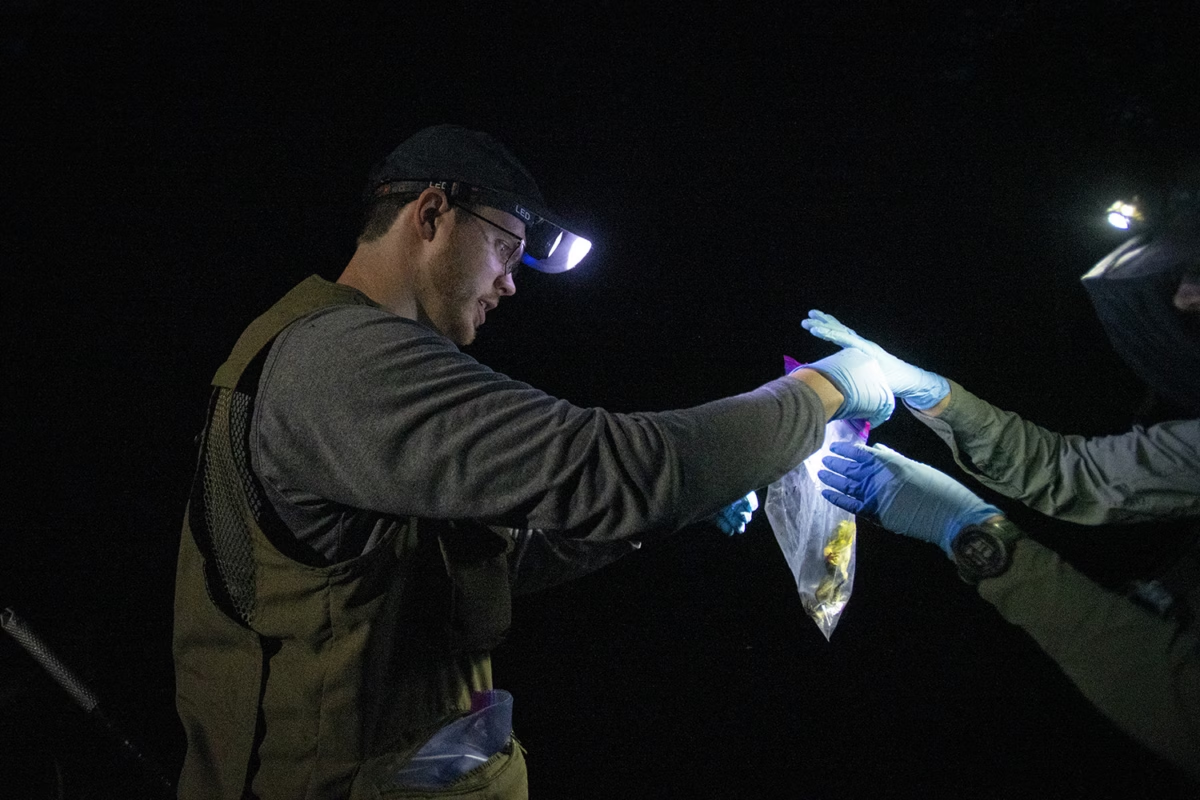
Cleary (shown above collecting frogs for research) will travel to Colombia to collect South American isolates of Basidiobolus, a gut-dwelling fungus found in amphibians and reptiles that produces medically promising compounds. The resulting genome sequences are expected to reveal new species and undiscovered biosynthetic pathways, completing the first truly global picture of how this fungal genus evolved its chemistry.
Tiana Freeman, psychology
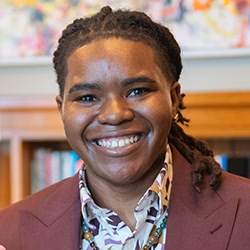
Black Girl Cityscapes: Navigating Care, Connection, and Opportunity in Worcester
Ph.D. supervisor: Nicole Overstreet, associate professor of psychology
In her dissertation, Freeman will explore how Black girls understand, interpret, and navigate the city through their everyday movements, relationships, and creative expression. The resulting multimedia interactive toolkit will offer a new way to understand Worcester through Black girls’ perspectives while providing community organizations, educators, and local leaders with insights to inform more equitable youth programming and city initiatives.
Sylvia Kor, economics

Healthcare Congestion and Treatment Intensity: Evidence from Administrative Hospital Data in Bangladesh
Ph.D. supervisor: Jon Denton-Schneider, assistant professor of economics
To examine how hospital congestion affects recorded treatment intensity and outpatient care in resource-constrained health systems, Kor will collect and digitize administrative records covering more than one million patient observations from public hospitals in Bangladesh. With this expanded dataset, Kor will contribute new evidence to hospital congestion and capacity-utilization literature.
Nathan Lucky, history (Holocaust studies)
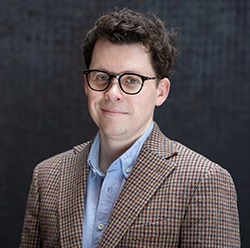
Information Borderlands: The Transformation of Global Jewish News Networks, 1917-1950
Ph.D. supervisor: Frances Tanzer, associate professor of history
Lucky’s dissertation will trace how Jewish news networks fundamentally changed from WWI through post-WWII. The first Jewish news agency, the JTA, was founded in 1917, shaped Jewish survival and, from 1941–46, employed refugee journalists. Lucky seeks to uncover these hidden voices and networks that were not marginal, but central to the flow of global news.
Wen Ting Ooi, geography
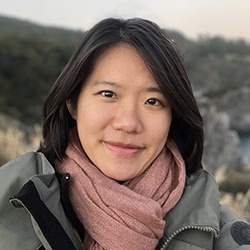
Urban island waterfront liminalities – comparing grey coastal climate infrastructure between Taiwan and Long Island, New York
Ph.D. supervisor: Mark Davidson, professor of geography
This project examines how urban islands in Taiwan and Long Island, New York, are culturally adapting to grey coastal climate infrastructure, exploring the shifting narratives and aesthetics that shape our understanding of the “liminal” borderlands between land and sea. By working with local communities and creative practitioners, Ooi aims to show how local culture reshapes global climate strategies, offering insight into more locally sensitive paths for coastal development.
Lauren Parry, biology
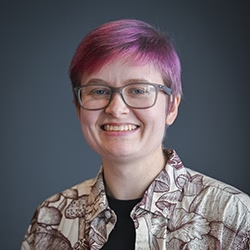
Characterizing sterol responses to azole stress in the emerging fungal pathogen Basidiobolus
Ph.D. supervisor: Javier Tabima Restrepo
Parry will investigate how Basidiobolus, an emerging fungal pathogen with an unusual membrane sterol makeup, responds to azole antifungal drugs at the molecular level, using sterol analysis and gene expression data from multiple isolates, including a human clinical strain. Parry’s research will test the evolutionary conservation of azole response pathways and improve our understanding of membrane biology in emerging fungal pathogens.
Zainab Shabbir, psychology

Conversations about Race, Ethnicity, and Migration: Understanding Ethnic-Racial Identity and Belonging Through the Belonging Calibration Framework
Ph.D. supervisor: Ana Marcelo, associate professor of psychology
This dissertation introduces and empirically tests the Belonging Calibration Framework to explain how individuals interpret responses to identity-related disclosures and adjust what they share, how they engage, and where they expect to belong. Shabbir’s findings will clarify how everyday interactions shape ethnic-racial identity and belonging and will inform evidence-based guidance for educators, advisers, peer mentors, and student-affairs professionals.