The U.S. forests involved in carbon-credit programs face significant and growing risks from climate-driven disturbances such as wildfire, drought, and insect outbreaks, according to a study published in Nature on May 20. Carbon credits are one form of market-based investment to keep greenhouse gases out of the atmosphere.
The study’s findings raise critical questions about the long-term reliability of these widely used climate solutions, which enable companies to fund projects that store carbon in forests, according to its authors. While forests can absorb large amounts of carbon dioxide, their research shows that this storage is far less permanent than many policies assume.
“The research indicates that a large share of forest carbon offset projects face a significant chance of losing carbon over time, particularly as climate change intensifies disturbance patterns,” says Christopher A. Williams, a co-author and professor of geography and environmental science in Clark’s School of Climate, Environment and Society.
An well-known expert on the climate impacts of forests, Williams contributed to the study, “Forest carbon protocols underestimate climate-driven carbon loss risks,” by lead author Chao Wu, a former postdoctoral researcher in biology at the University of Utah and now an assistant professor at China’s Tsinghua University, and senior author William Anderegg, professor of biology and leadership team member of the University’s Wilkes Center for Climate Science & Policy. The research team included scientists from seven other universities and organizations.
“Forests are facing increasing risks due to climate change. Those risks have been underappreciated to date in climate policies like carbon markets. With better science, we can set these policies up to potentially work better,” Andregg says. “These are multi-billion-dollar carbon markets that have a problem with risks to durability, but the good news is that we’re providing a potential solution as well.”
Rising risks to forest carbon storage
The study combined extensive forest inventory data, satellite observations, and climate modeling to assess the likelihood that forests will lose stored carbon over the next century. The findings show that disturbances — especially wildfire — pose a substantial and increasing threat.
“Compared to other natural disturbances, we found that wildfire is the largest climate-sensitive risk to durability for forest nature-based climate solutions,” Wu says. “Our analysis shows for the first time what a robust buffer pool should look like for current carbon offset U.S. forest projects after accounting for accelerating climate threats.”
A “buffer pool” is a reserve of extra carbon credits set aside in case projects fail or forests lose carbon unexpectedly.
The research team mapped areas across the continental United States, showing their risks of a carbon “reversal” – or carbon loss – occurring at least once in the next 100 years from wildfire, drought or insects. The maps compared the risks under historical models and updated ones that account for climate change.
The differences are stark.
Under the team’s analysis, the portion of the country projected to experience a reversal by wildfire expanded from 10% to 33%; from 19% to 21% for drought; and from 23% to 25% for insects. Broad areas in Idaho, Southern California, Arizona and New Mexico show an 80% or more chance of experiencing such a carbon loss due to wildfire over the next century.
Carbon markets and the challenge of permanence
Nature-based climate solutions — like protecting or restoring forests — play a central role in global climate strategies.
For instance, Williams’ Biogeosciences Research Group uses remote sensing and big-data geo-computation to quantify these carbon emissions avoided by protecting forests, removing carbon with forest growth, and examining the important climate impacts of changing surface reflectivity (albedo) that happens with changes in tree cover. With Clark researcher Natalia Hasler, Williams developed a toolset used by practitioners and land managers to estimate how albedo change might affect reforestation or afforestation projects across the world.
However, such nature-based climate solutions rely on the assumption that carbon stored in trees remains out of the atmosphere for decades to centuries.
“Nature-based climate solutions are either protecting forests or growing them to store carbon and keep it out of the atmosphere,” according to Anderegg. “Most policies fund that investment in forest carbon through a claim of a ‘carbon offset’ where fossil-fuel emissions are allowed to continue somewhere else. Somebody’s buying that credit, assuming that a ton of carbon in the trees is the same as a ton of carbon in fossil fuels that you emit to the atmosphere.”
To manage the risk of carbon loss, carbon credit programs set aside a portion of credits in a shared “buffer pool,” which functions like insurance. However, the study finds that these reserves are currently too small to cover likely future losses — potentially by several-fold.
A path toward more reliable climate solutions
Despite the challenges, the researchers emphasize that improvements are within reach. By incorporating the latest science into policy design, carbon credit programs can better manage risk and strengthen their environmental integrity.
“There is some positive news here. Once you have the best-available science and data directly incorporated into programs and policies, you can then inform and strategically guide where new projects get developed. This ability to choose and really focus on forest carbon in low-risk areas is very promising,” Anderegg says. “This can incentivize these forest activities where they’re likely to last, and then maybe steer clear of areas where forests are likely to be gone in 100 years.”
“The good news,” Williams says, “is that updating buffer pool sizes, improving risk assessments, and prioritizing lower-risk regions could significantly improve the durability of forest carbon storage.”
The underlying research for the study was supported by the David and Lucille Packard Foundation, the National Science Foundation, the Department of Energy, NASA, and the Wilkes Center for Climate Science & Policy.
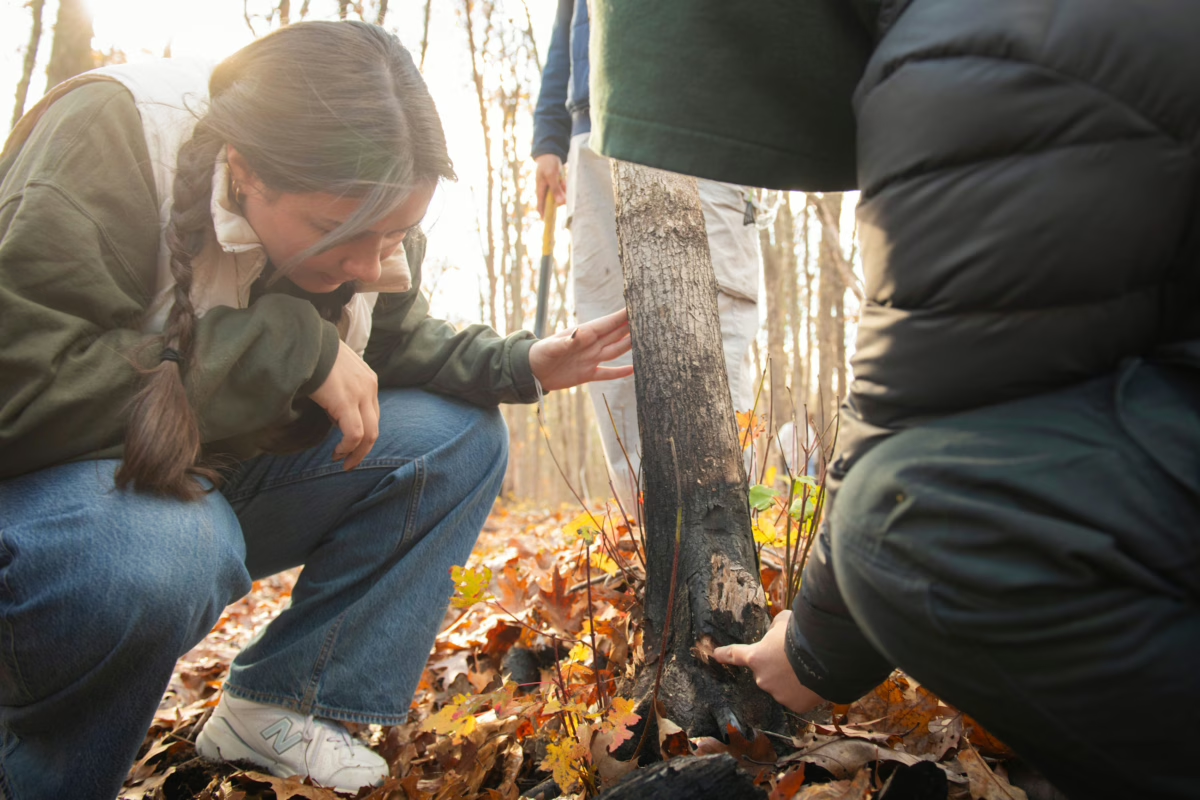
Featured photo at top: Students in the School of Climate, Environment, and Society’s Field Methods for Environmental Science class, taught by Geography Professor Dominik Kulakowski, visit a Massachusetts forest. Kulakowski, Christopher A. Williams, and other environmental science professors in the school teach about the climate-driven impacts of wildfire, drought, and insects on forests. Photo by Steven King, University Photographer