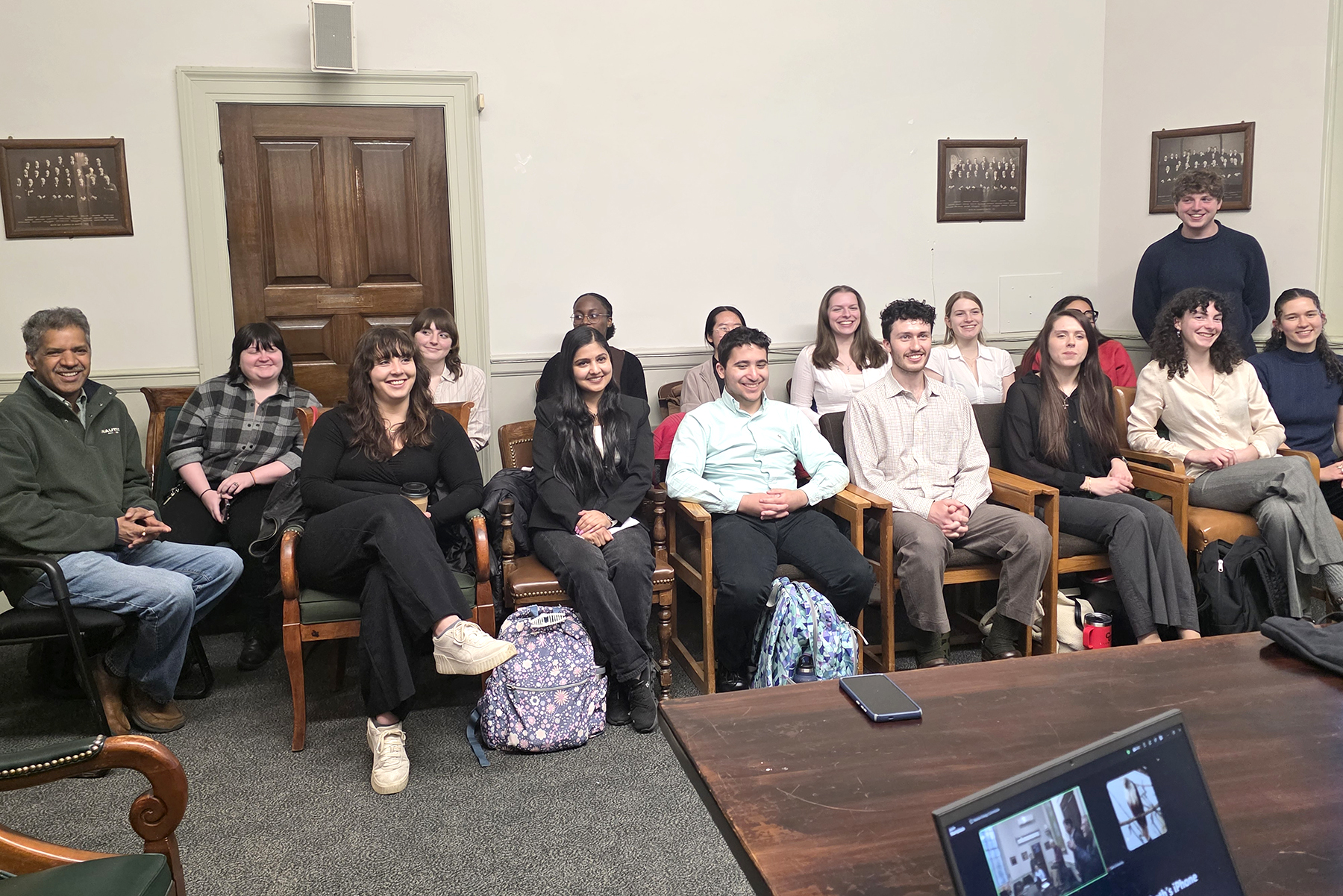
On April 22 — Earth Day — a group of Clark University students visited Newton, Massachusetts, to present months of rigorous analysis and applied research to the city’s Energy Commission. What began as a classroom initiative evolved into a meaningful contribution to a city’s climate strategy.
The work emerged from Environmental Knowledge, Governance and Justice Studio, a course taught by Ravi Hanumantha, visiting assistant professor in the Department of Sustainability and Social Justice. Designed to bridge theory and practice, the studio places students in real-world policy contexts and challenges them to engage directly with communities, data, and decision-making processes.
The Department of Sustainability and Social Justice is affiliated with the School of Climate, Environment, and Society.
At the heart of this collaboration was a shared goal to support Newton’s transition toward electrification and long-term emissions reduction. Groups of students worked on three separate but connected efforts, each blending technical skills, policy insight, and community engagement.
Designing Smarter Surveys for Electrification
Student Contributors: Asmita Baidya, M.S. ’26; Derek Fino ’25, M.S. ’26; Jack Keane, ’25, M.S. ’26; Kate Roller, Jack Keane, ’25, M.S. ’26; and Saorla Scully Jack Keane, ’25, M.S. ’26
The first phase of the project addressed a deceptively complex question: How can a city better understand its residents’ readiness for electrification?
Students developed a targeted sampling and survey design strategy to improve how Newton collects data on household energy use and electrification potential. Instead of relying on broad outreach, the team identified ways to strategically sample households and refine survey instruments. This approach ensures that future programs, such as heat pump adoption or building retrofits, are informed by representative and actionable data.
Their work laid the foundation for more precise policymaking and will help the city move beyond assumptions toward evidence-based planning.
Building a Dashboard That Matters
Student Contributors: Anna Camilli ’25, M.S. ’26; Jack Keane, ’25, M.S. ’26; Nelida Djassi, M.S. ’27; Quill Mulcare, M.S. ’27; Emma Nicodemus ’25, M.S. ’26; and Shawn Selzer ’25, M.S. ’26
In parallel, another group of students focused on how cities communicate their climate progress. They conducted a global scan of sustainability dashboards and analyzed the platforms municipalities use worldwide to track energy use, emissions, and climate goals.
The result was not only a comparison but also a set of carefully curated recommendations. Students identified best practices in visualization, accessibility, and transparency, and translated these into a proposed framework for Newton’s public-facing dashboard.
Their recommendations focused on selecting the most meaningful metrics, those that balance technical rigor with public clarity. The goal was simple: to create a dashboard that informs residents, guides decision-making, and builds trust.
Tracking Emissions Sector by Sector
Student Contributors: Fengying Guo ’25, M.S. ’26; Allison Kimball ’26, M.S. ’27; Gelian Rosa ’25, M.S. ’26; Caitlin Schubert ’19, M.S. ’26; and Emily Wells ’25, M.S. ’26
The third component of the initiative involved constructing a detailed greenhouse gas inventory for Newton from 2019 to 2024.
This effort required students to collect and harmonize data across multiple sectors, including residential and commercial energy use, transportation, and methane leaks. They worked with evolving data sources and updated emission factors, carefully accounting for methodological changes over time.
By the end of the analysis, the team developed a comprehensive picture of the city’s emissions profile, highlighting both progress and persistent challenges. Their work quantified total emissions and revealed sector-specific trends, offering critical insights for future climate action.
Collaboration Beyond the Classroom
The project was strengthened through collaboration with advisors and practitioners working at the intersection of energy, policy, and implementation, who ensured that the students’ work aligned with with real policy needs and practical constraints. Key advisors included Michael Gevelber of Boston University, Reihaneh Irani-Famili of Viridi Edge, and Jon Slote, a retired solar engineer and current member of the Newton Energy Commission.
“This project reflects Clark University’s commitment to connecting classroom learning with real-world impact in the communities it serves,” Hanumantha says. “As cities across the country grapple with the complexities of climate transition, partnerships like this highlight an essential truth: The next generation of researchers and practitioners is not waiting to make an impact — they are already doing so.”