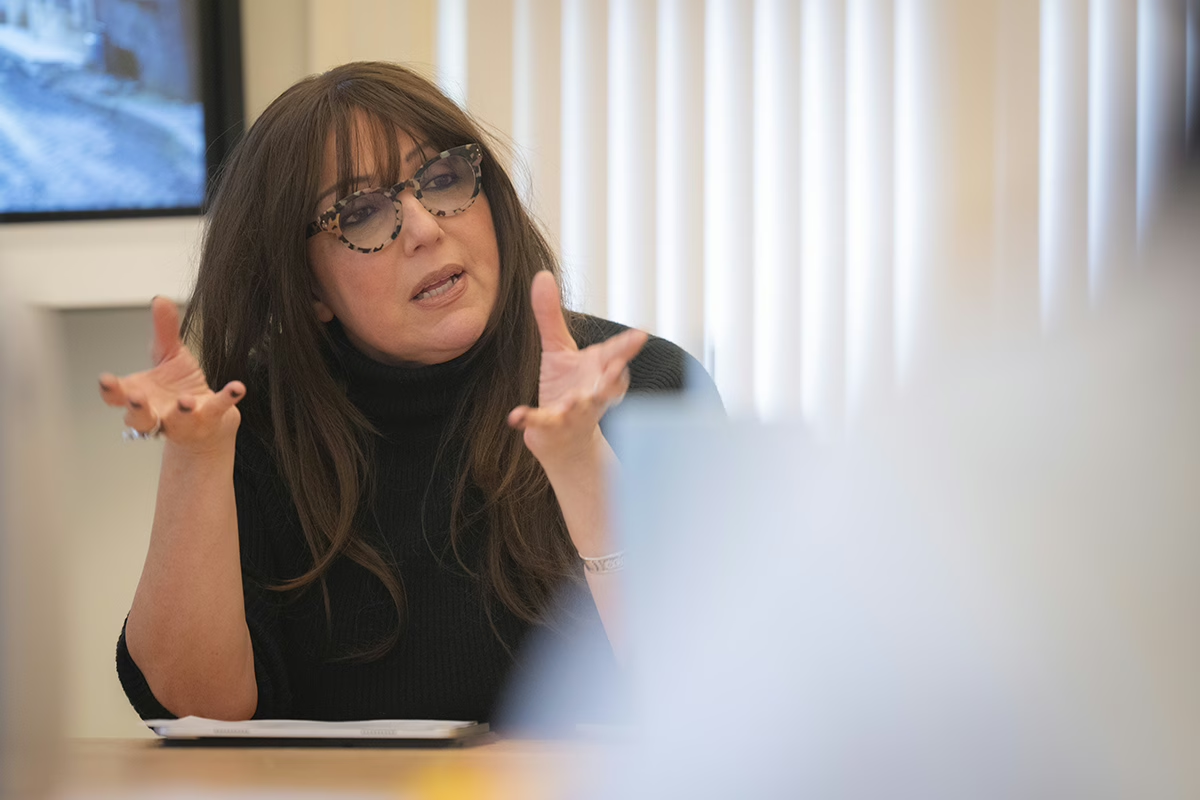
Clark scholar has deep family connection to the country’s history
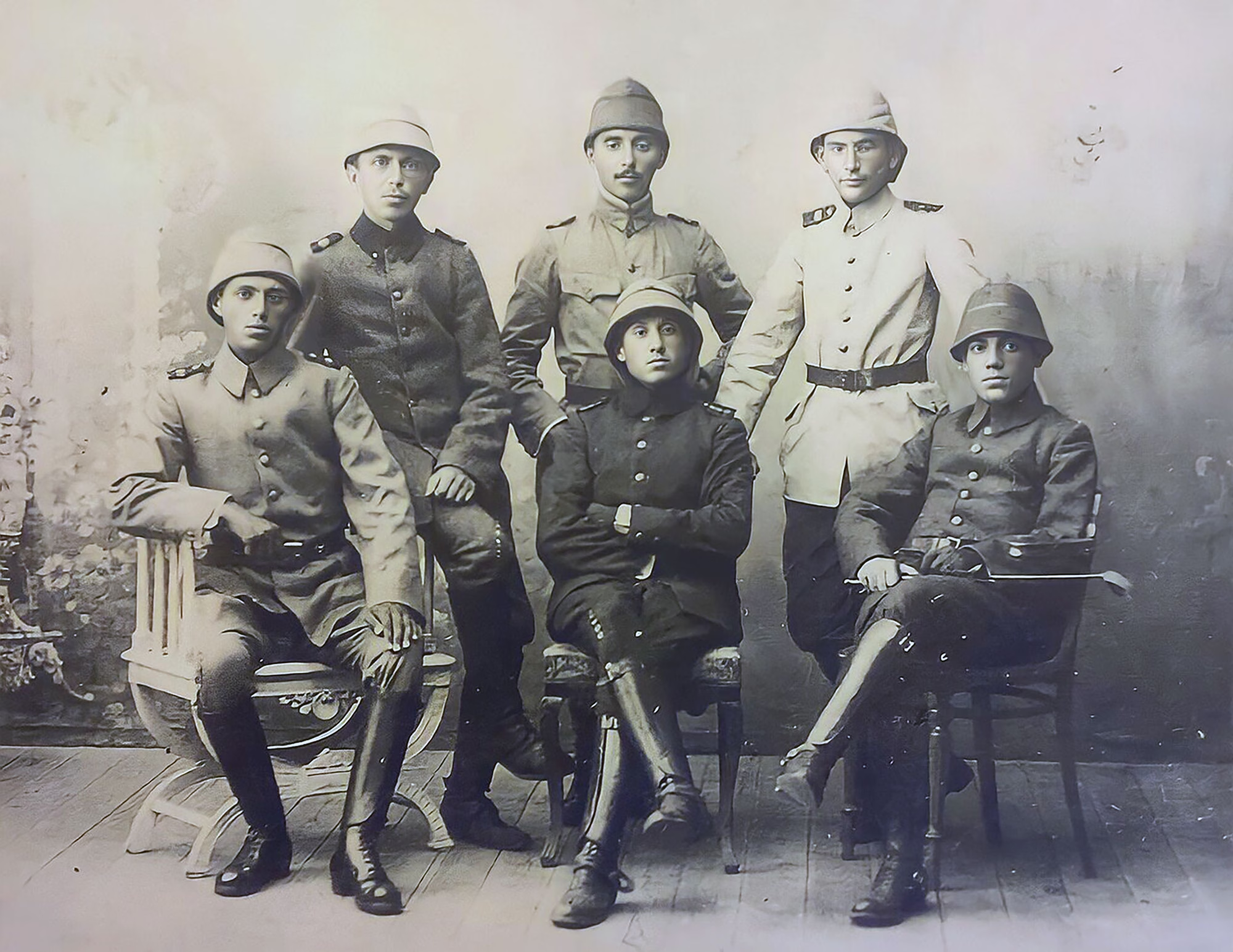
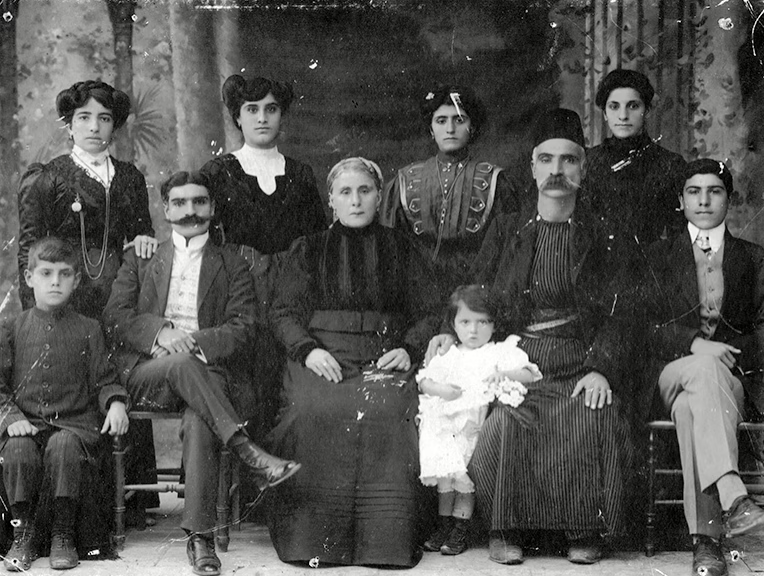
Elyse Semerdjian found the only remaining artifact of her father’s family history 25 years ago in her grandmother’s armoire in Aleppo, Syria.
“This photograph was never meant to be a precious artifact,” writes Semerdjian, a professor of history in Clark’s Strassler Center for Holocaust and Genocide Studies, in the introduction to her award-winning book, “Remnants: Embodied Archives of the Armenian Genocide.”
Yet, the “photograph is the only possession I have documenting my family on the eve of the medz yeghern, ‘the great crime,’ as the Armenian Genocide is often referred to in Armenian,” explains Semerdjian, who joined the Strassler Center nearly three years ago as the Robert Aram and Marianne Kaloosdian and Stephen and Marian Mugar Chair of Armenian Genocide Studies.
The Armenian Genocide is widely said to have begun on April 24, 1915, when Ottoman authorities, fearing a revolution supported by France and Britain, arrested 250 intellectuals and community leaders in Constantinople (modern-day Istanbul). As part of Armenian History and Heritage Month in April, Armenian Genocide Remembrance Day is observed on the date each year in the United States and other countries.
From 1915 to 1916, Ottoman paramilitary authorities forced as many as 1.2 million Armenians to march in the Syrian desert without food or water, massacred hundreds of thousands, raped and abducted Armenian women in front of their husbands, abducted children, drove survivors to concentration camps. Throughout their war for independence, Turkish nationalists continued the atrocities and ethnic cleansing of Armenians, culminating in the formation of the Republic of Turkey in 1923.
More than 30 countries, including the United States, now recognize the Armenian Genocide. A point of international contention has been Türkiye’s refusal to characterize the deaths and atrocities as “genocide.” The country describes the killings of what it considered to be Armenian “traitors” as casualties of war, likening their deaths to those of Muslims and Turks during the same period, and has criminalized speech about the genocide under Article 301, subjecting intellectuals and activists to criminal proceedings, Semerdjian notes.
Like the missing details of her family’s legacy, the “remnants” of Armenian history were “erased by the atrocities” that occurred as the Ottoman Empire dissolved and Turkish nationalists took power, Semerdjian explains.
In her book, she explores “how gender, patriarchy, and the body informed genocidal thinking” by uncovering the “remnants” of this personal and communal history and trauma that have been hidden away in state archives and inscribed upon bodies and minds. She forefronts the narratives of Armenian women, who describe their rapes, involuntary tribal tattoos, and forced marriages by Ottoman perpetrators, and includes some stories of male victims of sexual violence.
“Remnants” has drawn praise from critics and scholars alike, winning the 2025 Raphael Lemkin Award from the Institute for the Study of Genocide and the 2024 Association for Middle East Women’s Studies Book Award.
For many years, Armenian Genocide scholars had not fully attended to the stories of women victims, in part because they had been “deemed too personal and too emotional to be worthy of historical study,” according to Semerdjian. Even today, many survivors and their families feel a sense of shame and avoid talking about the sexual violence and tattoos.
“For me, ‘Remnants’ is about trying to break free, to integrate oral history and anthropology, and even to share a little bit of my own story,” Semerdjian says. “Because of the genocide, I don’t know much about my own family. Our bloodlines are just completely severed. My father doesn’t even know the name of his own grandparents.”
In many families, “genocide survivors decided not to share about the past. In part, they don’t want to re-traumatize anybody, including their children,” she explains. “So, the book is also about admitting that, as historians, there are some things we may never know.”
‘Skin and tattoos are another way of reading trauma on the body’
Semerdjian became interested in researching survivors’ tattooed bodies after watching Suzanne Khardalian’s 2011 documentary film, “Grandma’s Tattoos.”
During the Armenian Genocide, Arab, Turkish, and Kurdish men took some Armenian women as their wives and daughters and in other cases as domestic laborers in conditions described as slavery. To integrate the Armenian women into their families, tattooed Arab mothers inked the tribal markings on the Armenians’ faces, necks, chests, and hands — a traditional rite of passage and inscription of belonging.
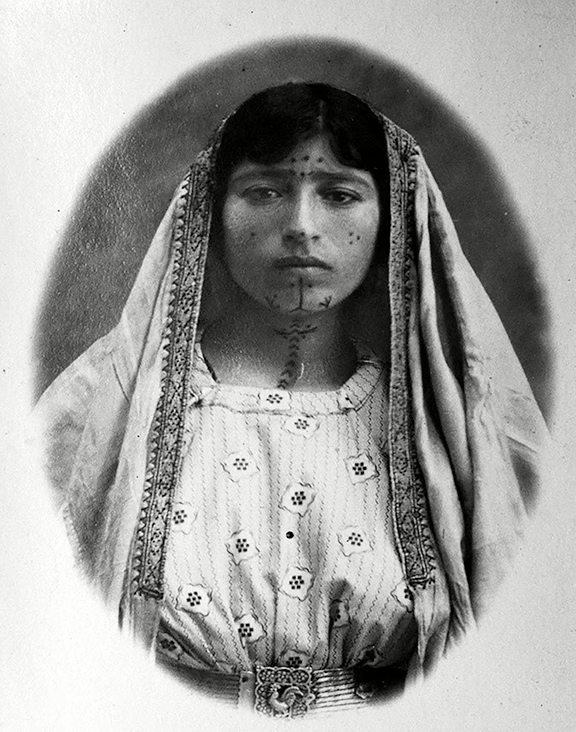
“The tattoos loomed over that documentary. I wanted to know more about them,” Semerdjian recalls. “I wanted to know what the tattoos meant, and why they were applied. And how they are remembered as trauma by the Armenians.”
In “Remnants,” Semerdjian argues that the history of the Armenian Genocide can be read in the victims’ tattoos and scars, along with their memories and trauma, which also have been inherited by their descendants. Along with the written records from state archives, these “embodied archives” — the subtitle of her book — also provide historical evidence.
“ ‘Embodied archives’ is a way of talking about all these types of emotional experiences that we don’t typically register as being worthy of history,” she says. “Skin and tattoos are another way of reading trauma on the body.”
A running theme in her book is the gendering of genocide, something she fears is perpetuated today throughout the world.
“My primary objective with the book was to get people to take gender seriously when talking about genocide. Genocide is itself a manifestation of extreme patriarchy,” she says.
“The perpetrator understands how communities and families are structured by patriarchy, and they take aim at it — the separation of women and children, and the elimination of men. Shame is also weaponized to unravel a community. If we continue to structure relations through patriarchy, it makes us vulnerable to genocide.”
Throughout her book, Semerdjian introduces the survivors of gendered violence during the Armenian Genocide, like 17-year-old Loutfie Bilemdjian, photographed with tribal tattoos on her face. Loutfie was abducted from her city of Aintab (now Gaziantep in south-central Turkey) and sold to three different men, according to the “Registers of Inmates, the Armenian Orphanage in Aleppo,” held in the United Nations Archive at Geneva.
‘For me, ‘Remnants’ is about trying to break free’
Elyse Semerdjian
Semerdjian also recounts what is believed to be the first memoir written by an Armenian survivor and abductee, Pailadzu Captanian, who describes “how women were stripped by the Kurdish guards and forced to walk for days in the sun with no protection in what she called a ‘column of the naked … [that] had been turned into a slave market.”
The Ottoman forces’ shame-inducing stripping of Armenians’ clothing, a sort of “social skin,” renders them exposed and dehumanized, Semerdjian explains. Clothing “contained the power to identify gender and social class, and for most of Ottoman history, sumptuary laws codified the relationship between clothing, religion, and ethnicity,” she writes. “Those virtual skins, clothing and undergarments, littered the countryside as evidence of the procedural forced stripping that was a prelude to killing.”
The book finishes with an examination of what remains, bones, in the killing fields of Dayr al-Zur, Syria, a place Armenians, including Semerdjian, made pilgrimage to prior to Syria’s Civil War (2011-2024). She also explores “what it’s like when you have a whole region of the country that’s covered in mass graves, and how people experience those sites, because many of them are unmarked,” she says.
Her research on mass graves prompted her to launch a class about death and the afterlife, which she taught this semester. She also teaches Armenian history, including the history of the Armenian Genocide, and courses on gender, the Middle East, and the Ottoman Empire.
Returning to ‘magical’ Aleppo, a city of multiple languages and cultures
Over the years, Semerdjian has lived and studied in the United States and Syria. Along with other survivors, her grandparents fled to Aleppo during the Armenian Genocide. The city still holds a place in her heart — her father was born there, and she spent much time in Aleppo during childhood.
During a master’s program in Middle Eastern studies at the University of Michigan-Ann Arbor, Semerdjian “started using Ottoman sources to reconstruct the lives of women, and I also realized there were a lot of minorities and marginalized groups in those documents as well.”
Her research continued during her Ph.D. program in history at Georgetown University and when serving as the Dumanian Visiting Professor in Armenian Studies in the University of Chicago’s Department of Near Eastern Cultures and Languages.
Semerdjian returned to Aleppo, the city where her relatives still live, to research the stories and history of Armenians there. “But like other Syrians, I felt like I had to go back to the source of the trauma and address the roots, which was the Armenian genocide,” she says.
Her next research project aims to examine Aleppo’s history but also embrace the current reality, which is that parts of the city are gone. So how does Aleppo come back from this, and how do all these vibrant minorities survive in a city that’s becoming increasingly unlivable?”
Yet, Semerdjian cannot begin her project until she can return to Aleppo. Her last visit was in 2010 — before the start of the Syrian Civil War. Although she visited Syria in January, Aleppo was inaccessible due to ongoing fighting; a closed airport in Damascus. It is currently accessible through Lebanon which is unsafe.
“Aleppo was, and it always is, magical because there are so many different communities living there. From quarter to quarter, the dynamics shift by class and religion. You have church bells and you have minarets, and you have different languages spoken in the streets — Turkish, Kurdish, Arabic, Armenian, French,” says Semerdjian, who speaks several languages and conducts her historical research by reading primary documents in Armenian, Arabic, and Turkish.
“Syria has about 16 different religious and ethnic minorities,” she adds. “It is not a homogenous place. So how can these diverse people learn how to cooperate and live together?”