

Clark University
Clark University logo
Clark University
  • Academics
    • Degree programs
    • The Clark Experience
    • Undergraduate curriculum
    • Graduate Education
    • Advising
    • Honors Program
    • 4+1 Accelerated Master’s Degree
    • Schools and departments
    • More…
  • Admissions
    • Undergraduate admissions
    • Graduate admissions
    • Continuing education
    • International students
    • Tuition and fees
    • Financial aid
    • More…
  • Student Life
    • Housing and dining
    • Health and wellness
    • Athletics and recreation
    • Worcester
    • Involvement
    • Student Success
    • More…
  • Research
    • Highlights
    • Facilities and labs
    • Centers and institutes
    • Fellowships
    • More…
  • About
    • Facts
    • Mission
    • Campus
    • Leadership
    • Clark Inspired
    • Diversity and inclusion
    • More…

Bookmarks

  • Library
  • Academic calendar
  • Courses and schedules
  • ClarkYOU
  • People directory

Resources for:

  • Future students
  • Current students
  • Faculty
  • Staff
  • Families
  • Alumni
  • Visit
  • Apply
  • Request information
  • Ways to give

Apply

Research

  • Highlights
  • Facilities and labs
  • Centers and institutes
  • Fellowships
  1. Clark University
  2. Research
  3. Highlights
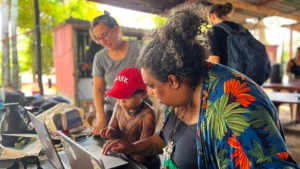
Florencia Sangermano works with Indigenous communities in the Brazilian rainforest

Protecting Indigenous lands and human health

Geographer Florencia Sangermano and her global colleagues conduct research on how Indigenous lands in the Amazon region help buffer and protect humans from forest fire-related illnesses and, in many cases, animal- and insect-borne diseases.

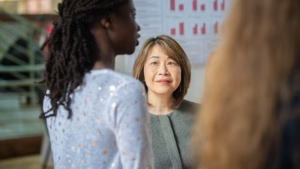
Ellen Foley, professor in the Department of Sustainability and Social Justice

Taking the temperature of global health

How do you measure global health? How can partnerships work toward improving health outcomes that are more equitable? Anthropologist Ellen Foley works to elevate the voices of experts from the Global South who explore those questions.

Psychology Professor, James Cordova

Reducing stress for sustainable bonds

Psychology Professor James Córdova envisions that, one day, couples’ “relationship checkups” with mental health professionals will be as easy to schedule as dental appointments. That could have significant effects on individuals’ mental health, he adds.

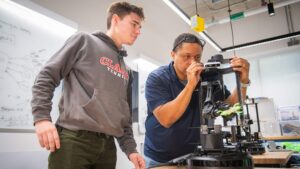
Professor Gary Holness works with a student on a robotics devices with applications for agriculture

Could robots help farmers?

Farmers have acres of fields to look after, and it can be hard to spot an insect infestation before crops endure significant damage. What if a robot could help? That’s a question Computer Science Professor Gary Holness and students are tackling hands on.

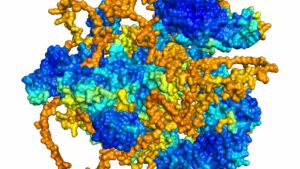
3D rendering of E3 ubiquitin-protein ligase HECTD1 as predicted by alphafold and colored according to confidence in the model

The roads to treating cancer

Two professors and a doctoral candidate have combined their expertise in chemistry and computer science to conduct research that could one day lead to treatments for cancer and Alzheimer’s disease.

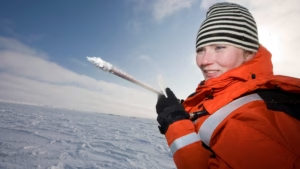
Karen Frey conducting climate research in the Arctic.

Entering the iceless age

The Arctic of the future figures to be warmer, stormier, and greener than ever imagined, says polar scientist Karen Frey, a longtime contributor to and a lead author on the annual Arctic Report Card, established by NOAA two decades ago.

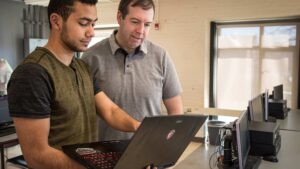
John Magee helping a computer science student on their project

The human side of computing

Computer Science Professor John Magee is interested in learning how systems can improve people’s lives. Magee works with user interface technologies that allow people with disabilities to communicate and participate in the world.

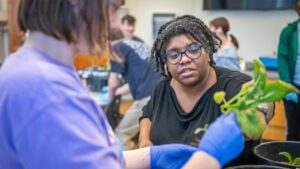
Biology Professor Chandra Jack studying plant microbe interactions in her lab

What will we eat in 2050?

Biologist Chandra Jack studies plant microbe interactions, examining how microbes influence traits such as when a plant flowers or whether it can compete against neighboring vegetation, and applies that knowledge to sustainable agriculture.

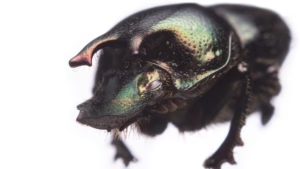
Onthphagus orpheus

Of dung beetle hookups and climate change

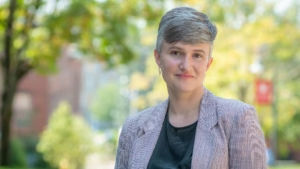
For evolutionary biologist Erin McCullough, the mating rituals of dung beetles are not only fascinating, they also can provide a window into understanding how climate change might affect biodiversity.

Professor Elizabeth Blake

Food lit worth chewing on

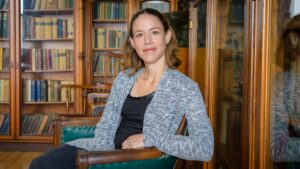
When English Professor Elizabeth Blake opened The Alice B. Toklas Cook Book, she was captivated by more than the recipes. Published in 1954, the book is a serious literary and theoretical investigation into the power of food, the value of art, and queer life.

A person viewing asmr content on a laptop

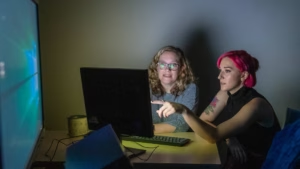
The whispering world of ASMR

In their research, Hugh Manon, professor of screen studies, and Shuo Niu, professor of computer science, are digging into the social media phenomenon that is ASMR, or autonomous sensory meridian response.

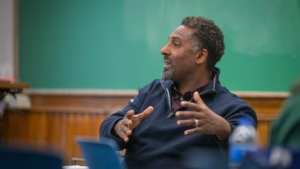
Professor Michael Addis (detail) speaks about the toll that the performance of masculinity takes on men

What men lose when performing gender

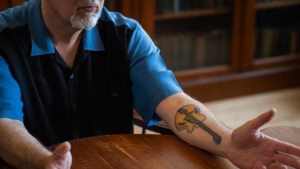
Psychology Professor Michael Addis’ research indicates masculinity is a performance a person gives to reinforce their gender in alignment with societal and cultural norms. That can be damaging to the person involved — and to others.

Professor Abbie Goldberg

Of love, law, and LGBTQIA+

Psychology Professor Abbie Goldberg has spent her career researching, writing, and teaching classes about diverse families, including LGBTQIA+ parent families and adoptive-parent families, as well as the experiences of marginalized groups like transgender youth.

Psychology Professor, Alena Esposito conducting research about the way we learn

The language(s) of learning

As part of a first-of-its-kind longitudinal study funded by the National Science Foundation, Psychology Professor Alena Esposito seeks to answer: Which practices work best for bilingual schoolchildren?

Nadia Ward, youth mental health expert, recording a podcast

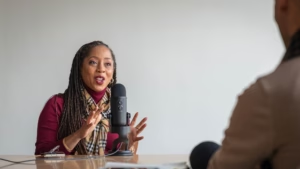
On the frontline of mental health

Under the leadership of Nadia Ward, Clark’s Mosakowski Institute directs its intellectual resources toward creating immersive, technology-assisted approaches that effectively treat behavioral health issues among adolescents and young adults.

Music Professor Benjamin Korstvedt

The Fourth is with him

As one of the world’s foremost authorities on 19th-century Austrian composer Anton Bruckner, musicologist Benjamin Korstvedt has closely studied his symphonies and life, including his often-contradictory images.

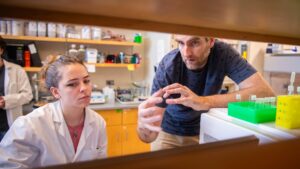
Biology Professor Nathan Ahlgren and a student in the lab investigating how iron nourishes and shapes the adaptation of Synechococcus.

How phytoplankton helps us breathe

Biologist Nathan Ahlgren is investigating how iron nourishes and shapes the adaptation of Synechococcus, a marine phytoplankton and a key driver to the photosynthesis that generates as much as 15 percent of the oxygen we breathe.

Justin Shaw teaching a British Literature class

From Othello to ‘other’

As Clark’s resident Shakespeare scholar, English Professor Justin Shaw helps his students perceive why the Bard continues to move audiences to tears, to laughter, to deeper understandings of human motivation—and also why his words still.

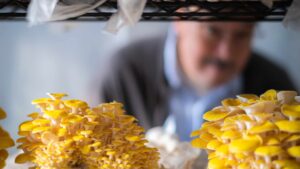
Professor David Hibbett examining mushroom specimens at Fat Moon Farms

The mysteries of the mushroom

For years, David Hibbett, the Andrea B. and Peter D. Klein Distinguished Professor of Biology, has worked to unlock the secrets of mushrooms. Now, he and fellow biologist Javier Tabima Restrepo are working with students to research the fungal genus Lentinus.

Professor and digital humanities scholar Eduard Arriaga-Aranco, in the classroom

Language learning and digital humanities

Professor Eduard Arriaga-Arango is recognized as an expert in digital humanities, studying how language, literature, culture, and technology collide and intersect. He characterizes the differences between traditional and digital humanities as “yak and hack.”

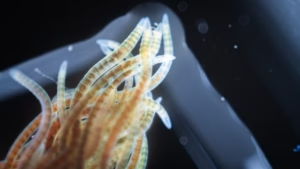
Worms in the Kudroli Physics Lab move together to try to break the surface of a water droplet

Will robot worms heal what ails you?

Physics Professor Arshad Kudrolli and Ph.D. candidate Sohum Kapadia conduct experiments detailing how California blackworms move through water-filled spaces. The research is expected to inform the development of soft robots that could navigate the complext “terrains” of the human body.

Betsy Huang listens to a student discuss their research during a recent ClarkFest, research showcase

Humanities and the ‘good life’

Humanity and the humanities face disruption from seemingly unmitigable forces such as climate change and artificial intelligence. For English Professor Betsy Huang, contemporary speculative fiction offers pragmatic visions of hope and eye-opening messages of caution.

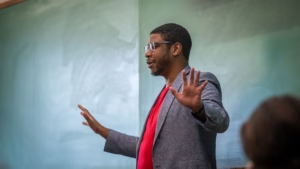
Professor Osman Power Green, teaching

Quenching an inner thirst for knowledge

Professor Ousmane Power-Greene doesn’t believe that college-level history should be available only to those who can afford the privilege. He engages students who are eager to access his expertise, but who could not do so without a vital initiative.

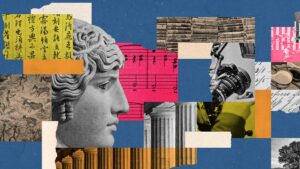
Collage style artwork with motifs from the visual arts, music, and world literature

Narratives of nature

Clark has a renewed focus on the environmental humanities. English Professor Stephen Levin and his colleagues are part of this field of research that took off after the founding of the Association for the Study of Literature and Environment in 1992.

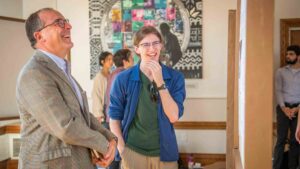
Provost Sebastián Royo and Samuel Cooper ’24 share a laugh during ClarkFEST on Oct. 25.

How are ‘climate dollars’ distributed? 

After the Inflation Reduction Act, one of the most ambitious investments in climate and energy in U.S. history was signed into law, Samuel Cooper ’24 was curious how New England would benefit compared to the rest of the country.

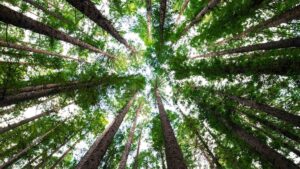
A tree canopy viewed from below

Where tree restoration heats the Earth

As efforts to restore tree cover accelerate to help avoid runaway climate change, a study by two Clark researchers highlights how restoring tree cover can, in some locations, heat up the Earth rather than cool it.

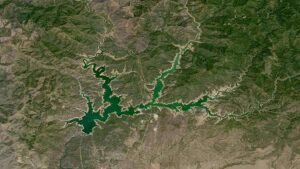
NASA Satellite image of Shasta Lake

AI meets climate science

Working with NASA and IBM, Clark’s Center for Geospatial Analytics has produced the world’s first geospatial AI foundation model, allowing scientists to more quickly understand the impacts of climate change — and how humans might adapt.

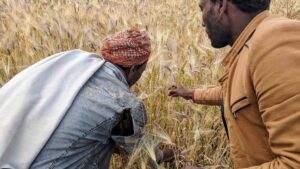
A researcher works with a farmer, studying traditional grains

Feeding the world by going with the grains

A Clark professor is part of an international research project to determine whether Ethiopian farmers’ age-old practice of planting and harvesting traditional grain mixtures could offer a climate-resilient solution to global food insecurity. 

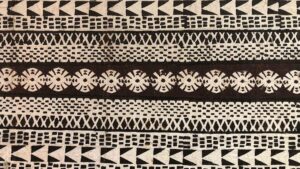
Fijian masa, a hand-printed designs on bark cloth

Protecting the Pacific Islands

Professor Abby Frazier, lead author of a chapter in the Fifth National Climate Assessment, is exploring the physical and socioeconomic impacts on Pacific island communities hit hard by “compound climate extremes” — a combination of multiple climate hazards.

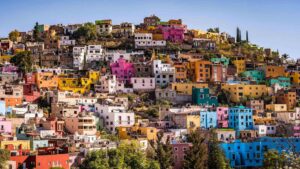
An aerial view of colorful buildings on a hillside in Mexico.

Mexico’s big thirst

Funded by a $1.5 million grant from the National Science Foundation, a team of 11 faculty and over a dozen students are collaborating with community stakeholders and municipal and federal governments in Central Mexico to address the region’s longstanding water crisis.

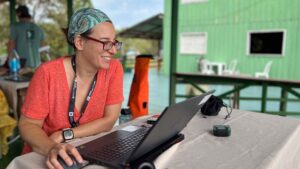
Florencia Sangermano works at a computer analyzing ecoacoustic data in Brazil

The sounds of science

Geography Professor Florencia Sangermano first began attaching audio recorders to trees in Central Massachusetts to capture the sounds of birds, weather, and humans in and at the edges of forests. Now she has become globally recognized in the expanding field of ecoacoustics.

Be a force for change.

Come study at a small research university with a strong liberal arts core.

  • Undergraduate
  • Graduate
Visit
Apply

Still curious? Request more information.

Inquire
Apply


Clark University logo

Invest in the next generation of Clarkies.

Ways to give

950 Main St, Worcester, MA, USA 01610 • 508-793-7711

  • Facebook
  • X
  • Instagram
  • TikTok
  • YouTube
  • LinkedIn
  • Threads

  • Report a concern
  • Careers
  • Privacy policy
  • Maps & directions
  • Campus safety
  • Office directory
  • Events
  • Website feedback

Website accessibility
Nondiscrimination policy

Copyright © 2025 Clark University