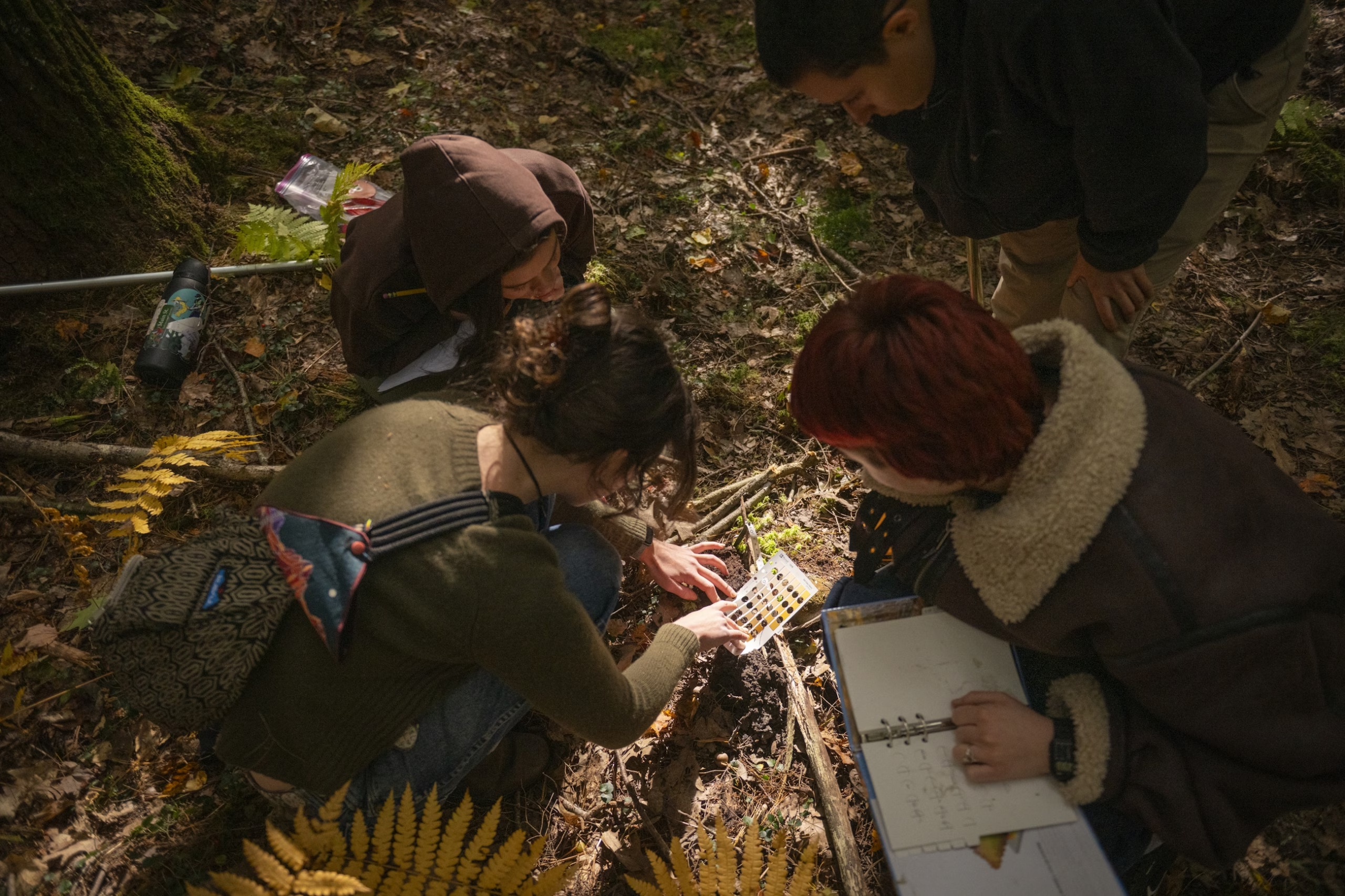

Clark economist contributes to new tool aimed at curbing fertilizer ‘hot spots’ and polluted waterways
With its 600 miles of coastline and 220 beaches, Long Island Sound generates a multi-billion-dollar “blue economy” for Connecticut and New York each year. The critical estuary harbors over 1,300 wildlife species, and millions of tourists and residents enjoy the Sound for fishing, boating, swimming, and other activities.
Yet, for many years, the waterway has been threatened by excess nitrogen pollution from sewage and lawn fertilizers that produce slow oxygen “dead zones,” killing fish and other marine life and producing unsightly algae. Since 2001, joint federal and state “Save the Sound” efforts have reduced nitrogen loads, but water monitoring by the Long Island Sound Partnership indicates that area residents could do more to curb pollution runoff.
The question remains: How can this be accomplished?

Enter principal investigator and Economics Professor Robert Johnston of Clark University’s School of Climate, Environment, and Society (CES), director of Clark’s George Perkins Marsh Institute.
Integrating the results of a two-year study, he and colleagues at the University of Connecticut, University of Maryland, and University of Miami have released a story map and tool to help policymakers and the public understand the impacts of lawn fertilizers on the Sound’s water quality. (The team’s second study, yet to be released, focuses on how to curb nitrogen pollution from aging residential septic tanks.)
“The goal of this project was to provide the results that people need to make decisions on how to most effectively reduce water pollution due to lawn fertilizer—in a simple, user-friendly format. Anybody can access the web map, for example, to reveal hotspots of lawn fertilizer use across the watershed,” Johnston says. “Users can trace each step in the process, from predictions of who is applying fertilizer — how much and where — to what happens once that fertilizer hits the ground, and how much of the resulting nitrogen pollution reaches Long Island Sound.”
Funded by a two-year, $812,000 grant from the Long Island Sound Study and Connecticut Sea Grant, the study focused on the watershed and coastal areas surrounding Long Island Sound. The resulting “Long Island Sound Lawn Fertilizer Outreach Targeting Tool” covers roughly a 2,500-square-mile area with a population of 3 million people in Westchester, Fairfield, New Haven, Middlesex, and New London counties in Connecticut, and Nassau, Suffolk, and Suffolk counties on Long Island, New York.
The tool pinpoints fertilizer-hotspot neighborhoods, not individual homes.
“The tool has received considerable attention from policymakers and stakeholders, informing how they might want to design and target behavior-change campaigns for lawn fertilizer use,” Johnston adds. “It helps them understand why targeting particular areas versus others would likely be more effective in reducing nutrient pollution to Long Island Sound.”
“If you want to really have an impact on reducing nitrogen, you go where the fertilizer is — the larger lawns and newer, larger homes in less densely populated, exurban areas.”
Over the years, multiple studies across the U.S., including those focused on Long Island Sound, have pointed to exurban neighborhoods — with newer, larger homes and bigger lawns — as contributing large amounts of nitrogen pollution from fertilizer use, according to Johnston. These studies are typically published in academic journals and are not intended to provide direct decision support.
“Compared to the original academic research, this study takes three major steps forward — toward practical results that people can use to inform decisions,” he says.
Combining high-resolution geospatial data with a sample from surveys of single-family homes, the researchers predicted fertilizer use on residential lawns across the watershed. Then, they linked those predictions “to a model identifying, at each point in the landscape, how much nitrogen from that fertilizer is expected to reach the water,” Johnston explains. Finally, “we included additional study results to predict how different types of homeowners would react to particular types of behavior-change campaigns.”
Among the challenges faced by behavior-change campaigns for lawn care is the “free rider problem, where people don’t change their own behavior because they think their neighbors will take responsibility,” according to Johnston.
“It’s easy to imagine that our own actions won’t matter — that it’s just one lawn,” he says. “But it’s not one lawn — it’s hundreds of thousands of lawns where everybody’s making that same calculation.” Among the goals of the study was to identify the types of behavior-change messages that are most likely to influence behavior.
Johnston worked with University of Maryland researchers to develop models that would predict how — and why — residents might change their behaviors around fertilizer use. They based the models on the university’s prior surveys distributed to residents around Long Island Sound.
“We found that messages focused on the potential exposure of local children and pets to lawn chemicals were particularly effective.”
The researchers found that when seeking to change residential fertilizer use, “it’s not only where you target, but it’s the messages you use,” he says. “Across the board, we find that the most effective approaches are not the types of approaches that people are currently using.”
Typically, campaigns to curb lawn-fertilizer use are launched by nonprofit environmental organizations with limited resources, according to Johnston. They often target densely populated, urban neighborhoods because it’s easier and cheaper to reach more people in those areas, and their messaging frequently focuses on improving water quality and protecting the environment.
“Our research shows that, in terms of impact, those are among the worst places to implement these campaigns, because even if they’re effective at motivating people to change their behavior, so little of the nitrogen going to the Sound is coming from those areas,” Johnston explains. “Why? Because the lawns in dense urban areas are often tiny, and the residents don’t tend to fertilize much.”
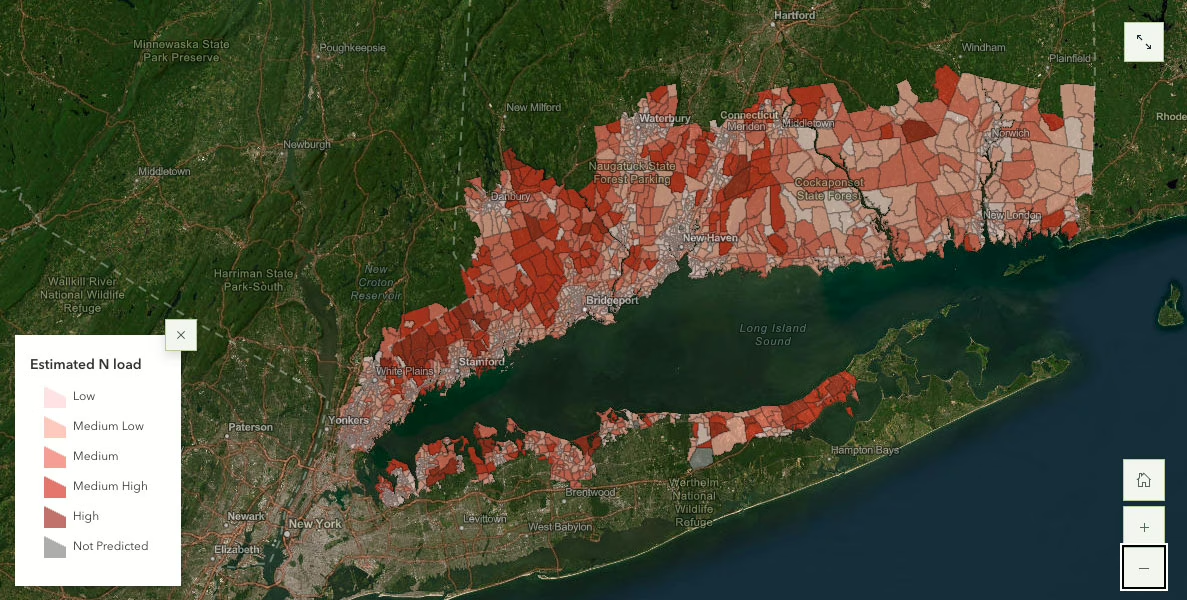
The researchers’ map indicates these low-nitrogen areas, colored light pink (above), where behavior-change campaigns are predicted to have less impact on improving the Sound’s water quality. They include places like New Rochelle, Great Neck, and Manhasset in New York, and Bridgeport, New Haven, and Waterbury in Connecticut.
On the other hand, “if you want to really have an impact on reducing nitrogen, you go where the fertilizer is — the larger lawns and newer, larger homes in less densely populated, exurban areas,” he says.
That would include high-nitrogen areas — colored dark red on the map — including parts of Greenwich, New Canaan, Newtown, Wallingford, and Colchester in Connecticut, and Harrison, Huntington, Oyster Bay, Smithtown, and Riverhead in New York.
Yet, the researchers predict that messaging centered on water quality and the environment might not prove as effective in these areas.
“Based on our survey responses, we found that messages focused on the potential exposure of local children and pets to lawn chemicals were particularly effective,” when seeking to motivate potential behavior change among homeowners. “Lawn chemical exposure is something local, tangible and important to people — that’s what makes this type of message powerful.”
This new study “delivers practical results. It’s designed to be clear and usable — you don’t have to be a scientist to use it — and it overcomes one of the challenges that we sometimes have as academics: providing simple information to inform real-world decisions.”
In addition to Johnston, the researchers include co-principal investigators David Dickson and Jamie Vaudrey of the University of Connecticut and David A. Newburn of the University of Maryland; Haoluan Wang of the University of Miami; and Qian Lei-Parent of the University of Connecticut. Tom Ndebele, a research scientist at the George Perkins Marsh Institute, provided additional research support.