Professor explores how Hindi remakes of popular U.S. films have reflected — and helped shape — global culture
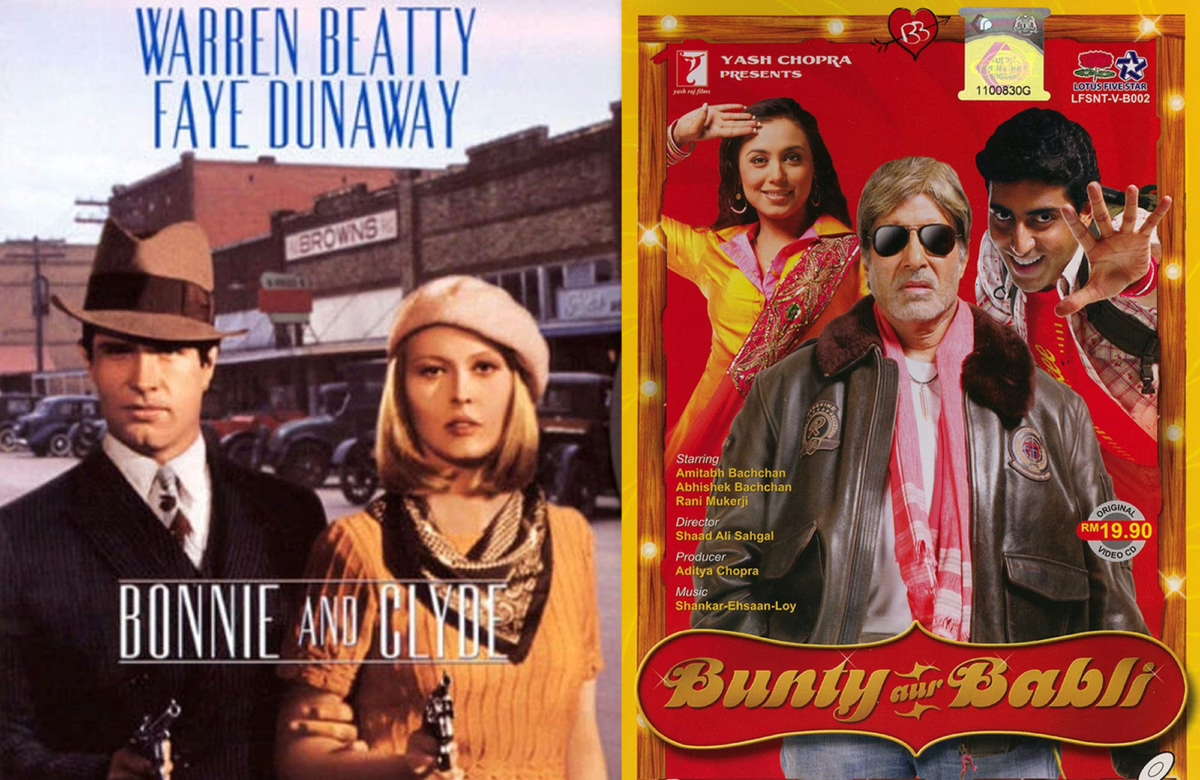
Screen Studies Professor Gohar Siddiqui recalls the serendipitous moment she became excited about researching Bollywood remakes of Hollywood films. She was in a graduate school film class watching “Bonnie and Clyde,” the 1967 crime-drama biopic about the infamous 1930s gangster couple who committed robberies and murders across the American South.
And she experienced a sense of déjà vu.
“It was my first time watching this film, yet I kept having this niggling feeling at moments: ‘I’ve seen this before,’” Siddiqui says. “It turns out I had just watched ‘Bunty aur Babli’ a few weeks earlier.
“The films, both brilliant, are very different in some ways,” she recalls. “The format, the song and dance numbers, and the comedy of ‘Bunty aur Babli’ are at odds with the tone of ‘Bonnie and Clyde.’ And yet, there are similarities, so my first response was a pleasurable feeling associated with having seen it before.”
That experience sparked her interest in “transnational cinematic intertextuality and influence,” according to Siddiqui.
Eventually, she was inspired to research remakes and write “Déjà Viewed: Nation, Gender, and Genre in Bollywood Remakes of Hollywood Cinema.” The book examines how ideologies of the nation, gender, and genres are negotiated in Bollywood remakes that cross cultural and industrial borders. Its title refers to the sense of déjà vu that audiences experience when “viewing” remakes, “something that is new and yet feels familiar,” she explains.

“From its beginnings, film has been an art form that has been intertextual and truly transnational,” says Siddiqui, who teaches classes on the history of international cinema, film genre, Bollywood, and global remakes.
When she first began digging into Bollywood remakes, Siddiqui couldn’t find much scholarship on the topic.
But she discovered that “fan blogs and reviews of Bollywood films were suddenly offering this amazing plethora of information about remakes. People were into remakes, and they were recognizing various references to, and similarities between, films from contemporary Bollywood and from various other industries, such as older Hindi films, films from regional film industries in India, and from international cinema.
“Of these, Hollywood was referenced more often than other films, in part because people were watching new and old Hollywood films through cable and satellite TV that became easily accessible to most households in the 1990s.”
Q&A with Screen Studies Professor Gohar Siddiqui
In a recent interview, Siddiqui further discussed her book, how her Clark courses influence her scholarship, and what she’s working on now.
In your book, why do you focus on Bollywood remake films after 1990?
Globalization in the ’90s affected the kinds of genres that were being produced in India, who the target audiences were, and how gendered ideologies about the nation were negotiated, particularly through the remake.
So, I could see how the remakes were important cultural texts that could be studied to understand how Bollywood, as a global industry, negotiated globalization and ideologies of gender, and the implications that had on a nation’s cultural ideas.
“Hollywood itself has a long history of producing remakes of domestic and international films and thus participates in practices of borrowing that may or may not acknowledge their sources.”
— screen studies professor gohar siddiqui
How has “Bollywood” been defined historically, and how has this meaning changed over time?
This is such a good question. Although the term “Bollywood” is often used to indicate all of popular Hindi cinema (also called Bombay cinema), the term connotes place, ideological positioning, and global presence as well.
Bombay (now called Mumbai) is the city where the Hindi film industry began, so “Bollywood,” as the name suggests, was used by some as a derogatory name that indicated Hindi films that rely on copying from Hollywood. There are other versions of this kind of naming (such as “Nollywood” for Nigerian cinema). Ideologically, this approach places Bollywood, Nollywood, and others as imitators of Hollywood, thus creating a hierarchy between the Western film industry and mainstream industries from other parts of the world. As a result, these non-Western film industries are seen as lacking originality.
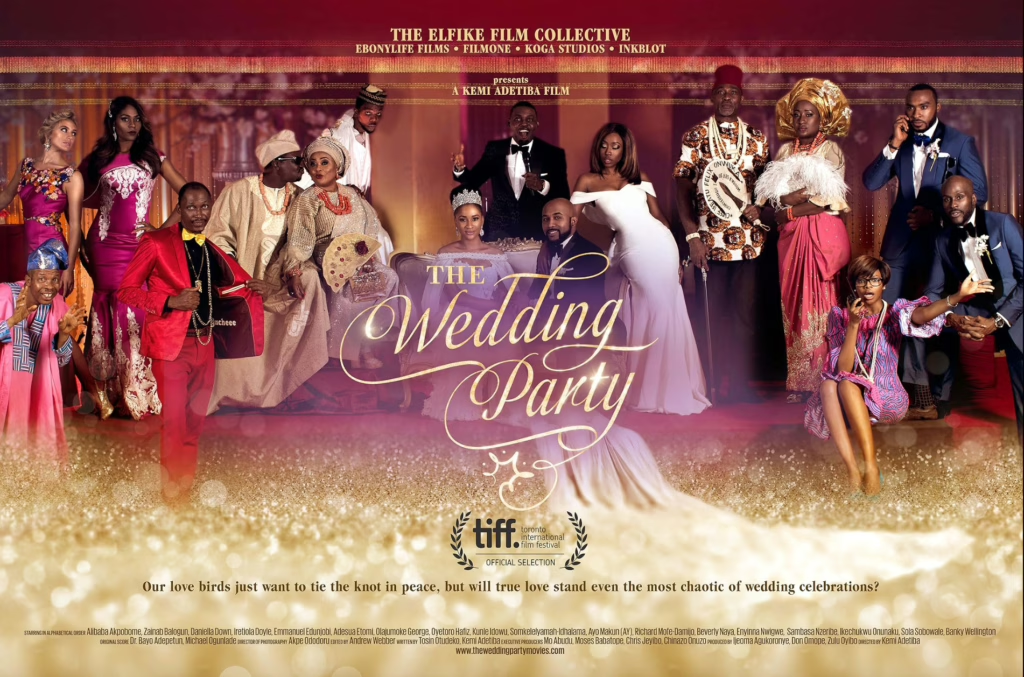
This is problematic because all mainstream industries rely on formulae that borrow tropes and plots in standard forms like genres, sequels, and remakes. For instance, Hollywood itself has a long history of producing remakes of domestic and international films and thus participates in practices of borrowing that may or may not acknowledge their sources.
Bollywood was officially granted industry status for film production in 1998. Yet, the name also gained currency in the ’90s specifically for certain kinds of Hindi films, such as the diasporic family films. There were filmmakers who refused to let their films be categorized as “Bollywood” to differentiate their work from these kinds of formula films. Many film scholars, including myself, tend to associate the term “Bollywood” with post-’90s films instead of seeing it as synonymous with the Hindi film industry. We thus see Bollywood as a part of the much larger body of films that comprise the entire industry.
Popular Hindi cinema has always had transnational appeal outside of South Asia, including the African continent, the former USSR, and parts of Europe. It started gaining popularity in mainstream Western markets in the late ’90s primarily as “Bollywood” because of various reasons tied to globalization.

Globally, the term “Bollywood” is also used as an adjective and is associated with more than just films. In my book, I quote the Indian film scholar and cultural theorist Ashish Rajadhyaksha, who sees Bollywood as the “export lager” of Indian cinema. For instance, the international reality TV show franchise “So You Think You Can Dance” had a staple genre, one of which was Bollywood. I remember seeing a dress in a U.S. store whose color was advertised as “Bollywood pink.”
As I have taught Hindi films over the years, I have noticed that students know more about these films, in part because of how the word “Bollywood” has become familiar in the United States. “Bollywood” connotes certain colors, flashiness, and dance styles, among other things. And so paradoxically, the term “Bollywood” is both a subset of Hindi cinema and more than Hindi cinema.
What is the interplay between gender and nation evident in Bollywood remakes?
As several other scholars before me have argued, gender is central to the construction of Indianness. Post-independence cinema in the 1950s (films like “Shree 420,” or “Mr. 420,” Raj Kapoor’s 1955 comedy-drama) fall back onto a gendered split where the heroine of the film anchors a cultural identity grounded in notions of purity, sacrifice, and ideal femininity so that the hero can represent the newly modernizing nation.
In the 1990s, this kind of split appears again, especially in films dealing with diasporic Indians. The burden of shoring up Indianness via a constructed feminine ideal allowed for the embrace of a global identity of the diasporic male hero. This is too simplistic of an explanation — in both kinds of films, the female characters are more complex, and yet the anxiety about modernity or Westernization is assuaged by constructing a certain femininity.
In my book, I start by exploring remakes in the 1990s because they make obvious the ways in which this connection of gender and nation is revisited and transformed across different genres historically.
How are queer identity and sexuality depicted in Bollywood remakes?
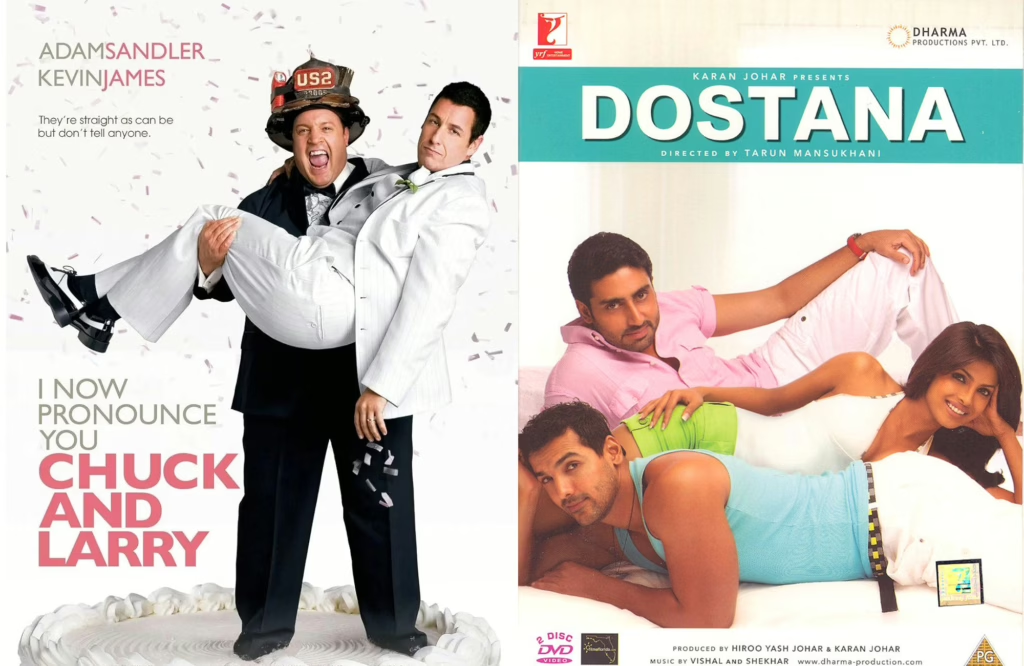
I don’t think there is one way. As I discuss in one chapter, the paths taken by two sets of films to depict queerness diverge significantly. For instance, I explore “Dostana” (“Friendship”), the 2008 story of two straight men, Sameer and Kunal, who pretend to be gay so they can rent a Miami apartment, but then both fall in love with their female roommate, Neha. A remake of Hollywood’s 2007 comedy-romance “I Now Pronounce You Chuck and Larry,” the Bollywood film is important for representing queer themes, but it also imports globalized stereotypes of sexuality.
In contrast, the intertextual triad created by Ismat Chughtai’s short story “Lihaaf,” Deepa Mehta’s film “Fire” (1996), and Abhishek Chaubey’s “Dedh Ishqiya” (“Passionate 1.5,” 2014) resist any generalized stereotypical understandings of sexuality and instead map queerness as a continuum as articulated within a South Asian cultural context.
How has your time spent as a scholar in India and America shaped your view of Bollywood, Hollywood, and film and culture in general?
I did not watch many films while I was growing up. That changed in college (at the University of Delhi), and in my bones, I still remember the joy of watching the Indian pop-folk song-and-dance number “Chaiyya Chaiyya” on the big screen in Bollywood’s “Dil Se…” (“From the Heart”), a 1998 romance thriller.
After coming to the U.S., I watched a lot of Indian films from different decades. Then, in my doctoral program at Syracuse University, I took a course on world cinema and another on Hollywood. Suddenly, things clicked. I had a vocabulary to think through all the fun stuff my brain had been accumulating over time. In addition to theoretical approaches based in gender and postcoloniality, I could think through concerns of production, reception, genre, and mode, but, most importantly, the form of film itself.
The things that I took away during that time remain central to my book: that cinematic influence is multidirectional, and the remake shows that; that film is not a transparent medium functioning as a mere vehicle for the plot but that, instead, how a film tells the story via cinematography or editing is crucial to how one interprets it; and that ideological concerns like those pertaining to gender are in play and connected with all of these aspects.
What would you like readers to take away from your book?
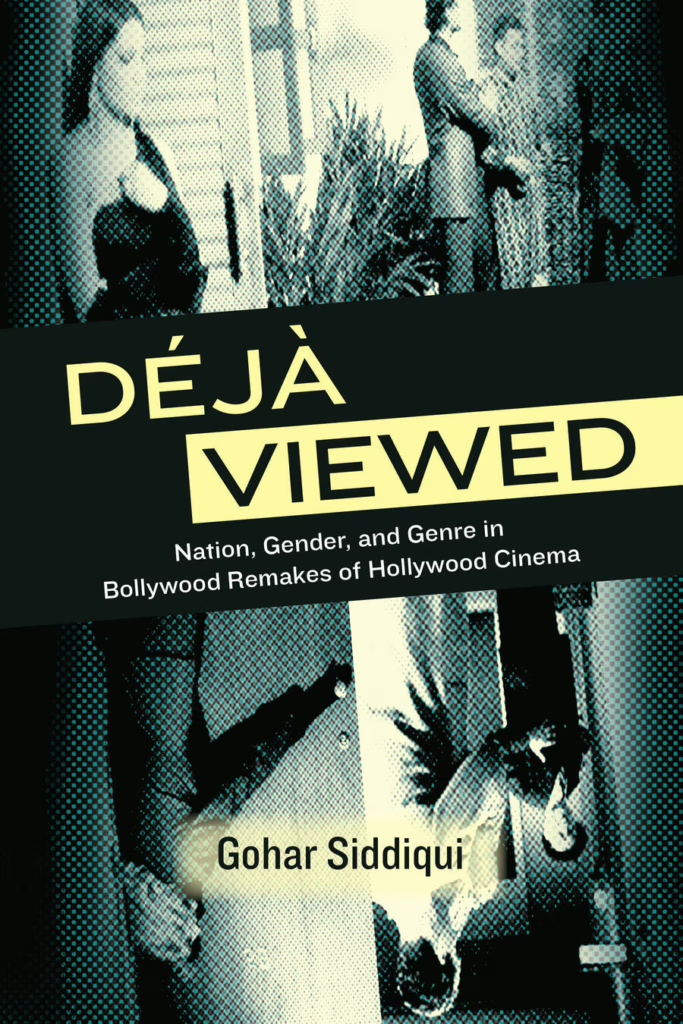
I hope that readers experience joy in thinking about the transcultural and transnational movement of film as opposed to buying into neocolonial hierarchies of certain industries being superior to others. A study of remakes does not just show how borrowing is an inherited aesthetic practice or one that can be part of the economics of mainstream productions but also conveys the love for cinema that crosses cultural borders.
Second, the book takes close analysis of film form seriously and underlines the importance of unpacking cinematic aspects of film as crucial to the meanings it can generate within its historical and industrial contexts.
And finally, I hope that the book’s readers understand how gender is crucial not just to the history of Hindi cinema and how it has been used for construction of an imagined Indianness, but that gender becomes visible through the remake when it grapples with translating one genre’s gendered ideologies into another.
How do you integrate your research into your classes at Clark?
Research and teaching are organically linked for me. Broadly, methodologically, my research is in gender studies, with a particular focus on transnational feminism. The international cinema courses I teach contain little bites of film theory and cultural and historical contexts. But at a broader level they are connected to my research — to how ideologies of power work in different international contexts and how they work across borders of industries, cultures, caste, class, and gender.
Specifically, my areas of research are Hindi cinema, remakes, and docudramas. I teach upper-division courses on two of these topics; I teach a research topics course on Bollywood, and I have taught a capstone on global remakes, which will soon be revamped into a “special topics” course. In Foundations of Screen Studies (SCRN 101), I also teach a unit on docudrama, which students research and work on for their final projects.
On the other hand, a lot of my research is also informed by my teaching. An essay I published on docudrama and Afghani film emerged from teaching those films in SCRN 101 and in international cinema courses. I have also published two essays on masculinity and stardom, and this research began when I was preparing to teach the relevant films in my Bollywood course.
What’s next for you in your research?
I am excited to be starting a new project, in which I am looking at stardom, the genre of the courtesan film, and the intersection of Urdu literary culture and cinematic gaze in these films. I plan on doing archival research in India related to this topic during my sabbatical and hope to develop a course based on this research.