FIFA player statistics. Teen girls’ sleep patterns and high-school start times. Ideological discourse in online communities. Identification of water organisms. Patterns in movies and games.
While these topics may seem far-flung, they share something in common: All can be explored through data science.
At Clark, faculty and students are doing just that via CROSSROADS — Creating Robust Opportunities for Student Success through Real-World, Organized, and Applied Data Science — a three-year initiative supported by a nearly $1 million National Science Foundation grant.
The project aims to connect data science to research and experiential learning across academic disciplines, as well to external partners, according to co-principal investigators Li Han, professor of computer science and director of Clark’s interdisciplinary Data Science Program, and Terrasa Ulm, associate professor and chair of interactive media in the Becker School of Design & Technology.
CROSSROADS brings together faculty and students from the arts, business, computing, education, humanities, sciences, and social sciences, as well as university offices and departments and outside partners.
“The idea is to create an ecosystem where students can engage with data science at different levels through interesting, meaningful questions.”
— li han, principal investigator
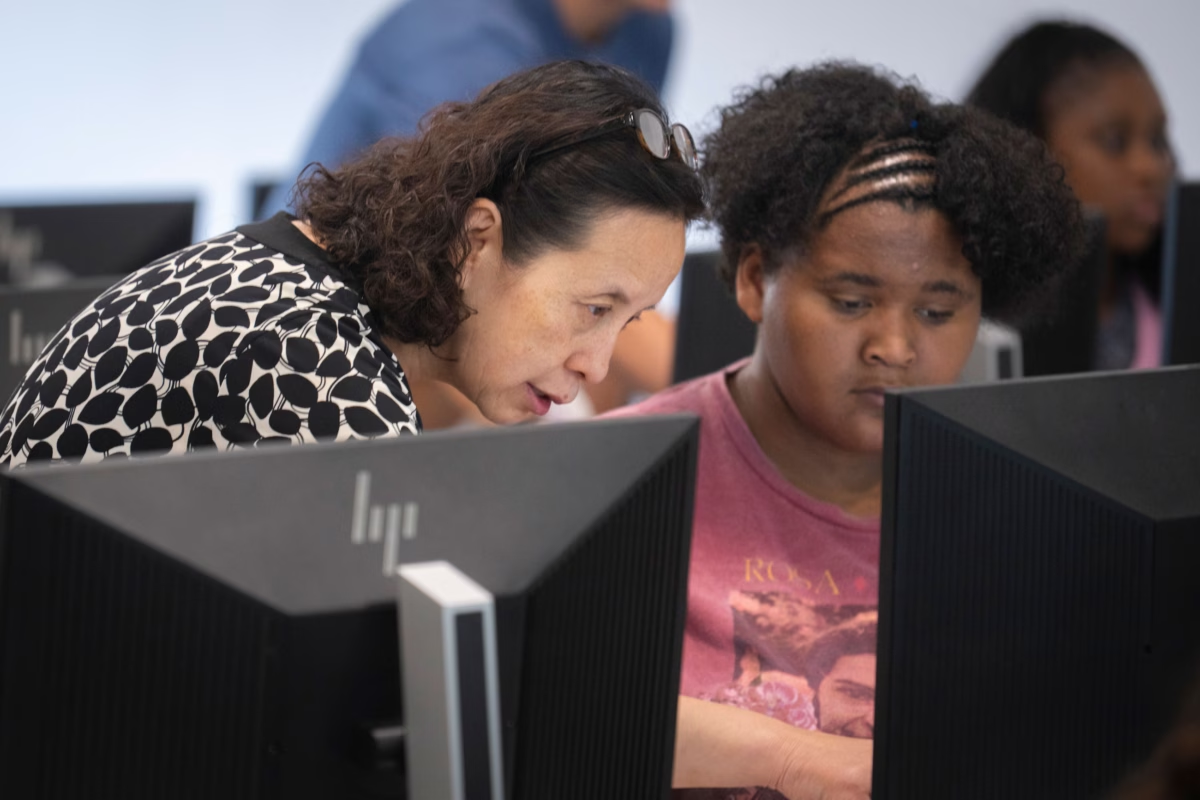
Faculty are seeking “to develop and test a holistic, sustainable model for undergraduate data science education, especially for smaller universities, where data science education can build on existing disciplinary strengths and collaborations,” says Han (above, with a Girls Inc. Eureka! participant). “We are particularly interested in how interdisciplinary collaboration, experiential learning, research, and partnerships beyond the university can reinforce one another.”
“By building across disciplines,” Ulm explains, “we hope to develop a model that strengthens students’ capacity in data science, helps prepare them to be more competitive in the workforce, and offers useful approaches for other institutions.”
The Clark-developed CROSSROADS model includes three approaches:
- Domain Exploration Modules — short, discipline-based learning experiences that use authentic data to investigate meaningful questions across fields.
- The Data Science Studio, through which undergraduate students develop their technical and professional skills, joining teams to work on open-ended projects with faculty, university offices, and external partners. Students may also receive funded fellowships to participate in a Data Science Studio that extends into the summer.
- Data Science Collaborative Workshops and the CROSSROADS Hub, which support broader engagement and exchange around data science. The workshops bring together faculty, students, educators, and external partners around data-related topics, questions, and practices, while the Hub provides a public space for sharing resources and supporting ongoing discussion.
The project started in 2025. In the first year, the faculty team launched the Data Science Studio, supported nine undergraduate fellows last summer, developed an initial set of discipline-specific modules, began community-facing programming, and established the CROSSROADS Hub.
Now in its second year, faculty are expanding implementation and assessment of the CROSSROADS model.
“The idea is to create an ecosystem where students can engage with data science at different levels through interesting, meaningful questions,” Han says. “Some students may encounter data science through a short experience in their own discipline, while others may move into a more sustained project, research, or fellowship opportunities. We want students to see how data science can connect with questions they care about.”
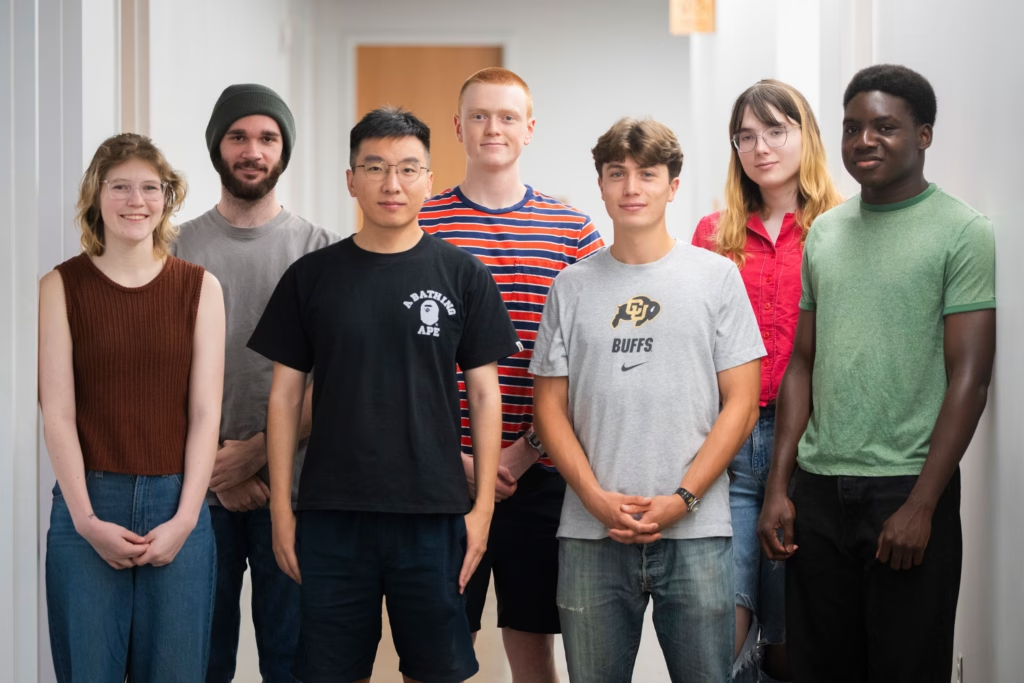
CROSSROADS team members
The CROSSROADS project involves a slew of faculty and students from across campus, as well as external partners.
Project leadership team and collaborators
- Li Han, principal investigator, and Terrasa Ulm, co-principal investigator.
- Ross Potter, principal data scientist: Leads the Data Science Studio, developed the ocean science module, and works on the development of several other Domain Exploration Modules. Those collaborating with Ross on various projects include:
- Lawrence Bolduc, university librarian: Development of faculty-focused workshops addressing bibliometrics, research analytics, and research landscapes.
- Karen Frey, professor of earth system science/geography: Research related to cryospheric-science research analytics.
- Katerine Bielaczyc, associate professor of education: As education and assessment specialist, Bielaczyc leads CROSSROADS’ education research, Institutional Research Board (IRB), and student-interview efforts.
- Division faculty leads who contributed to the CROSSROADS proposal; they now serve as senior personnel on the project:
- Arts lead: Matt Malsky, professor of visual and performing arts
- Business lead: Jing Zhang, dean of the Clark University School of Business
- Humanities lead: Eduard Arriaga-Arango, chair of the Department of Languages, Literature, and Culture
- Interdisciplinary programs lead: Lyndon Estes, professor of geography
- Sciences lead: Chuck Jakobsche, associate professor of chemistry
- Social sciences lead: Andrew Stewart, associate professor of psychology
Faculty involved with Domain Exploration Modules
- Elliott Epstein, assistant teaching professor in the Becker School of Design & Technology: Beginning discussions on development of a Domain Exploration Module.
- Peter Story, assistant professor of computer science: Developed, and refining, an initial Domain Exploration Module.
- Javier Tabima Restrepo, associate professor of biology: Completed several Domain Exploration Modules; developing additional modules.
- Catalin Veghes, visiting lecturer in computer science: Design and development of the CROSSROADS Hub and Domain Exploration Modules.
Faculty involved with Data Science Studio projects
- Nathan Ahlgren, associate professor of biology: Data Science Studio project on water-sample data organization and analysis.
- Elena Esposito, associate professor of psychology: Data Science Studio project involving data analysis for a mathematics learning game.
- Laurie Ross, associate provost and dean of the college, and Jennifer Safford-Farquharson of the Department of Sustainability and Social Justice and the Collaborative for Community Engagement: Data Science Studio project on Worcester youth data, with analysis and insights contributing to discussions at Worcester’s Governance Council on Children, Youth, and Families, and its Operations Team.
External partners
- Community Legal Aid of Worcester: CROSSROADS students are involved with an ongoing project to connect two organizational databases.
- Girls Inc. of Worcester: Last spring, CROSSROADS worked with CEO Tiffany Lillie on Data Science Studio projects. In the summer, CROSSROADS students held data workshops and “data chats” for Eureka!, a Girls Inc. STEM program, at Clark.
Students
Through the Data Science Studio, 10 students worked with faculty on projects last spring. Eight students are members of the studio this fall.
In addition, nine students received funded CROSSROADS fellowships to work on data science projects last summer. As indicated below, several are continuing to work on projects this fall, with one receiving a fellowship stipend.
The nine summer fellows include:
- Maxwell DiRienze ’27, computer science and interactive media double major. Last summer and this fall, DiRienze has worked for the CROSSROADS Hub and on a project with Community Legal Aid of Worcester. In addition to a summer fellowship, DiRienza also received a fellowship stipend this fall.
- Chloe Halverson ’26, M.S. ’27, data science and computer science double major; currently enrolled in the 4+1 Accelerated Master’s in Biology program.
- Summer: Worked on a movie data analysis module and data-science workshops for middle schoolers involved with Girls Inc. of Worcester and for incoming first-generation Clark students participating in ACE (Advancing Clark Excellence).
- Fall: Working on a water-sample data project as part of M.S. research, in collaboration with a Data Science Studio team.
- Jovana Jonic ’26, M.S. ’27, data science and biology double major; currently enrolled in the 4+1 Accelerated Master’s in Biology program.
- Summer: Developed biology modules.
- Fall: Developing additional biology modules as part of M.S. research.
- Henry Kuerbis ’26, M.S. ’27, data science and biology double major; currently enrolled in the 4+1 Accelerated Master’s in Biology program.
- Summer: Worked on a FIFA player analysis module and helped with Girls Inc. and ACE student workshops.
- Fall: Developing additional biology modules as part of M.S. research.
- Hadassah Ofosu-Amoani ’27, data science and geography double major. Last summer, served as a student assistant in Professor Lyndon Estes’ lab, working on a GIS research project.
- Cadence Shrader ’26, M.S. ’27, interactive media major. Last summer, worked on the CROSSROADS Hub.
- Christopher Siems ’26, M.S. ’27, data science and computer science double major. Last summer, worked as a research assistant on a psychology project studying online ideological spaces.
- Adriel Titus-Glover ’29, data science major. Last summer, worked on the CROSSROADS Hub.
- Branson Witt ’27, data science and mathematics double major.
- Summer: Research assistant on projects involving online ideological spaces (psychology) and higher-education student retention; in August, presented a CROSSROADS paper on higher-education student retention at a research conference in South Korea.
- Fall: As part of his data science honors project, Witt is expanding his machine-learning study of social media text.