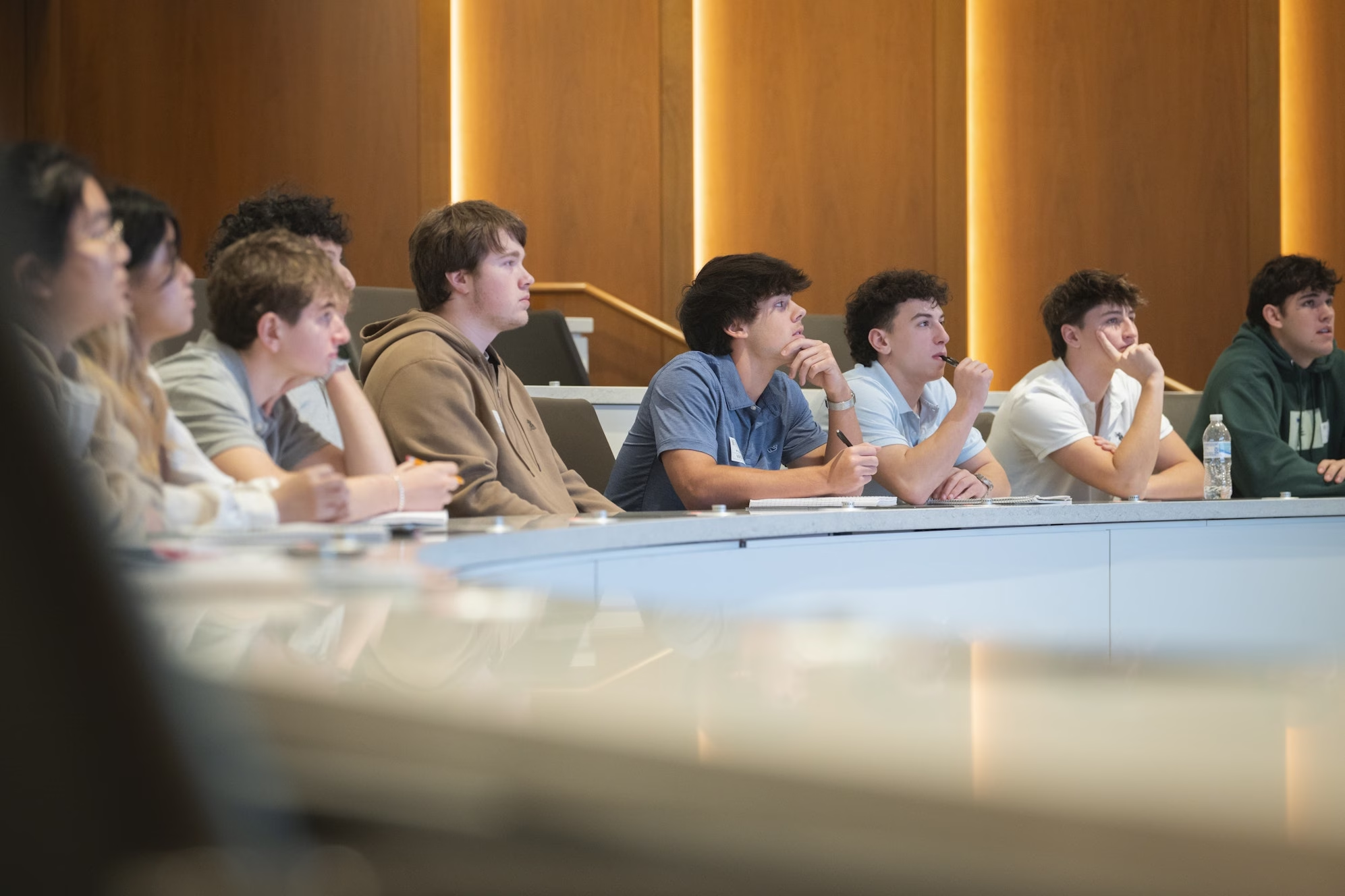

From puppets to video games and from coding data to microscopic organisms, roughly 100 students showcased research and creative projects at the fall 2026 edition of ClarkFEST on Wednesday, Oct. 28.
The biannual showcase highlights the academic and research excellence of Clark undergrads, as well as the faculty mentorship that made the projects possible. The event is sponsored by the office of the Dean of the College.
The biannual showcase highlights the academic and research excellence of Clark undergrads, as well as the faculty mentorship that made the projects possible. The event is sponsored by the office of the Dean of the College.
More than 200 students attended ClarkFEST to check out their peers’ posters, panel presentations, and displays.

“ Team Magica” is the current placeholder name for a rogue-like turn-based RPG project from a group of Becker School of Design & Technology students, including Louis Matos ’27. “You play as a team of magical girls, and you’re trying to defeat these random enemies and witches and save the galaxy,” Matos explains.
The team has created concept art and the game’s combat system is working.
“The most exciting part for me has been seeing my idea come to life and my team work so hard with me on making it a reality,” says Matos. “I feel like we’ve gotten so far in the short time that we’ve been working on it.”
“Have you ever opened a TikTok for a break and found yourself losing track of time?” asks computer science major Ayana Syuy ’28. Most people know that experience well. Syuy is exploring how infinite-scrolling interface design exploits cognitive biases. She is studying how these so-called “dark patterns” in social media affect students’ mood, productivity, and sense of control. For this project, six Clark students completed a baseline survey, a 10-day mood diary, exported six months’ worth of data from TikTok, and will do a follow-up interview.

“The first finding is that scrolling did impact mood significantly, and positively, when it interrupted a task. The most rewarding sessions were essentially the most costly ones,” she says. “The second finding is that habit, stress relief, and boredom were top triggers for users to even open the platform.”
Nick Darby ’29, a data science and finance major, took images of local pond water samples collected by the Worcester Cyanobacteria Monitoring Collaborative, which are used by Clark biology students, and created a searchable and labelable dataset that can be used by scientists or a machine learning algorithm.

“I’m building something that will help people in the real world. When I give this back to the biology department and we start labeling everything, it’s actually going to make a change,” he says. “I’m making something real.”
Sarina Talerico ’27 and Solan Homestead ’27, computer science majors and recipients of an inaugural Clark AI Innovation Grant, showed off a prototype for an artificial intelligence trash sorting system, for which they 3D printed parts in the Lux Lab.

The pair are training a machine learning model to determine whether waste belongs in a landfill or with the recycling. A camera will review each piece of waste placed on plate on a trash bin and dump the item into the correct receptacle. Weight sensors will help determine where the waste belongs, they explained. Their model makes a first classification, and then AI seconds it.
“We ran into a lot of issues because it was our first time doing a lot of these things. It was my first time working with weight sensors,” says Talerico. Homestead adds, “Electronics are funky. Code is funky. Things happen, but it’s fun overall.”
As part of her capstone project for Intimate Relationships, a course with Psychology Professor Michael Bamberg, Antonia Schneider ’28 is researching the current cultural phenomenon of the “trad wife,” or “traditional wife.” Schneider, a psychology major and Asian studies minor, became interested in the topic when she noticed a trend on social media: “Young women wanting to become housewives at a very, very young age,” she says.

These “trad wife” influencers have eschewed professional careers outside the home and built a following on social media, depicting a “blissful” — yet financially successful — life of baking bread, raising children, and serving their husbands, according to Schneider.
“I wanted to see how women position their agency in their romantic relationships, specifically traditionalist women,” she explains.
Learn more about what it’s like to be a student here.


Photos in above gallery by Ismael De La Cruz ’27


Photos by University Photographer Steven King and Ismael De La Cruz ’27