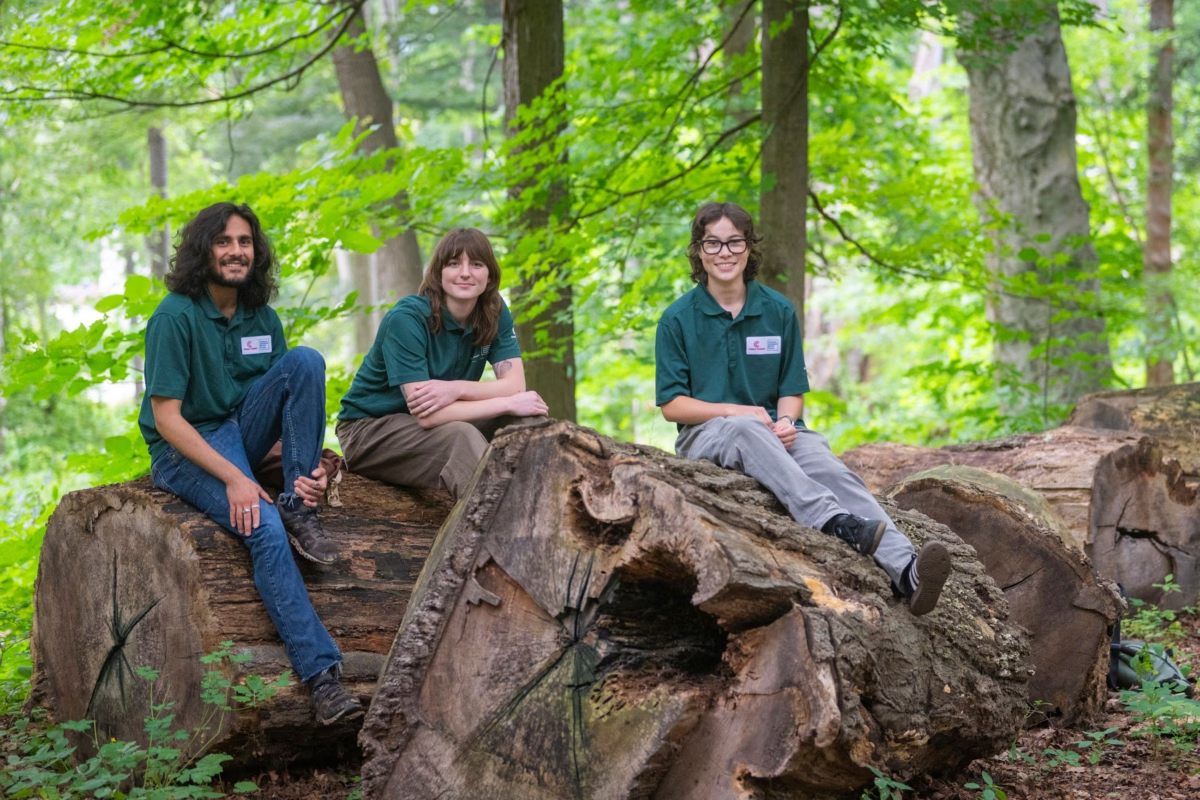
Three students from Clark’s School of Climate, Environment, and Society emerged from their months-long AmeriCorps/Campus Compact EnviroCorps experience with hands-on skills, job experience, and a new appreciation for community-based environmental work.
“I’ve learned from this experience that there are other like-minded people out there who care as much as I do about environmental preservation and conservation,” says Alexa McPherson ’26, MPA ’27 (above, right).
Along with Emily Wells ’25, M.S.-ES&P ’26 (center), and Humza Musharraf ’26 (left), McPherson spent the spring and summer leading environmental education programs — a key part of the federal program’s mission — and helping establish a 2,000-square-foot Miyawaki “pocket forest” in Attleboro, a city of nearly 47,000 people in southeastern Massachusetts.
They also contributed to the ongoing restoration of Clark University’s 26-acre Hadwen Arboretum, working with their mentor, Geography Professor John Rogan, and three other students — Owen Chase ’26, Abby Cooney ’27, and Jamie Young ’27.
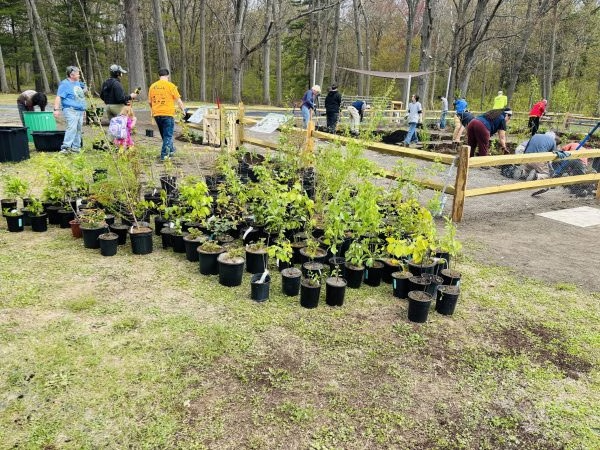
In Attleboro, the six students and Rogan joined 80 to 90 community members in May and June to plant a climate-resilient Miyawaki forest on a former baseball field behind the school.
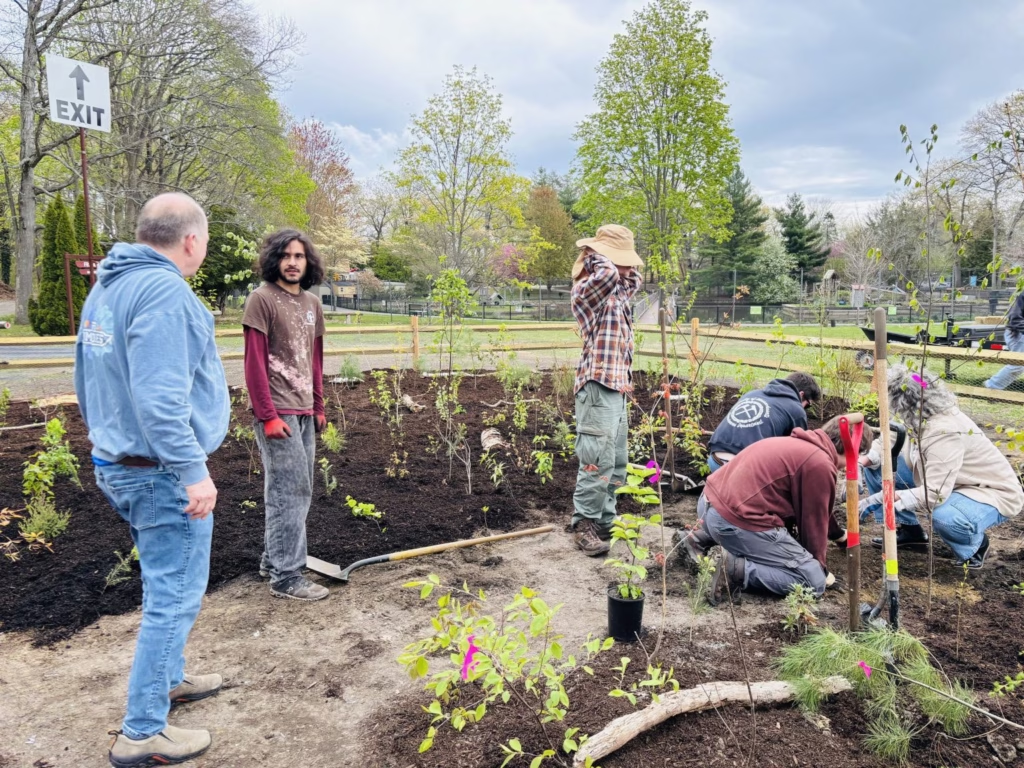
Named for Japanese botanist Akira Miyawaki, the densely packed “pocket forests” can help “mitigate flooding, reduce stormwater damage, and increase drought resilience by … deepening soils that absorb and hold water — about 10 times that of a stand of a single tree species,” according to the Ocean River Institute, the Cambridge, Mass., environmental education nonprofit that worked with the Attleboro Parks and Forestry Department and community members to raise funds for the project.
Institute Director Rob Moir contacted Rogan after hearing about his forest restoration efforts, including fielding a team of Clark students to plant two Miyawaki forests in Worcester in 2025.
“Many cities are longing for public participation and involvement,” Rogan told WBUR, which highlighted the Attleboro, Worcester, and other Miyawaki forests in June. “Any type of greenery is better than none.”
For the three Clark-AmeriCorps students, the Attleboro project proved the power of community-based environmental work.
“It was really amazing to see all these organizations focused on protecting nature, educating the public, and creating spaces for people to enjoy,” McPherson says.
Attleboro’s Miyawaki forest includes 350 native trees and shrubs packed into an area the size of six parking spaces. McPherson, Musharraf, and Wells helped identify species and prepare the planting site, held environmental education workshops for Attleboro High School students before planting began, and served as scientific resources during the volunteer events.
“What struck me most about the weekend project was not just the method but the people,” Moir wrote in a WBUR commentary celebrating the project’s environmental impacts and community-building. “High school students worked alongside college volunteers and local residents. Saplings were carefully dug from nearby woods, their roots kept intact with native soil. Compost tea was used to support microbial life, and logs rich with fungi were placed among the plantings. Every step reflected an understanding that building a forest is as much about relationships as it is about trees.
“That feels like an important lesson at a time when climate change can seem overwhelming in scale.”
Besides the Attleboro project, the Clark-AmeriCorps students taught sixth graders at The Rashi School in Dedham, Mass., about biodiversity, soil science, and native plants, and developed citizen-science projects that will engage the public in monitoring climate change.
In Clark’s Hadwen Arboretum, much of their work focused on managing invasive species, including burning bush, bittersweet, and tree-of-heaven.
As part of his capstone project with Sustainability and Social Justice Professor Morgan Ruelle and his AmeriCorps work, Musharraf designed the Hadwen Arboretum Phenology Trail. Part of the National Phenology Network, the arboretum’s Phenology Trail uses QR codes to track seasonal changes in trees and other plants.
“Seeing my project through to its conclusion has been really valuable,” the environmental science and policy major says. Now living in Chicago, Musharraf plans to pursue opportunities in ecological restoration. “Working on invasive species management has been really valuable preparing me for ecological restoration,” he adds.
Wells, who plans to pursue field-based conservation work with land trusts or other organizations focused on ecological restoration and stewardship, said her AmeriCorps experience helped connect her with those already working in the field. Her other experience this year included working as a part-time farmers market coordinator for the Regional Environmental Council, overseeing the Beaver Brook and University Park farmers markets in Worcester.
“The networking and hands-on conservation experience have been the two biggest highlights for me,” says Wells, a who majored in biology and international development and social change as an undergraduate and graduated from Clark’s 4+1 Accelerated Master’s Program in Environmental Science and Policy. “It’s been really cool getting to form connections with a bunch of different people through our AmeriCorps projects.”
McPherson, who majored in political science and minored in global environmental studies, first thought she would pursue a career in environmental policy. But through her AmeriCorps experience, she discovered that she prefers hands-on conservation and stewardship. After obtaining her MPA through Clark’s 4+1 Accelerated Master’s Program next year, she hopes to work for a land trust or similar conservation organization.
“I’ve definitely gotten better at seeing each problem as having its own unique solution that creates opportunities,” she says of her AmeriCorps experience.