In 1857, Frederick Douglass stood on the stage of the newly opened Mechanics Hall in Worcester and delivered an address in which he spoke about the immorality of slavery, the Dred Scott decision that denied citizenship to Black people in the U.S, and the emancipation of the West Indies in 1838. The Civil War was four years away, the Emancipation Proclamation six years, and it would be eight years until Union soldiers reached Galveston, Texas, to free the last remaining enslaved people in the country, a day now celebrated on June 19 as Juneteenth.
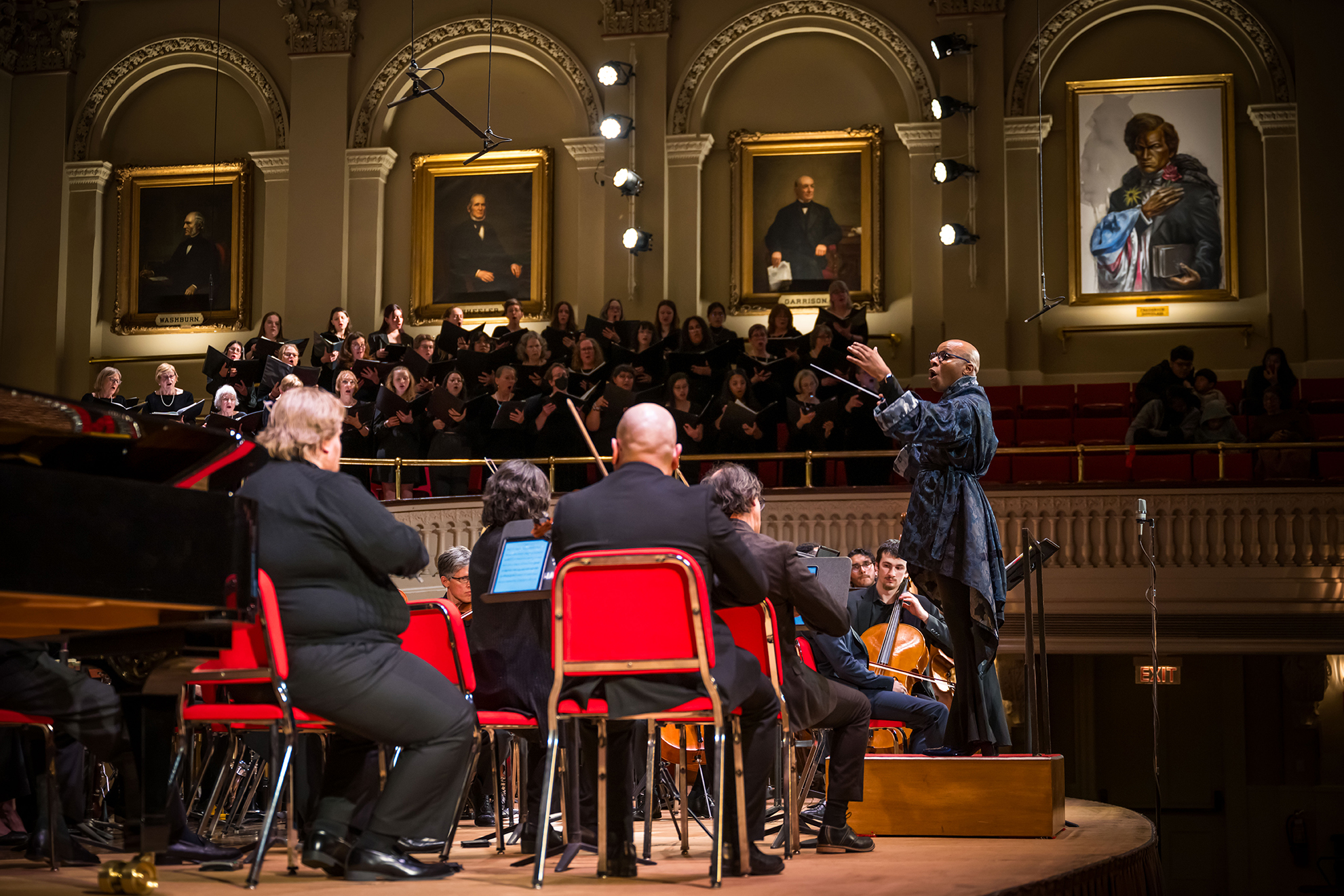
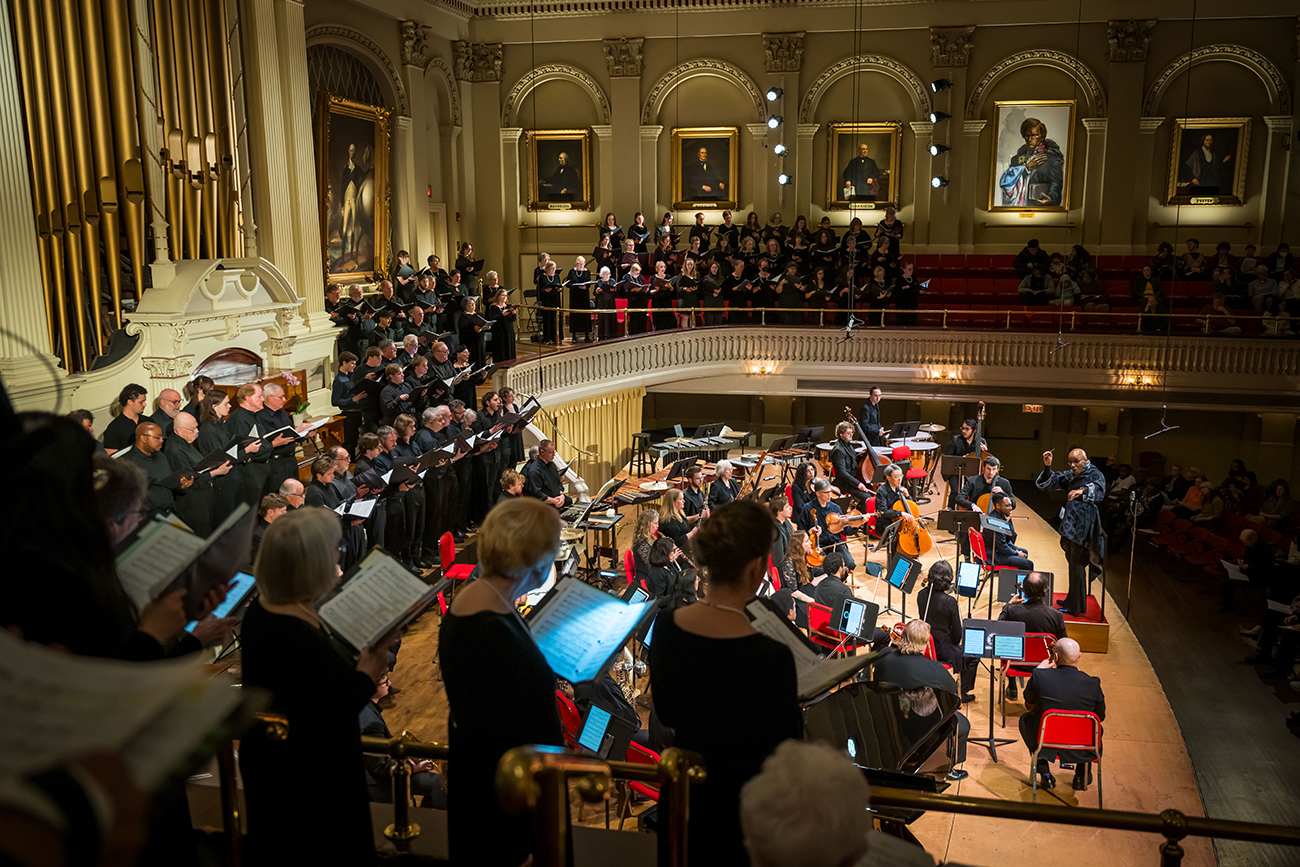
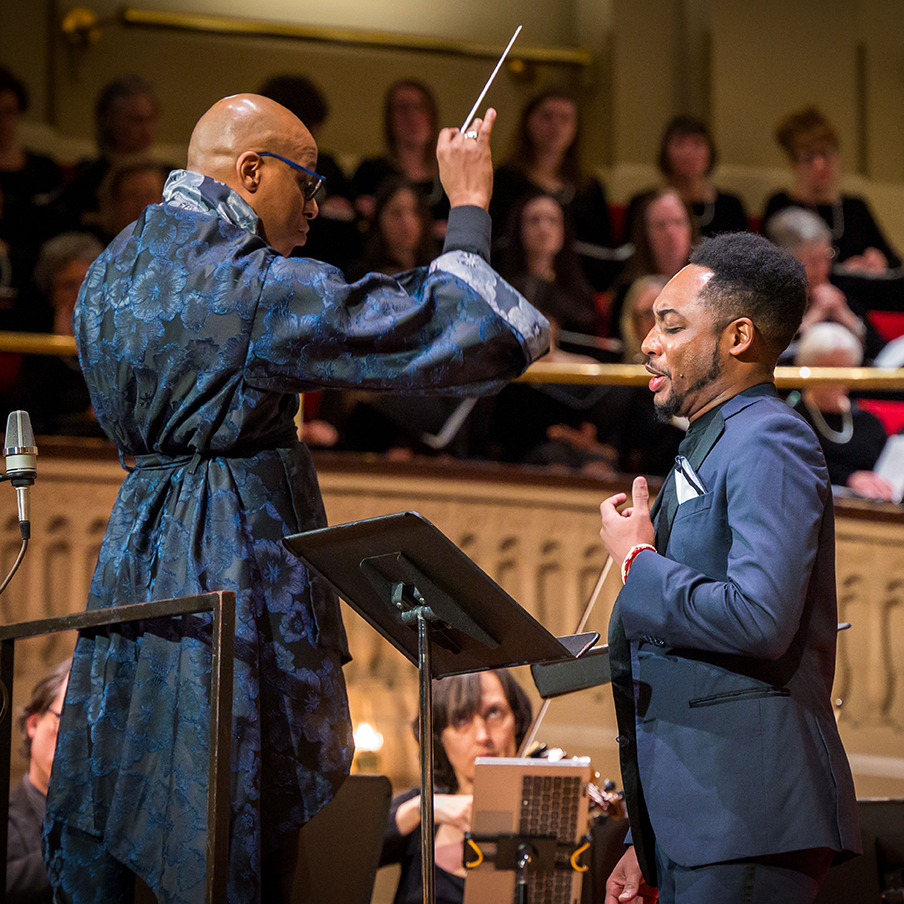
One hundred sixty-nine years after Douglass’ words rang out, they were revived on the Mechanics Hall stage, this time set to music. “Frederick: A Cantata on the Life of Frederick Douglass” had its world premiere on April 25, conducted by Cailin Marcel Manson, director of music performance at Clark, and featuring a chorus that included the Clark University Choir. Manson discussed the work on a Zoom call from Cesenatico, Italy, where he is leading Opera al Mare, a young artists program of Opera Vermont, of which he is music director.
“Worcester was a pretty significant place in the story of Frederick Douglass,” Manson says. The famed abolitionist and author first spoke in Worcester in 1841, at around 23 years old, three years after escaping from his enslavers in Maryland and making his way to New York disguised as a sailor. Douglass eventually lived in New Bedford and Lynn, Massachusetts, and Rochester, New York, as well as in the United Kingdom for several years after the publication of his first autobiography in 1845, when he was still considered a fugitive.
Douglass’ connection to the city was recognized in 2024 as part of the Mechanics Hall Portrait Project, which commissioned portraits of prominent Black Americans to join those already hanging in the Great Hall (Clark Professor Toby Sisson served on the selection panel). Douglass was chosen along with Sojourner Truth, who did extensive advocacy work in Worcester, and William and Martha (Tulip) Brown, Worcester business owners, community leaders, and activists involved with the Underground Railroad. The city was a major “stop” and a sanctuary city for those escaping slavery.
It was not lost on Manson that “Frederick” was performed under the watchful eye of artist Imo Nse Imeh’s portrait of Douglass. “He was just over my right shoulder the whole time,” Manson says. But more poignantly, the audience included many of Douglass’ descendants.
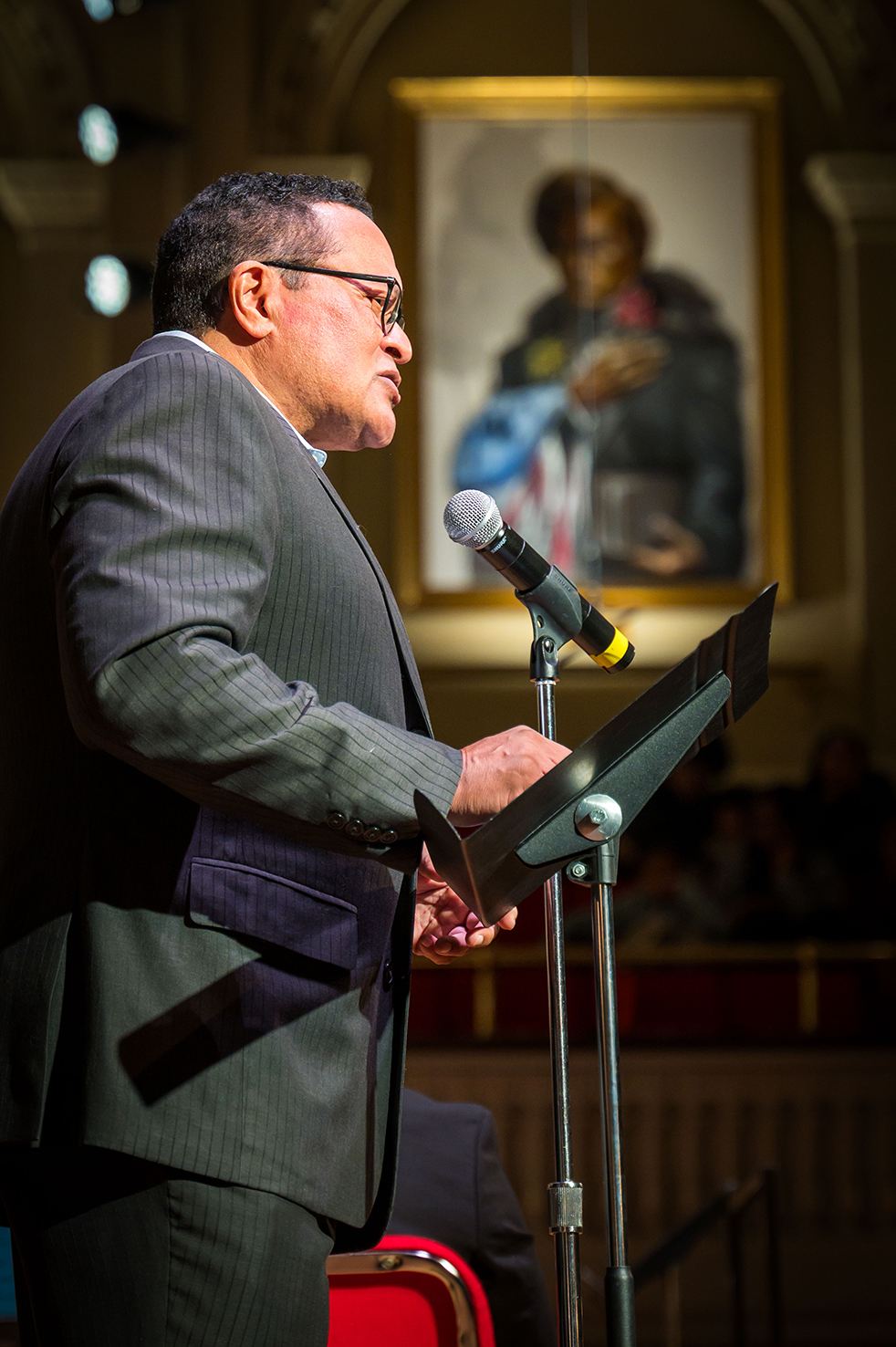
Kenneth Morris Jr. — who is descended from both Frederick Douglass and Booker T. Washington, founder of the Tuskegee Institute (now Tuskegee University) and at one time the most famous Black man in the country — addressed the audience before the performance. “He set us up perfectly,” Manson says. “It was emotional because the work humanizes Frederick, and because so many of his descendants were there.”
“The piece is pretty epic in scale,” Manson says. Composer Brian Story — who died suddenly just days after completing the cantata — was inspired to write it after performing, as a member of the Worcester Chorus, in a concert Manson conducted at Mechanics Hall in 2023. The opera program had also featured selections from “Songs of Harriet Tubman,” a song cycle set to the words of the formerly enslaved woman and social activist.
In “Frederick,” Story didn’t shy away from dark and “heavy” moments, Manson notes, even incorporating the sounds of chains and whips into the music. “At the end of a movement, Frederick says that once he learned to read, he was determined to be free, and the last sound is a chain dropping to the floor. And the crack of the whip punctuated Frederick’s description of slavery as ‘one of the great diseases of the country.’”
On July 5, 1852, Douglass gave arguably his most famous speech, “What to the Slave is the Fourth of July?,” in which he called out the irony of white Americans celebrating their freedom while keeping millions of people in bondage. Celebrating Juneteenth, Manson says, is an answer to that speech. Americans may recognize July 4, 1776, as the first Independence Day, but for Black people, independence came much later: when the last enslaved people were freed on June 19, 1865.
“When we started rehearsing ‘Frederick,’ I told the Clarkies, ‘We are in a time that seems unprecedented, where everything seems volatile,’” Manson says. “‘But we are remembering one of our greatest and best, and his words are still challenging us to be better.”
One of the most poignant stories in Douglass’ life, Manson says, is that when he was enslaved, the wife of his “master” saw how smart he was and started to teach him how to read. When her husband found out, the lessons stopped, but Douglass continued to learn on his own.
“He struggled,” Manson says. “He defied death at times. But he could not not speak the truth. He held a mirror to society for its ills, because fundamentally, he believed it could be better.”
Douglass didn’t confine his advocacy to fighting for equality for Black Americans. He was also heavily involved in the women’s suffrage movement and even spoke at the first National Women’s Rights Convention — held in Worcester in 1850.
In 1847, Douglass founded an abolitionist newspaper, The North Star. Its motto was “Right is of no sex. Truth is of no color. God is the Father of us all, and we are all brethren.” He believed that every law should be applied equally to every person, regardless of gender or color.
“I don’t know if many of my students in the choir would have read this much Frederick Douglass had they not done this,” Manson says of the concert. “The arts do more than introduce students to great ideas and great literature. They have to inhabit those ideas,” even if they are unsavory and from long ago. “We’re not always OK with everything we sing, but we have to wrap our minds around it, get our hearts in a place where we can acknowledge what it is and how we are different from its viewpoint, and engage with it. That process is invaluable.”
Music is a major part of African American culture and began as — and in many cultures still is — a communal experience, particularly during celebrations like Juneteenth, Manson says. “People come together and make sound together. There is always music because it is a fundamental part of gathering and celebrating. Music is what connects us to each other.”