Video, exhibit recall Clark’s storied rock ’n’ roll history
Throughout rock ’n’ roll history, playing in certain venues meant that a performer had made it.
Woodstock.
Madison Square Garden.
The Hollywood Bowl.
Atwood Hall.
Wait … Atwood Hall? At Clark University? That Atwood Hall?
One and the same.
The artists who performed in the venerable auditorium, and on other campus stages, form a compendium of rock royalty that is rare for a school of Clark’s size. Some arrived at Clark as established stars — Jimi Hendrix, The Grateful Dead, Janis Joplin — while others were in the early stages of their ascent—Bruce Springsteen, The Talking Heads, The Cars. Beginning in the late 1960s and into the ’90s, Atwood was a common stop for bands on their way to play gigs in Boston or New York: a quick stop in central Massachusetts to perform for some college kids, test the limits of the sound system, earn a few bucks, and move on to the next show.
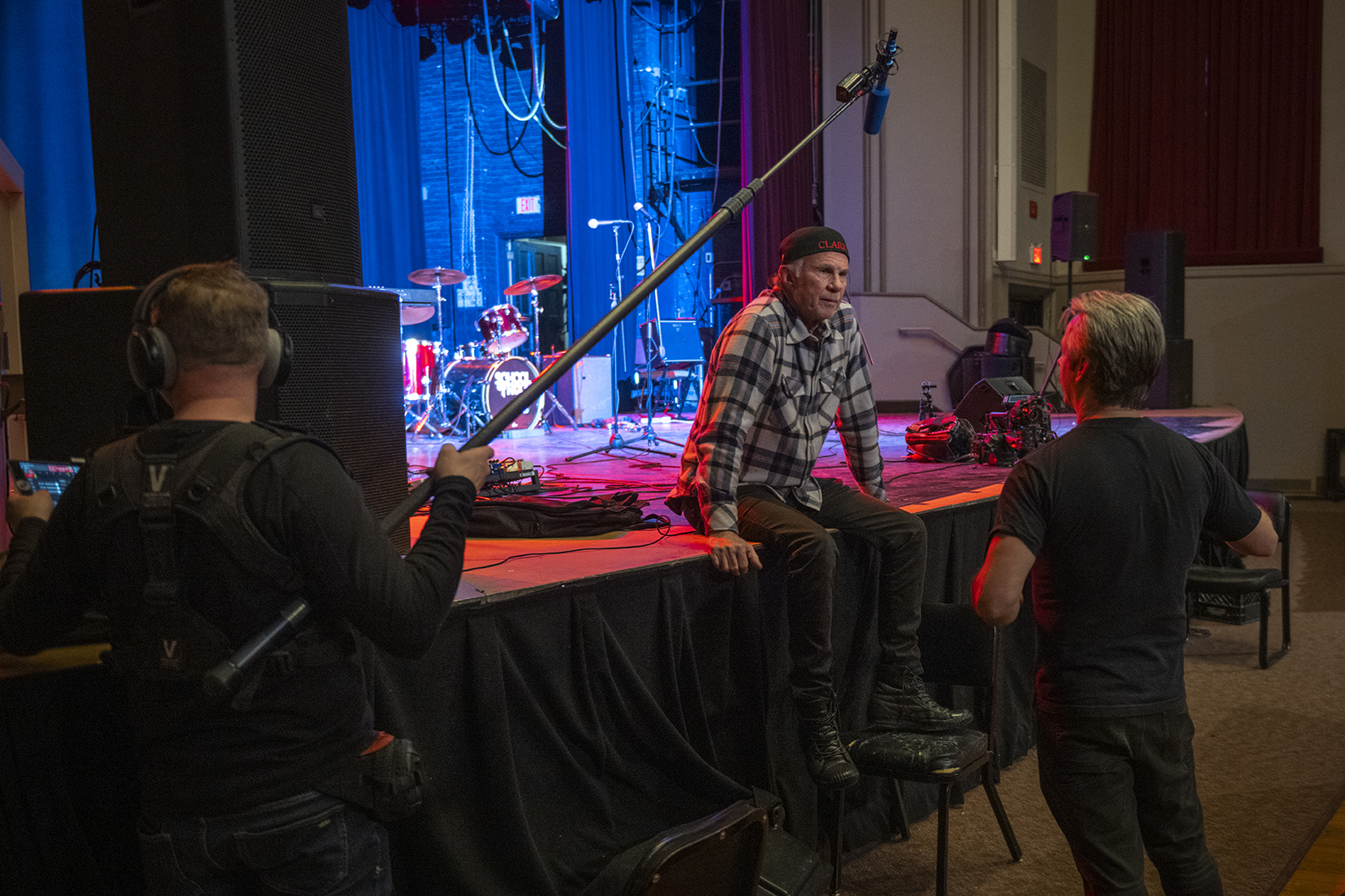
These memorable concerts have been memorialized in a new video, “Echoes of Atwood Hall,” and exhibition (see sidebar) thanks to the generosity of Clark Trustee Nancy Mack, P ’27, and her husband, Chad Smith, P ’27, the drummer for the Red Hot Chili Peppers (shown above, being interviewed in Atwood Hall).
“Music gives young people identity, connection, and hope,” Mack and Smith said. “The story of Atwood Hall is proof that a small university can become a cultural landmark when it opens its doors to creativity, risk-taking, and live music. We wanted to capture that spirit — the idea that art can happen anywhere and leave a lasting impact for decades.”
Through interviews and vintage clips, “Echoes of Atwood Hall” recalls some of the big-name artists who filled the Clark nights with musical magic and crafted a legacy that still resonates across the campus. Bob Echter ’69, who as chair of the Social Affairs Board was responsible for bringing Hendrix, Chuck Berry, and James Brown to the Atwood stage, notes that “we had concerts here because of love, a sense of home, a sense of family. People wanted to be together and be a community.”
And they liked things loud. Echter remembers the Grateful Dead blowing out the power, necessitating the rewiring of Atwood so they could perform a second show. Hendrix played back-to-back shows, earning $2,500 and $1,500. A year later, he would be the highest-paid act at Woodstock, earning $18,000.
The student-run Social Affairs Board and, later, the Pub Entertainment Committee, have been an influential cultural force at Clark, its members given great leeway to book musical acts.
“The autonomy was really incredible,” recalls Jodi Holman ’85 in the video. “That was amazing learning, to have that freedom and that trust at such a young age.”
The video includes alumni from across the generations who, as students, booked the likes of Ray Charles, Bonnie Raitt, Phish, Blues Traveler, James Taylor, and The Cars, who Dan Portnoy ’79 remembers, had just cut their first album and were still relatively unknown. “By the time they played for us they were going for 20 or 30 times the price,” he says.
“You know, when you had a full room, it was like, ‘Yes, kids are here. They’re having a great time. This is what it’s all about,” says Larry Webman ’92, whose experience of negotiating deals for bands to play at Clark served as a springboard into a career representing some of the most popular artists in rock and pop.
In his interview, Smith describes Atwood as a “jumping-off place.”
“If you get a chance to come in here, you’re gonna bring it — you gotta bring it,” he says. “And in the future, the kids that come here know that here is a place where really cool stuff happened.”