-
Exploring the Trends, the Science, and the Options of Buffer Management in the Great Bay Watershed
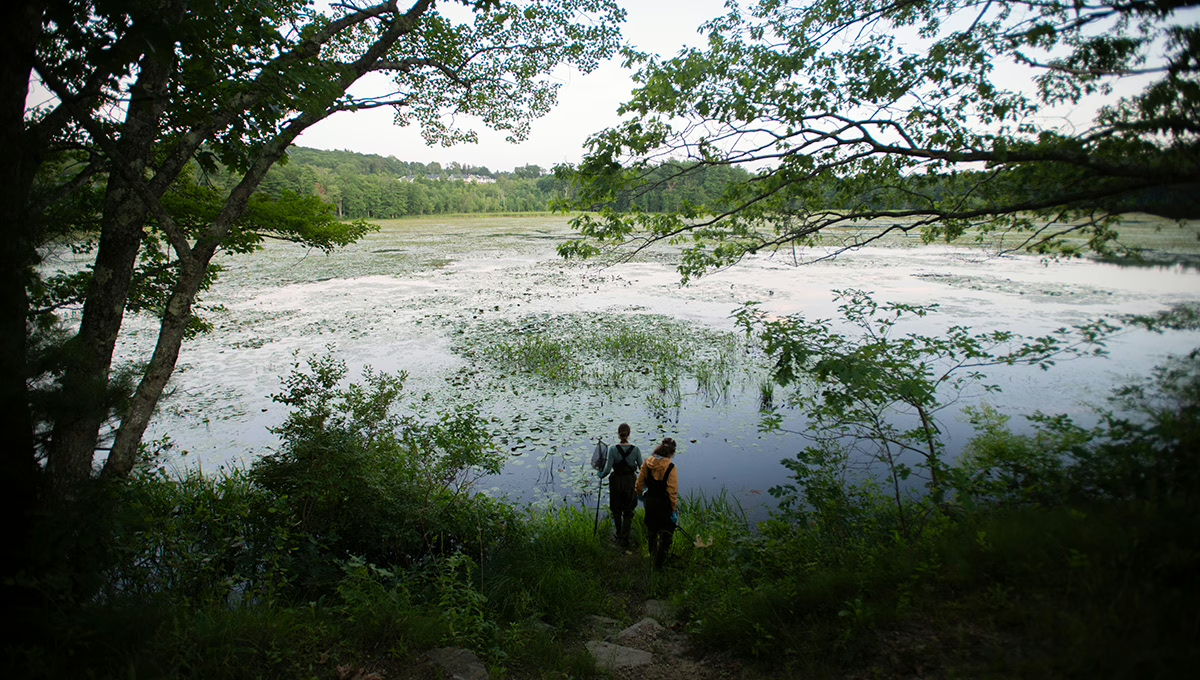
The US EPA recently designated New Hampshire’s Great Bay Estuary (GBE) as an impaired waterbody, which exhibits classic symptoms of nitrogen pollution. Sixty-eight percent of this nitrogen load originates from nonpoint sources including stormwater runoff, fertilizers, and septic systems—all of which could be mitigated through the coordinated use of buffer zones in the GBE region.…
-
Applied Science to Catalyze Natural Climate Solutions
Climate change is a global problem and limiting global warming below the 2°C threshold set by the Paris Climate Agreement will require both reductions in new greenhouse gas emissions and removal of existing gases from the atmosphere. Natural Climate Solutions (NCS) is a portfolio of conservation, restoration, and improved land management actions that increase carbon…
-
SCI Climate Science
The Nature Conservancy’s (TNC) Climate Science team uses climate information and climate risk assessments to inform and support conservation and adaptation planning that promotes resilience for people and nature. To help this effort succeed, global maps that enable consistent avoided forest conversion carbon accounting are needed. Avoided forest conversion offers the second highest climate mitigation…
-
Applied Science to Catalyze Natural Climate Solutions
Climate change is a global problem that will require both reductions in new greenhouse gas emissions and removal of existing gases from the atmosphere. This project’s aim is to provide the data and decision support tools needed for quantifying the albedo component of assessments evaluating climate change mitigation opportunities from reforestation and agroforestry, avoided deforestation,…
-
Avoided Deforestation as a Climate Opportunity in the U.S.
Forests are a globally-significant store of carbon, but this store is vulnerable to release from disturbance processes such as harvesting or fires that contribute to global warming. At the same time, intact forests serve as a major offset to rising CO2 concentrations as forest growth becomes stimulated by rising CO2 levels, enabling forests to absorb…
Clark University

Contact information
George Perkins Marsh Institute
Office location
Mailing Address:
950 Main Street
Worcester, MA 01610-1477
Visiting address:
Sackler Sciences Center
Rooms 342 – 350
1-508-751-4622
1-508-751-4600 FAX
Be a force for change.
Come study at a small research university with a strong liberal arts core.
- Undergraduate
- Graduate
Still curious? Request more information.

Invest in the next generation of Clarkies.