
Degree programs designed to address critical global challenges
With an integrative, challenge-centered curriculum and opportunities for community-led collaboration, the Department of Sustainability and Social Justice offers a unique educational space for future leaders, researchers, practitioners, and policymakers.
Learning outcomes
Our graduate and undergraduate degrees ground students in interdisciplinary academics and professional practice and promote four learning outcomes:
- Work across intellectual, professional, individual, and cultural differences.
- Understand and address complex social-ecological challenges, transforming institutions and systems to produce more socially just, climate-responsive, and sustainable outcomes.
- Act effectively in uncertain and unstable contexts.
- Communicate, facilitate, collaborate, and co-create with a diverse range of stakeholders: communities impacted by social and environmental problems, not-for-profit organizations, government agencies and policymakers, donors, and businesses.
Undergraduate majors

4+1 Accelerated Master’s
Gain the edge by earning a pathway to a master’s degree — with one year of additional study and available tuition scholarships.
Community Development & Planning, B.A.| M.A.
Peace Corps Prep Program
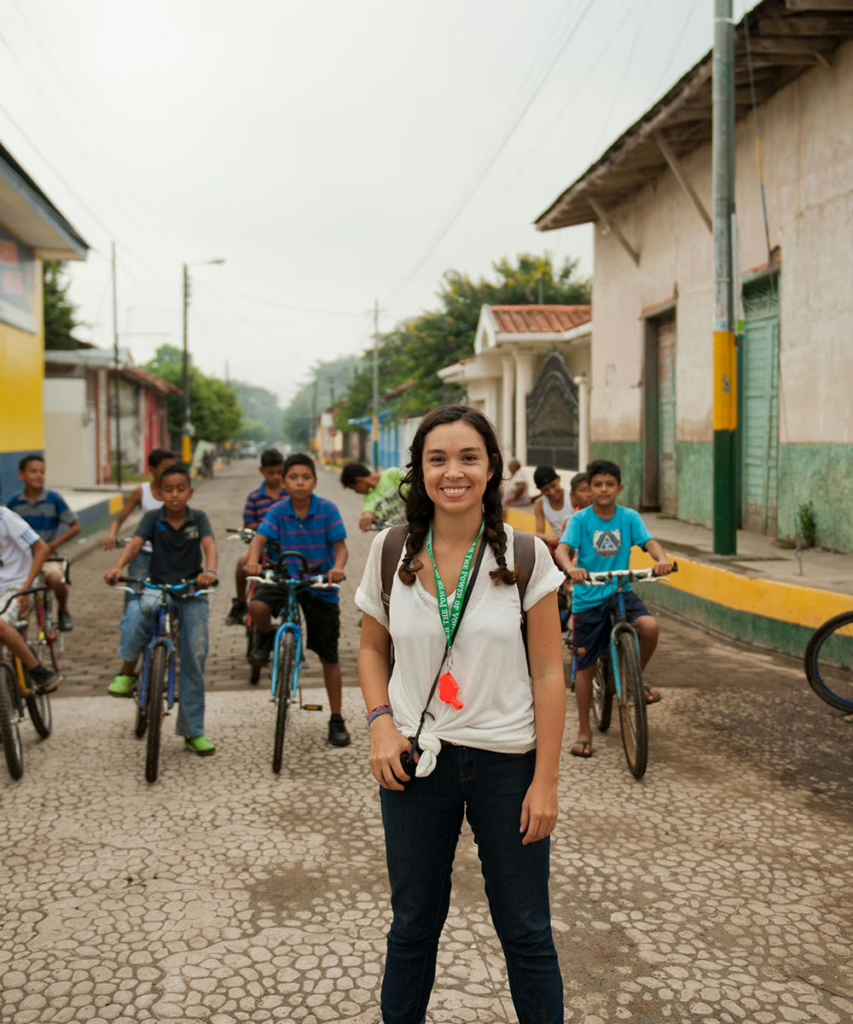
Open to all Clark University undergraduate students with any major, including international students, the program combines carefully selected courses with intercultural experience and community-based project learning to help prepare you for global service work. This gives you a competitive edge if you apply to be a Peace Corps volunteer, but also provides skills that are valuable in broad range of international development roles.
Graduate degrees
Graduate certificate programs
Monitoring and Evaluation
Design monitoring and evaluation systems for organizational learning and policy development. Students will learn to work across a range of programmatic areas, including youth work, food systems, climate change impacts and adaptation, water stress, pollution and health risks, refugees and forced migration work, and natural resource management.
Refugees, Forced Migration, and Belonging
Gain an understanding of forced displacement and migration issues, taking into account the complex social, political, economic, cultural, environmental, and technological factors shaping population movement and integration in our societies.
Youth Work Practice
Learn the ethos, knowledge, and approaches needed to build trust-centered, authentic, mutually respectful relationships with young people, as well as how to design and manage youth development programs.
Graduate fellowships and scholarships
Clark University master’s degree programs award generous merit-based scholarships to U.S. and international students. Scholarships are available for returned Peace Corps Volunteers (RPCVs) and other service organizations. Fellowships also are available to work on grant-funded research projects.