‘Coach’s box’ to be dedicated in honor of longtime basketball coach/AD
Wally Halas ’73, MPA ’93 never settled for good when great was achievable.
As Clark’s legendary men’s basketball coach and athletic director, he led a campaign on the courts and fields to make Clark a force in New England and Division 3 athletics. From 1974 to 1987, he and his coaches recruited a succession of talented athletes to the Clark campus, and the results were historic. The men’s and women’s basketball teams each twice reached the NCAA Final Four. Regional and state titles were also won by soccer, softball, field hockey, volleyball and women’s and men’s tennis; All-New England and All-American honors were earned by individuals on those teams, as well as the swim, cross-country and track and field squads.
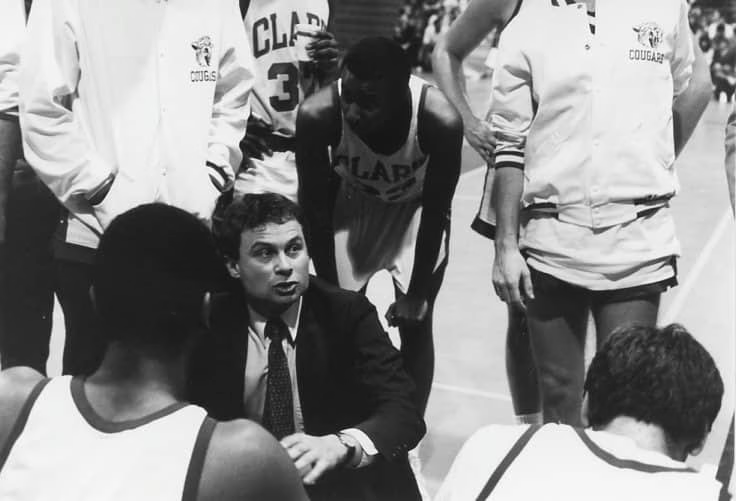
Athletic success came to Clark because Halas, who served as men’s basketball coach from 1974 to 1987 and athletic director from 1980 to 1987, wanted winning coaches and players and he figured out how to get them. Whether he was patrolling the sideline in the Kneller Athletic Center or overseeing an assertive recruitment campaign, one fact became eminently clear: nobody put Wally Halas in a box.
Until now.

This fall, Clark will honor Halas with the dedication in his name of the “coach’s box” — the 38-foot-long rectangular space painted on the basketball floor inside which the coach must stand during games. The NCAA mandated the coach’s box beginning in the 1984-85 season to prevent coaches from roaming too far along the sidelines, and straying beyond the boundaries can result in a technical foul. The Wally Halas Coach’s Box — which will be inscribed with his signature — will remind current and future Clark coaches that their terrain in the Kneller gym is not endless.
“I’m deeply honored and humbled to be recognized with the coach’s box,” Halas says. “It’s a uniquely Clark thing to do something slightly different than other schools, but a coach’s box is appropriate. In front of the bench is where the hard work gets done — it’s where you draw up a last-minute shot, and it’s where you celebrate success with your players and coaches after a big win.”
Halas notes with a laugh that the creation of the box was inspired by nomadic coaches like him, who roamed far and wide — sometimes a little too far and a little too wide — shouting out instructions, pointing out matchups, changing up defenses. “It was smart to establish the coach’s box,” he says. “We could do our work from inside there.”
Halas’ teams vigorously protected their home court. “We always took great pride in playing well at home; we didn’t want anyone beating us in the Kneller,” he recalls. His teams held to that pledge. From 1977 to 1987, Halas says, the men’s team went 108-8 inside the Kneller against Division 3 opponents.
Though he moved on from Clark to coach at Columbia and work in higher education development, currently as executive director for leadership gifts at Fairfield University, Halas has remained connected to his alma mater. Inducted into the Clark Athletics Hall of Fame in 1994, he’s attended HOF induction ceremonies, reunions and commencements, alumni games, and special events, and has remained a presence in the lives of his former players.
In addition to the coach’s box, a plaque will be installed in the Kneller that recognizes Halas’ accomplishments as athletic director, basketball coach (a record of 233-103 and 10 consecutive NCAA tournament appearances), baseball coach for seven years, and Clark student-athlete in baseball and basketball (1,448 career points).
Halas says the pursuit of excellence was universal at Clark “and I wanted to do my part to bring distinction to the University.” He credits his coaches and staff with creating a winning atmosphere, and a group of talented student-athletes with executing at a high level. This January, Halas organized a reunion of “my basketball family” of players and coaches from the 1970s and ’80s to reconnect and reminisce.
“It was an opportunity to let these guys know just how good they were, and to thank them for all the gifts they brought to my life,” he says. “We practiced hard on that court every day, and the coach’s box is a shared honor with all of them.”