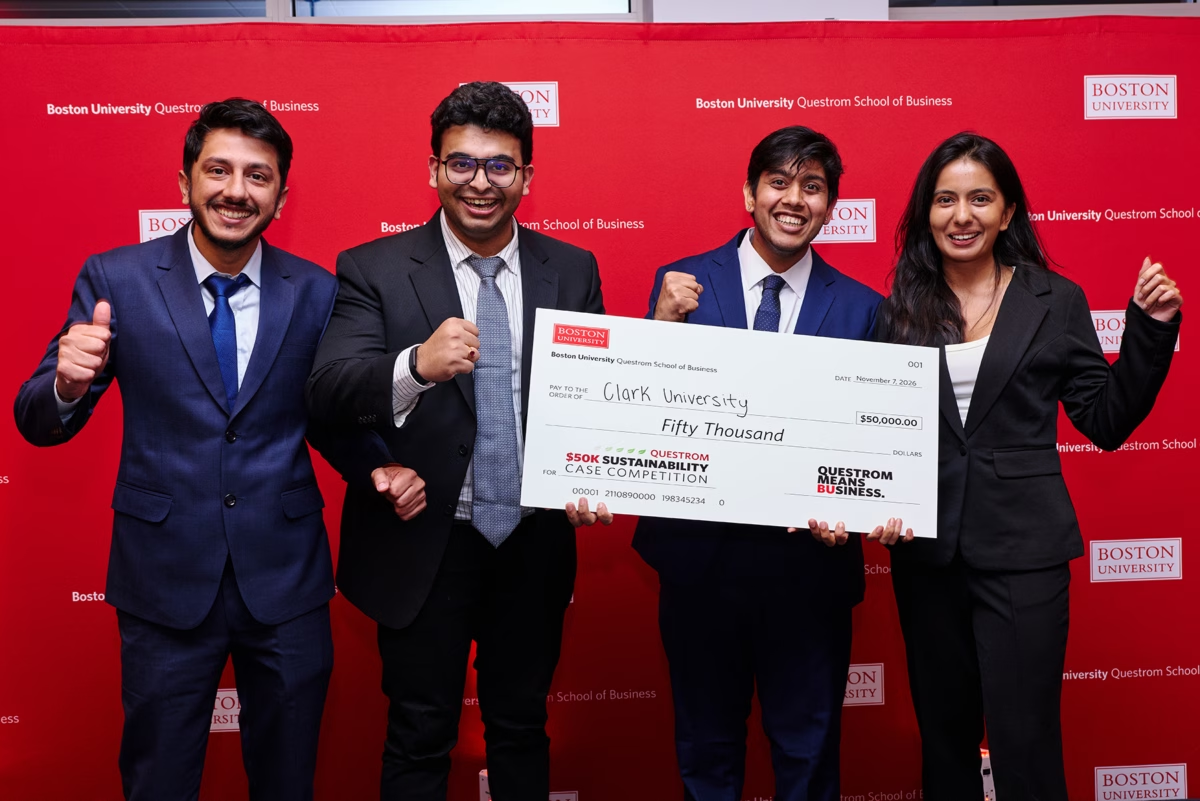
A team of four students from the Clark University School of Business (CUSB) took home the top spot at Boston University’s $50K Questrom Sustainability Case Competition, beating more than 30 teams in the final round and bringing national recognition to Clark.
The winning team brought together students from across Clark’s programs (above, left to right) Sahil Dadhwal, MBA ’27, concentrating in management information systems analytics; Aryadeep Ray ’27, a double major in finance and data science; Prajwal Balaji, MBA ’27, concentrating in finance; and Ojal Rayamahji, M.S. ’28, also studying finance.
The competition lasted two months and drew 300 students from more than 20 universities during its first round. After advancing to the second round, which took place at Boston University’s Questrom School of Business, the Clark team took four back-to-back rounds against 19 other teams, ultimately emerging as the winners.
A Smarter, More Sustainable Campus
The challenge centered on Schneider Electric, a global energy technology leader, and asked teams to develop a strategy for helping universities use smart-building technology and artificial intelligence (AI) to make campus operations more efficient, reliable, and sustainable. Teams also had to make the case why a university should choose Schneider Electric over its competitors.
The Clark students tackled a complex question: How can universities modernize their campuses when buildings, equipment, and energy needs vary so widely? Their solution focused on three priorities: introducing smart-building technology through a phased rollout, matching AI autonomy to the risks involved, and maximizing existing infrastructure rather than replacing it.
The team proposed starting with an assessment of campus energy use, followed by pilot projects in selected buildings before expanding across campus. They supported the recommendation with financial modeling and scenario analysis, showing how a phased approach could help manage costs and reduce risk. They also emphasized responsible AI implementation, with greater human oversight in sensitive environments such as research laboratories and medical facilities.
Finally, the team highlighted Schneider Electric’s ability to integrate with existing equipment and connect building and electrical systems, making the case for measurable sustainability improvements backed by practical implementation.
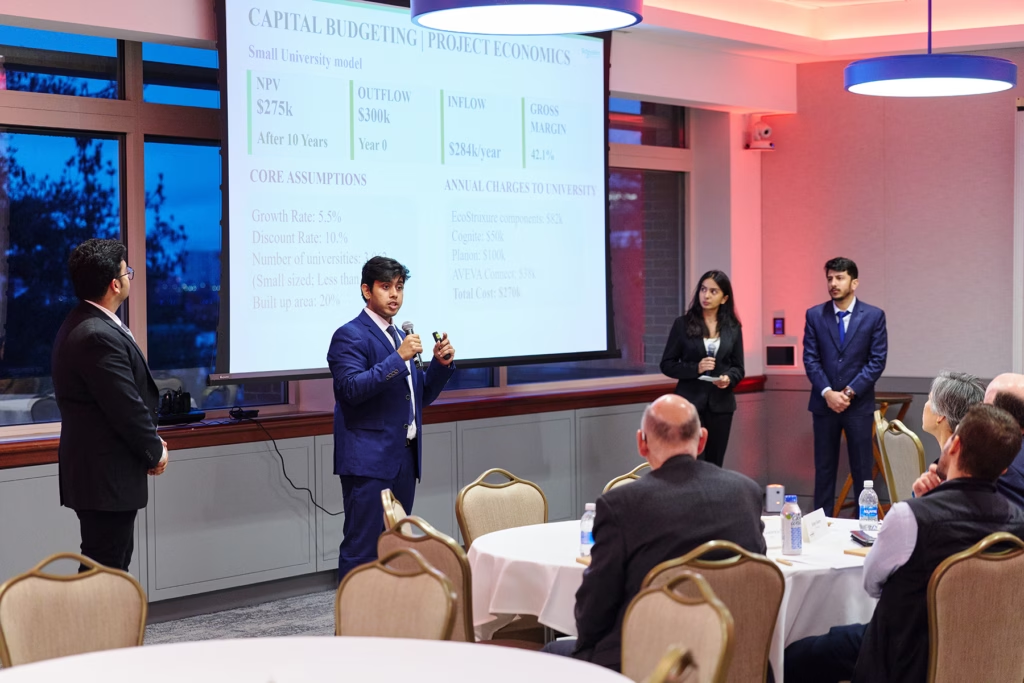
From Classroom Analysis to a Winning Strategy
The team credited Professor Alan Eisner with helping shape their presentation and sharpen their overall storyline. His guidance helped them turn extensive research and analysis into a clear, compelling recommendation — one supported by numbers and focused on the central business challenge.
For the students, the competition was a rewarding opportunity to bring together analytical thinking, financial modeling, and strategic problem-solving under a tight deadline. What began as an open-ended case became a complete recommendation, including a financial model, implementation roadmap, and competitive strategy.
“Winning the Questrom Sustainability Case Competition was a great experience for all of us,” Dadhwal said. “Working with people from different backgrounds helped us look at things from different perspectives, challenge our own ideas, and learn from each other. We also realized that sustainability is not just about protecting the environment. It’s about finding solutions that make financial sense and create a positive impact in the long run. Most importantly, it showed us what we can achieve when people with different ideas come together and work towards the same goal.”
Clark University’s School of Business offers undergraduate and graduate programs in fields such as accounting, finance, business analytics, and marketing. Through a combination of academic learning and practical experiences, students gain the skills and knowledge to succeed in a rapidly evolving business world.