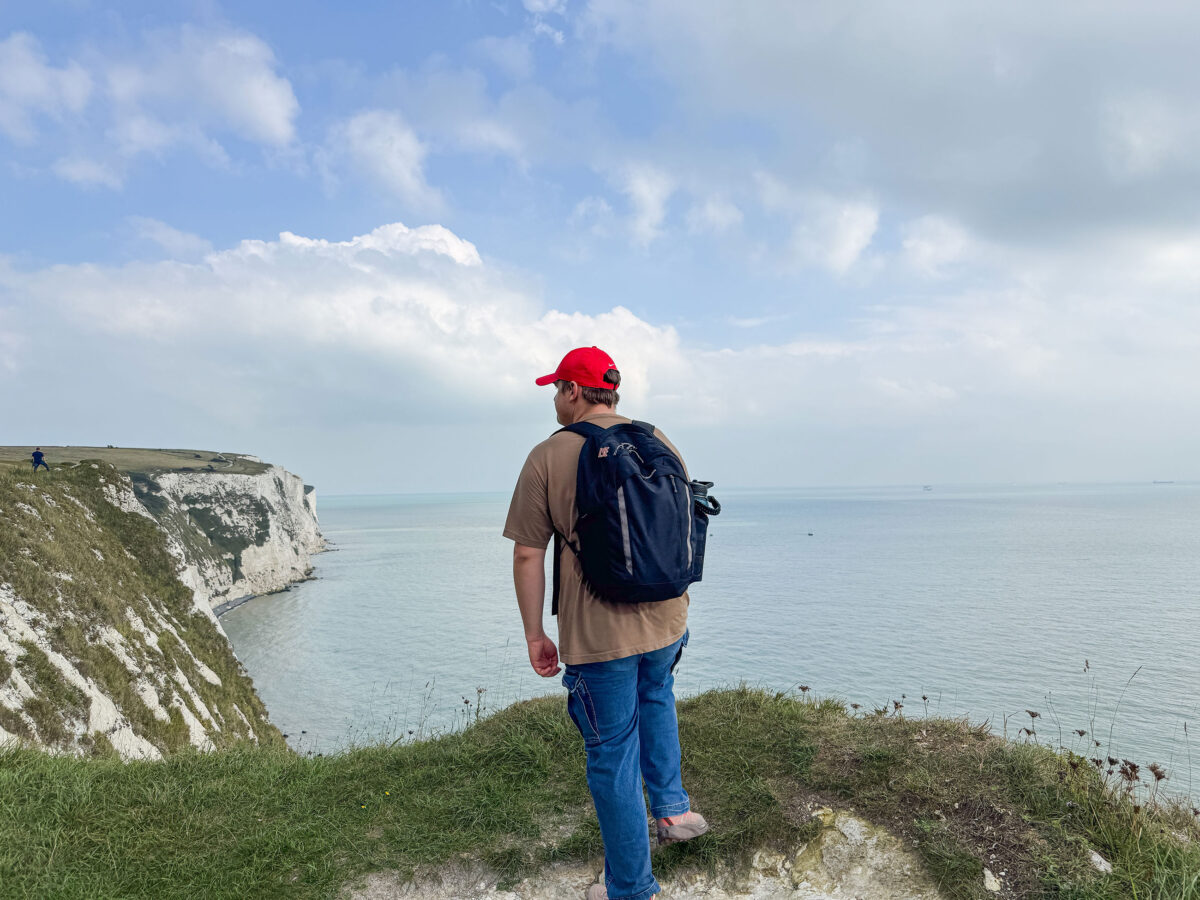
Branson Witt ’27 takes a break from his studies at the London School of Economics to visit the White Cliffs of Dover, on the southeastern coast of England. Photo above courtesy of Branson Witt; Clark photos by Steven King; video by Beth Prendergast.
Clark student finds a world of possibility in data science
Branson Witt ’27 came to Clark with an interest in applying research to improve health equity and access, address the issue of inner-city food deserts, and curb stormwater pollution.
And although he sought to study economics, he discovered data science when taking computer science courses. He liked that Clark’s undergraduate Data Science Program involves applied research and would allow him to pursue an economics track — one of several offered by the program.
Now a double major in data science and mathematics, Witt is studying abroad this academic year at the London School of Economics. He hopes to land a research position at the school or an internship in the city’s banking sector.
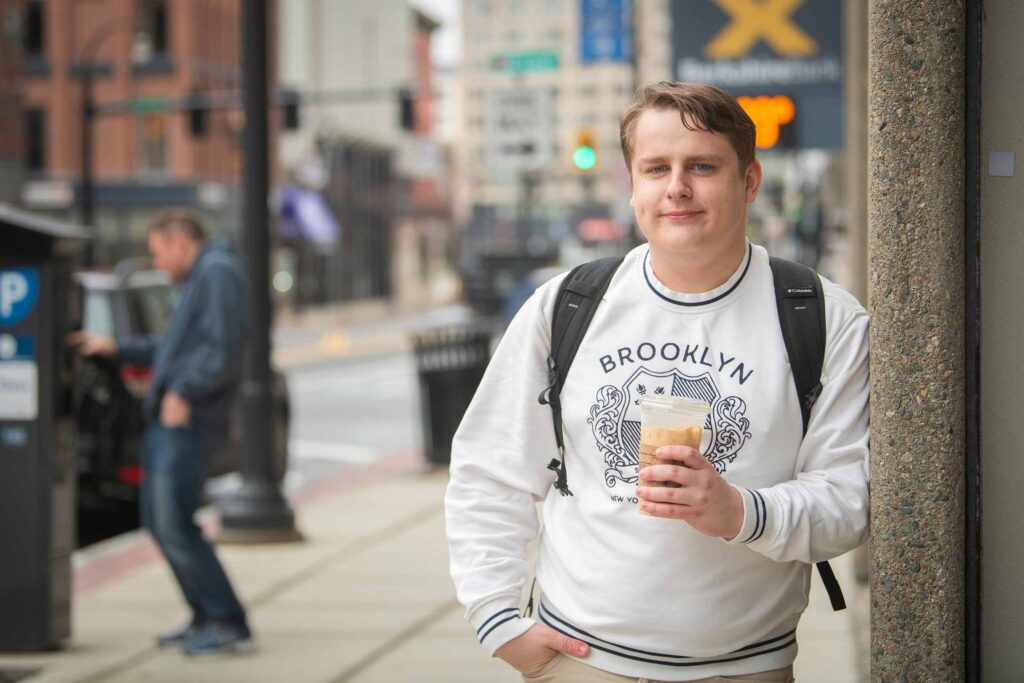
He credits Professor Li Han, director of the Data Science Program, as a major influence in his academic life. “She really pushed me to grow,” Witt says.
Han hired him as a department assistant, and Witt managed the Data Science Program’s social media channels, helped with outreach to admitted students interested in data science, wrote marketing copy, and communicated with local nonprofits that needed students’ help with data-related projects.
“I am majoring in data science because data is becoming an ever-more important tool in our world, especially with the rise of AI,” Witt says. “It’s the skill that every company is looking for, so going into data science makes you a jack-of-all-trades.”
Witt has taught data-science skills to his friends majoring in biochemistry and molecular biology “because,” he says, “it gives them an edge when applying to internships and jobs. It seems like no matter what the discipline is, you have to be proficient in the use of data.”
“My parents taught me to try to be a good person, and data science is a way to have an expansive impact.”
— branson witt ’27
He sees data science not only as a ticket to landing a high-paid job, but also as a way to help society.
“When you’re using data science for good, you’re able to harness the power of the computer to find patterns in data that pinpoint where people are experiencing troubles. That’s how we know all about issues like redlining,” in which residents of low-income neighborhoods have been systematically and historically denied mortgages and loans.
“While redlining may not be apparent to some people,” Witt explains, “the history of redlining is still very apparent in the data.”
Plus, he adds, data science is fun. “I like data science because it gives you the ability to look over thousands and thousands of data points and find patterns that you wouldn’t otherwise be able to see. It’s like trying to solve one giant puzzle.”
Putting data to use for Community Legal Aid
Witt applied his interest in data science to an internship last spring at Community Legal Aid in Worcester. He compared the organization’s internal data to that from the U.S. Census data to identify areas and populations in Central and Western Massachusetts that are not as well-served by the nonprofit.
Before coming to Clark, he had encountered issues of health equity and access when accompanying his mother to medical appointments.
“My mom had breast cancer when I was in middle school, and thankfully she survived, but I spent a lot of time following her around to all the different hospitals to get radiation treatment, X-rays, and scans,” Witt says. “I wondered why all the treatments weren’t available in just one place.”
Later, when his family moved from California to Bend, Oregon, his mother sought treatment for another medical issue in Portland once a month. “That’s 3-1/2 hours each way,” Witt says.
Around the same time, he became certified in search-and-rescue as a scuba diver. “We had to draw up a plan to show we were capable of doing a dive to rescue someone who got seriously injured,” he explains. “We had to identify a hospital facility with a barometric chamber” for a diver experiencing decompression sickness (the bends).
He discovered the closest barometric chamber was almost a four-hour drive away in Vancouver, Wash., “and the problem is, you can’t fly there, because that just exacerbates the symptoms.”
Pinpointing healthcare and stormwater runoff issues
Witt’s observations about health access gave him an idea for a final project in Computer Science Professor Pawan Gupta’s Data Structures class, where he developed a mapping tool that patients could use to identify the drive times to federally recognized healthcare facilities in Worcester County.
“Depending on the filters you apply, you can see which medical facility is the closest drive to you,” Witt says. When building the tool, it became clear to him that “there are rural areas in Worcester County that do not have access to any of these facilities within a 30-minute drive.”
Witt also drew upon his life experience for a Clark data science project that examined stormwater runoff on campus. As an elementary school student in California, he learned about the need to curb stormwater pollution, which, if not deterred, would run off onto the beaches. His interest continued in high school in Oregon, where he investigated stormwater runoff in his local community for an environmental science class project.
For Clarkathon, the annual hacking competition that in 2024 focused on the theme of sustainability, Witt sought to pursue his interest in identifying solutions to stormwater runoff.
He used data from LiDAR scans — a type of remote-sensing equipment that works by sending out laser pulses — of Clark’s campus. Created by the U.S. Geological Survey via drone or aircraft, the LiDAR scans and their data outputs, or point clouds, are publicly available. (LiDAR stands for “Light Detection and Ranging.”)
Witt built a stormwater model to simulate how water typically flows downward and pools on campus, creating an algorithm to identify the points between which the water might flow.
“I created maps to simulate thousands and thousands of streams and show choke points where you could handle the stormwater,” he says. “I overlaid it on maps of the school to show where the stormwater flows through areas of pollutants.”
When it rained, Witt took photos of the water flow at Clark, showing that his “theory was actually reality.”
A passion for good food — and food access
At some point, Witt plans to use data science to investigate the issue of food deserts, where many low-income neighborhoods across the U.S. don’t have access to healthy, inexpensive food. Instead, he notes, they often rely on Dollar General or other stores.
Last summer, he conducted research on Dollar General stores “across America and their impact on the local retail job market,” he says. “I am just starting this research, but I hope to expand it into a further research paper.”
Witt’s interest in food stems from a high school internship and career-exploration project, through which he participated in a culinary class at a local community college.
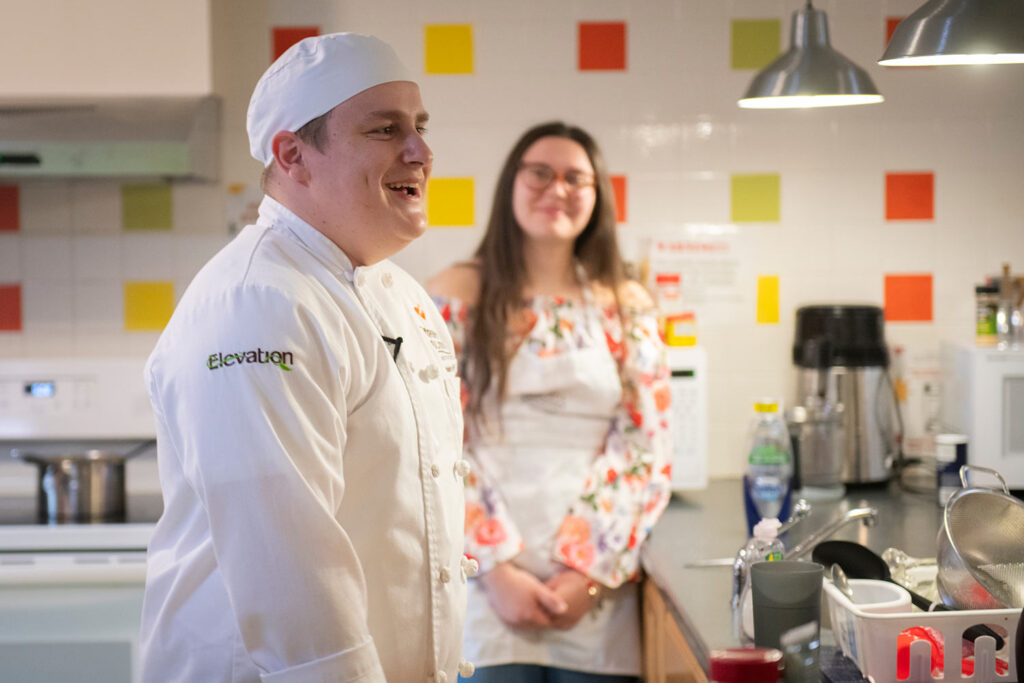
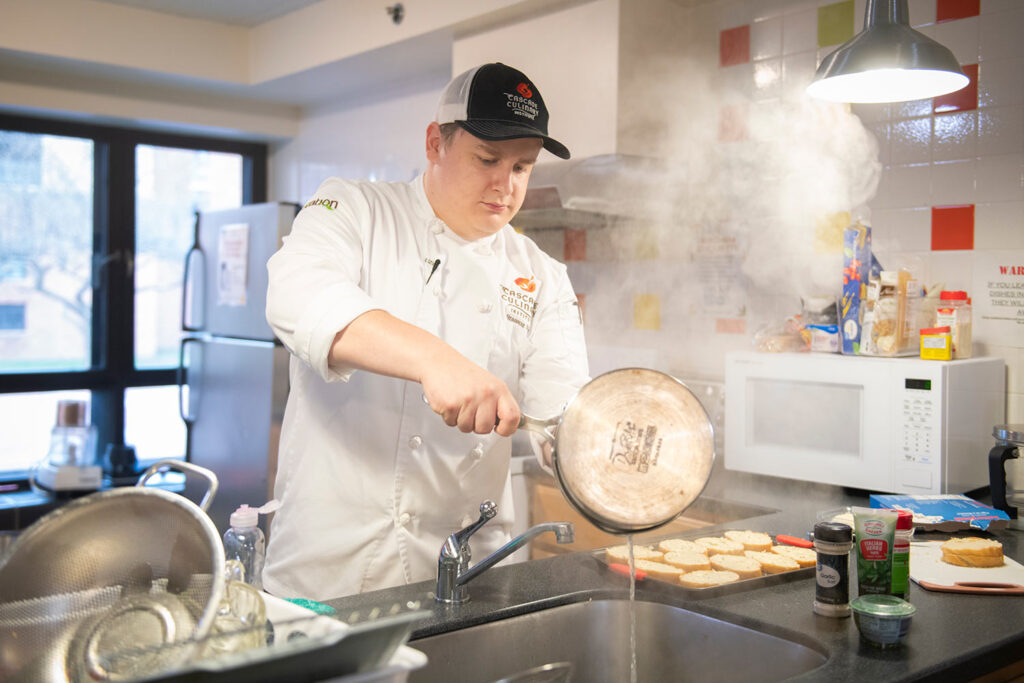
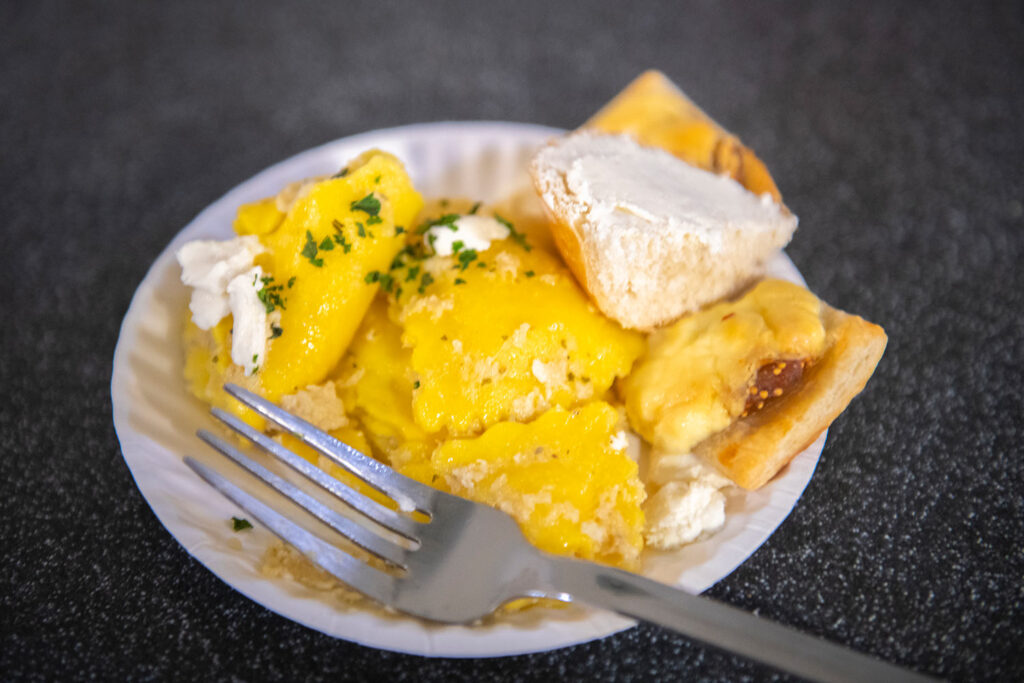
“They asked me to come back the next semester, even though it wasn’t required for me to do that. I decided to stick around because,” he says with a pause, “free pastries.”
Witt now has a slew of cooking skills (along with a full chef’s uniform). He put them to work in Clark residence halls, teaching his friends how to cook.
After Clark, Witt plans to attend graduate school. He is excited about continuing to apply data science to solving problems, benefiting local communities or the world.
“My parents taught me to try to be a good person,” Witt says, “and data science is a way to have an expansive impact.”