
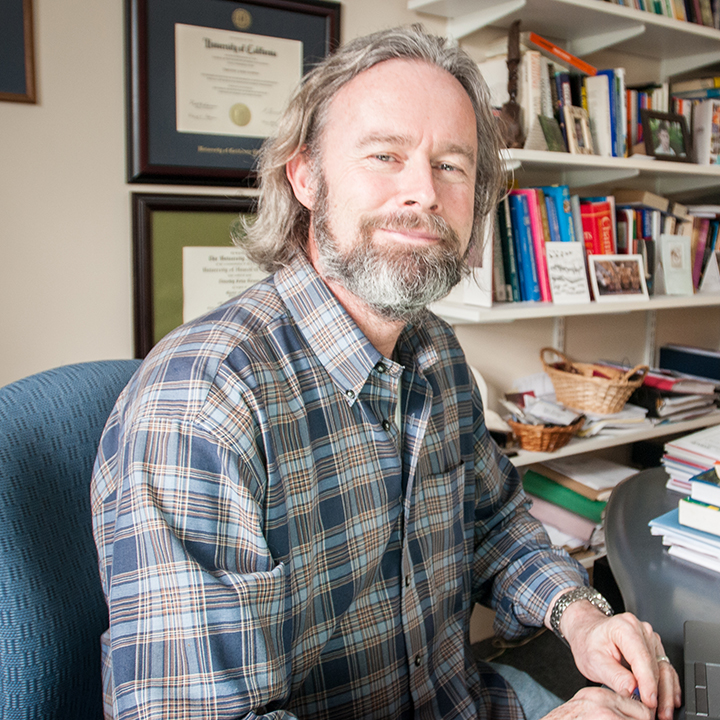
Timothy Downs

Professor, Sustainability and Social Justice

Tim Downs is an environmental scientist and engineer with over 30 years experience designing and managing collaborative projects at the nexus of water, health, environment and (more recently) climate change, working in the UK, the US, Latin America and Africa. He builds on his early work (2001, 2007, 2008) that helped establish a foundation for the co-creation paradigm of sustainability: existing knowledge and social-technical capacities (incl Indigenous) are pooled, then new ones co-created, by diverse stakeholder collaborations – placing local communities front and center. His research focus is on how humans change the environment, how those changes impact water, human health and wellbeing, and ecosystems, and how to mitigate impacts – using water and health as ‘gateways’ into social-ecological complexity. He is especially interested in issues of environmental and climate justice: the uneven distribution of positive and negative impacts across populations and landscapes. In a diversity of settings—New England, Mexico, East and West Africa—he works with affected communities, NGOs, governmental agencies, public sector providers, the media, the private sector and donors within and across sectors: health, energy, water supply & sanitation, food & agriculture, land-use, transportation, urban planning, climate-change adaptation & mitigation, biodiversity conservation & ecosystem stewardship.

From 2023-2026, Downs has served as Principal Investigator on the project “Co-creating Research and Education Capacities to Understand, Visualize and Mitigate Climate-Change Impact Cascades and Inequities in Central Mexico” ($1.5M), funded by the National Science Foundation’s prestigious Partnerships for International Research and Education Program (NSF/PIRE). The project represents a unique opportunity to test the co-creation paradigm. With research-based, experiential learning for students and community-centered work at its core, to date, 8 Clark students have lived and worked alongside local people for six months (January – June, 2024 and 2025) – to better understand how climate change is impacting water, health, livelihoods, food and agriculture, and ecosystems. The three pilot communities are: Miravalle, Iztapalapa, Mexico City; Tlahuac, Mexico City; and Valle de Bravo, State of Mexico. Deliverables include the first water balance model for the Mexico-Lerma-Cutzamala Hydrological Region, considering climate-change scenarios SSP2-45, 5-85, and land use/cover change under rapid urbanization (Hanumantha et al., 2026), as well as a Regional Climate Change Atlas that maps social, ecological and climate conditions, as well as impacts. They are also committed to revealing who is most impacted and vulnerable, and how to strengthen their capacity to anticipate and respond – the all-important climate justice issue. Another tangible benefit has been the co-creation of 3D-printed weather stations and mosquito traps, donated to local communities, so they have their own monitoring capacity. 

For an American Geophysical Union short film on the project. see: https://www.youtube.com/watch?v=r_wy42O6D6I

The Clark group is working with faculty peers at the National Autonomous University of Mexico (UNAM) to carry out field research and take courses together; they signed a Collaboration Convention in June 2023 to signal their shared commitment to a new model of long-term collaboration in education, research and advocacy centered on climate change, water, health and social justice.

For more, see: https://clarknow.clarku.edu/2022/12/08/water-is-life-three-year-nsf-study-in-mexico-brings-multi-pronged-approach-to-climate-impacts/

In summer 2018, Prof. Downs rode his motorcycle 6000 miles to join the Grannies Respond Caravan in protest of draconian family separation policy at the U.S.-Mexico Border.  He then raised money to send 7 IDCE students to volunteer helping heroic immigrant and asylum-seeker relief efforts in McAllen, TX. He and Profs. Anita Fábos and Sarah Mitchell, together with veteran social justice activist and student mentor Megan Martínez, co-authored a paper chronicling this impactful field research-meets-activism student experience (Glier et al., 2020).

Since 2015, Downs has been collaborating with colleagues at Boston University School of Public Health and local residents to explore the vulnerability of the shallow aquifer system in Holliston, Mass. to contamination by natural Manganese (Mn) and industrial chemicals. They are also looking into potential health risks to young children that may be the result of early life-stage exposures, including in-utero. Exemplifying engaged collaborative research in partnership with affected communities, and co-authored with 9 students, the paper: “Integrated Assessment of Shallow-Aquifer Vulnerability to Multiple Contaminants and Drinking-Water Exposure Pathways in Holliston, Massachusetts” was published 2018 in open-access journal Water and is available online at: http://www.mdpi.com/2073-4441/10/1/23/html

Downs was a Co-PI with UMass Medical School on the “National Children’s Study (NCS) project for Worcester County” (2008-2012), funded by the National Institutes of Health (NIH). He also served as PI on the project “Strengthening Vulnerable Communities in the Worcester Built Environment (2005-2009), funded by the National Institute of Environmental Health Sciences (NIEHS).

Downs’s research and teaching are integrated. Half of his portfolio is foundational environmental science classes, and half team-based practicums.  As examples of practicums, in his Spring 2022 “Sustainable Development Assessment & Planning” class (IDCE332/EN242) student teams critically evaluated the assessment and planning processes for 7 cases including a copper mining project, dams and reservoirs (3), a women’s empowerment project, a coastal climate resilience effort and a regional greenway project. In Spring 2022, team practicums in his “Cities, Regions, Climate Change & Health” class (IDCE365/EN265) included Hong Kong, Jakarta, Uttarakhand (Hindu Kush Himalaya), and New Orleans.

Recent publications (* student coauthors, ** community coauthors)

Articles:

Hanumantha, R.*, Ogneva-Himmelberger, Y., Ruelle, M., Mazari-Hiriart, M., Frey, K., Downs, T.J. [senior author, project designer] (2026). A Spatially Explicit Water Balance Model for Assessing Recharge Sensitivity to Climate and Land Cover Change in Central Mexico. Hydrological Processes 40(3). https://doi.org/10.1002/hyp.70473

Friedman, A., Boselli, E., Ogneva-Himmelberger, Y., Heiger-Bernays, W. Brochu, P., Burgess, M., Schildroth, S., Denehy, A., Downs, T.J., Papautsky, I., Claus Henn, B. (2023). “Manganese Concentrations in Residential Tap Water Samples from a Community-Initiated Case Study in Massachusetts”. Special Issue: Regulated and Emerging Chemicals in Drinking Water: Exposure and Health Research. J. of Exposure Sci. & Environ. Epidem. DOI: https://doi.org/10.1038/s41370-023-00563-9

Manley, E.*, Ogneva-Himmelberger, Y., Ruelle, M., Hanumantha, R.*, Mazari-Hiriart, M. and Downs, T.J. (2022). “Land-use/cover change in the México-Lerma-Cutzamala Hydrological Region 1993-2018”. J. Applied Geography. Vol. 147 (102785). https://doi.org/10.1016/j.apgeog.2022.102785

Book chapters:

Downs T.J. Training Sustainable Development Practitioners to Interrogate and Dismantle Systemic Racism as a Co-Creative Enterprise (2025). Towards a Community of Antiracist Praxis in Higher Education Transformative Principles, Practices, and Resources for the Classroom. Park, J., Ross, L. (Eds). Routledge. ISBN 9781032750316. 258 Pages

Downs T.J., Hanumantha R.K.*, Ogneva-Himmelberger Y., Ruelle M., Brissett N., Mazari-Hiriart M. (2023). “Integrative Collaborative Design of Research-Based Climate-Change Resilience Engineering Education: Insights from México-Lerma-Cutzamala Hydrological Region”. Science, Engineering, and Sustainable Development. Krueger, R., Telliel Y., Soboyejo W. (Eds). De Gruyter. DOI: 10.1515/9783110757507-008

Downs T.J., Hanumantha R.K.*, Ogneva-Himmelberger Y., Ruelle M., Mazari-Hiriart M. (2023). “Illustrating Climate-Change Resilience Engineering: Conceptual Design of Water Supply & Wastewater/Stormwater System for the México-Lerma-Cutzamala Hydrological Region”. Science, Engineering, and Sustainable Development. Krueger, R., Telliel Y., Soboyejo W. (Eds). De Gruyter. DOI: 10.1515/9783110757507-009

Downs T.J., Ogneva-Himmelberger Y., Ruelle M., Hanumantha R.K.*, Mazari-Hiriart M., Guzmán C., Ramírez-Aguilar M., Santos-Burgoa C. (2022). “Health as a Socio-Technical Enterprise Anchored in Social-Ecological Justice & Stakeholder Collaboration: Insights from México-Lerma-Cutzamala Hydrological Region”. In: Leal Filho, W. (eds) Handbook of Human and Planetary Health. Climate Change Management. Springer, Cham. https://doi.org/10.1007/978-3-031-09879-6_15

Degrees

  • Doctor of Environmental Science in Environmental Science and Engineering, University of California, Los Angeles, 1998
  • M.S. in Ocean Engineering, University of Hawaii, Manoa, 1990
  • B.S. in Civil Engineering, Loughborough University, 1984

Affiliated Departments

Sustainability and Social Justice, International Development, Community and Environment (IDCE)

Scholarly and creative works

  • Article in Refereed Journal

    “Using geospatial analysis to model present and future water balance: the case of Mexico-Lerma-Cutzamala Hydrological Region”.

    Water Resources Research
    2025
    Ravi Hanumantha, Yelena Ogneva-Himmelberger, Morgan L. Ruelle, Marisa Mazari, Karen E Frey, Timothy Downs
  • Article in Refereed Journal

    “A System Dynamics Model of Water Balance for the Mexico-Lerma-Cutzamala Hydrological Region”.

    Science of the Total Environment
    2025
    Ravi Hanumantha, S Varalakshmi, Yelena Ogneva-Himmelberger, Morgan L. Ruelle, Marisa Mazari, Karen E Frey, Timothy Downs
  • Article in Refereed Journal

    Climate Change and Sustainable Water Resources Management a System Dynamics Approach in Mexico-Lerma-Cutzamala Hydrological Region.

    Water Resources Research
    2025
    Ravi Hanumantha, S Varalakshmi, Yelena Ogneva-Himmelberger, Morgan L. Ruelle, Marisa Mazari, Karen E Frey, Timothy Downs
  • Chapters In Books

    Antiracist Praxis
    Chapter: Training Sustainable Development Practitioners to Interrogate and Dismantle Systemic Racism as a Co-Creative Enterprise.

    Published by Routledge
    2025
    Timothy Downs
  • Presentations

    Climate-Change Impacts and Adaptations in Central Mexico: Challenges and Opportunities

    UCLA Department of Civil & Environmental Engineering Seminar Series
    UCLA
    May
    2024
    Sponsored by UCLA
    Timothy Downs
  • Article in Refereed Journal

    Manganese Concentrations in Residential Tap Water Samples from a Community-Initiated Case Study in Massachusetts

    J. of Exposure Sci. & Environ. Epidem.
    May
    2023
    Alexa Friedman, E. Boselli, Yelena Ogneva-Himmelberger, W. Heiger-Bernays, P. Brochu, M. Burgess, S. Schildroth, A. Denehy, Timothy Downs, I. Papautsky, Birgit Claus-Henn
  • Presentations

    Transforming Climate-Change Education, Research and Action

    Clark Alumni and Trustees Gathering
    Chicago, IL
    October
    2023
    Sponsored by Clark
    Timothy Downs
  • Chapters In Books

    Development Engineering in Practice: Case Studies from Around the World
    Chapter: Illustrating Climate-Change Resilience Engineering: Conceptual Design of Water Supply & Wastewater/Stormwater System for the Mexico City-Toluca Social-Hydrological Region

    Published by De Gruyter
    2023
    Timothy Downs, Morgan L. Ruelle, Yelena Ogneva-Himmelberger
  • Article in Refereed Journal

    Land-use/cover change in the México-Lerma-Cutzamala Hydrological Region 1993-2018

    J. Applied Geography
    2022
    Vol. 147
    Ethan Manley, Yelena Ogneva-Himmelberger, Morgan L. Ruelle, Ravi Hanumantha, Marisa Mazari-Hiriart, Timothy Downs
  • Article in Refereed Journal

    Characterizing metals exposure during critical periods of development using deciduous teeth in a community-initiated pilot study

    J. Exposure Sci. & Environ. Epidem.
    2022
    Alexa Friedman, Julia Bauer, J. Austin, Timothy Downs, Y. Tripodis, W. Heiger-Bernays, Roberta White, Manish Arora, Birgit Claus-Henn
  • Article in Refereed Journal

    An Integrative Collaborative Project Approach to Climate-Change Resilience and Urban/Regional Sustainability for the Mexico City Region

    Open Journal of Civil Engineering
    2022
    Timothy Downs, Morgan L. Ruelle, Nigel Brissett, Ravi Hanumantha, Marisa Mazari-Hiriart, Rob Krueger, Edward R. Carr
  • Chapters In Books

    Handbook of Human and Planetary Health
    Chapter: Health as a Socio-Technical Enterprise Anchored in Social-Ecological Justice & Stakeholder Collaboration: Insights from Mexico City-Toluca Region

    Published by Springer
    2022
    Timothy Downs, Yelena Ogneva-Himmelberger, Morgan L. Ruelle, Ravi Hanumantha, Marisa Mazari-Hiriart, Christian Guzman, Matiana Ramirez-Aguilar, Carlos Santos-Burgoa
  • Chapters In Books

    Development Engineering in Practice: Case Studies from Around the World
    Chapter: Integrative Collaborative Design of Research-Based Climate-Change Resilience Engineering Education: Insights from Mexico City-Toluca Social-Hydroecological Region

    2022
    Timothy Downs, Ravi Hanumantha, Yelena Ogneva-Himmelberger, Morgan L. Ruelle, Nigel Brissett, Marisa Mazari-Hiriart
  • Article in Refereed Journal

    An Integrative Collaborative Project Approach to Climate-Change Resilience and Urban/Regional Sustainability for the Mexico City Region

    Open Journal of Civil Engineering
    Spring
    2022
    Timothy Downs, Morgan L. Ruelle, Nigel Brissett, Ravi Hanumantha, Marisa Mazari-Hiriart, Robert Krueger, Edward R. Carr
  • Presentations

    Climate Change Impacts and Adaptation for the Mexico City Region: An Integrative Collaborative Approach

    17th International Conference on Environmental, Cultural, Economic and Social Sustainability
    Netherlands
    24 – 26 Feb 2021
    2021
    Sponsored by Society of Environmental, Cultural, Economic and Social Sustainability (SECESS)
    Timothy Downs
  • Chapters In Books

    Development Engineering in Practice: Case Studies from Around the World; Soboyejo W., Telliel Y., and Krueger, R. (Eds)
    Chapter: Integrative Collaborative Design of Research-Based Climate-Change Resilience Engineering Education: Insights from México-Lerma-Cutzamala Hydrological Region

    2021
    Timothy Downs, Ravi Hanumantha, Ethan Manley, Morgan L. Ruelle, Yelena Ogneva-Himmelberger, Christian Guzman, Adalberto Noyola-Robles, Marisa Mazari-Hiriart
  • Presentations

    Climate Change Impacts and Adaption for the Mexico City-Toluca Social-Hydroecological Region

    IDCE Masterclass Online
    03
    2021
    Timothy Downs, Morgan L. Ruelle, Yelena Ogneva-Himmelberger
  • Presentations

    Climate Change Impacts and Adaption for the Mexico City-Toluca Social-Hydroecological Region

    IDCE Research Forum
    01
    2021
    Timothy Downs, Morgan L. Ruelle, Yelena Ogneva-Himmelberger
  • Article in Refereed Journal

    Understanding stakeholder positionalities and relationships to reimagine asylum at the US–Mexico border: Observations from McAllen, TX

    J. Human Geography
    2020
    Staples Temperance, Emma Gregory, Glier Halley, Megan Martinez, Anita Fabos, Sarah Mitchell, Timothy Downs
  • Reviews, Abstracts, Pamphlets

    “Metals exposure in a community-initiated pilot study of drinking water.”

    August
    2020
    ISEE
    virtual meeting
    A. Friedman, Julia Bauer, C. Austin, E. Boselli, Timothy Downs, M. Aurora, Birgit Claus-Henn
  • Presentations

    “Designing integrative collaborative academic programs in environmental science and health”.

    Research Seminar Series
    Social Science Environmental Health Research Institute, Northeastern University, Boston, MA
    Feb 04
    2020
    Sponsored by Social Science Environmental Health Research Institute
    Timothy Downs
  • Article in Refereed Journal

    Unlocking High Sustainable Energy Potential in Zambia: An Integrative Collaborative Project Approach.

    J. Sustainable Development
    2020
    Vol. 13
    Issue #1
    Timothy Downs, Matthew Zimmerman, Nick Altonaga, Ramesh Dahal, Elizabeth Kubacki, Nathanial Lapides, John Richards
  • Article in Refereed Journal

    The Case for Integrative Sustainable Development Practice Based on the Minas Conga Gold-Mining Experience in Peru

    Journal of Geoscience and Environment Protection
    2020
    Vol. 8
    Issue #5
    Timothy Downs, Andrea Cabrera-Roa, Katherine Dixon, Phyllis Duff, Eric Pasay, Hannah Silverfine
  • Presentations

    “Metals exposure in a community-initiated pilot study of drinking water.”

    International Society of Environmental Epidemiology (ISEE). Annual Conference 2020.
    virtual
    2020
    A. Friedman, Julia Bauer, C. Austin, E. Boselli, Timothy Downs, M. Aurora, Birgit Claus-Henn

Awards and grants

  • Co-creating Research and Education Capacities to Understand, Visualize and Mitigate Climate-Change Impact Cascades and Inequities in Central Mexico

    NSF/Partnerships for International Research & Education (PIRE)

    clock icon Apr. 1, 2023 – May. 1, 2026
  • Co-creating Research and Education Capacities to Understand, Visualize and Mitigate Climate-Change Impact Cascades and Inequities in Central Mexico

    NSF

    clock icon Apr. 1, 2023 – Mar. 31, 2026
  • Co-creating Research and Education Capacities to Understand, Visualize and Mitigate Climate-Change Impact Cascades and Inequities in Central Mexico

    NSF/PIRE

    clock icon Apr. 1, 2023 – Mar. 31, 2026
  • “Building Transdisciplinary Research Capacity to Solve ‘Wicked’ Problems: Graduate Student Field Training in Ghana and Mexico”

    National Science Foundation’s International Research Experiences for Students (IRES) Program.

    clock icon Jun. 30, 2020 – May. 31, 2023
  • Co-creating Research and Education Capacities to Understand, Visualize and Mitigate Climate-Change Impact Cascades and Inequities in Central Mexico

    NSF/Partnerships for International Research & Education (PIRE)

  • “Planning Grant: Engineering Research Center for Climate Resilience & Development”

    National Science Foundation’s Engineering Research Center (ERC) Planning Program

    clock icon Jan. 1, 2020 – Dec. 31, 2020
  • Mexico City Field Visit to Build Academic Research & Learning Partnership with UNAM.

    Leir Foundation

    clock icon May. 21, 2019 – Jun. 12, 2019