HERO students find common ground in researching outcomes of urban tree-planting program
One of Clark University’s premier undergraduate research programs wrapped up its 26th summer recently, as students presented their findings on a tree-planting program aimed at curbing heat islands in Massachusetts cities.
“We got a well-rounded experience,” said Nate Kidd ’26, summing up his eight weeks with Clark’s Human-Environment Regional Observatory (HERO) program.
“There’s not really any research or leadership program that you’re going to find like HERO,” said Kidd, a geography major. “I’m normally a GIS [geographic information science] person, but I was doing a lot of qualitative research. We got to explore everything.”
Abigail Riseman ’26 had looked forward to participating in HERO since high school, when she discovered the program while researching environmental majors at various colleges.
“I didn’t see a lot of other schools with a research program like this,” said Riseman, a geography major and mathematics minor. “HERO definitely helped me choose Clark, especially because of how small the program is, and how the professors work directly with you.”
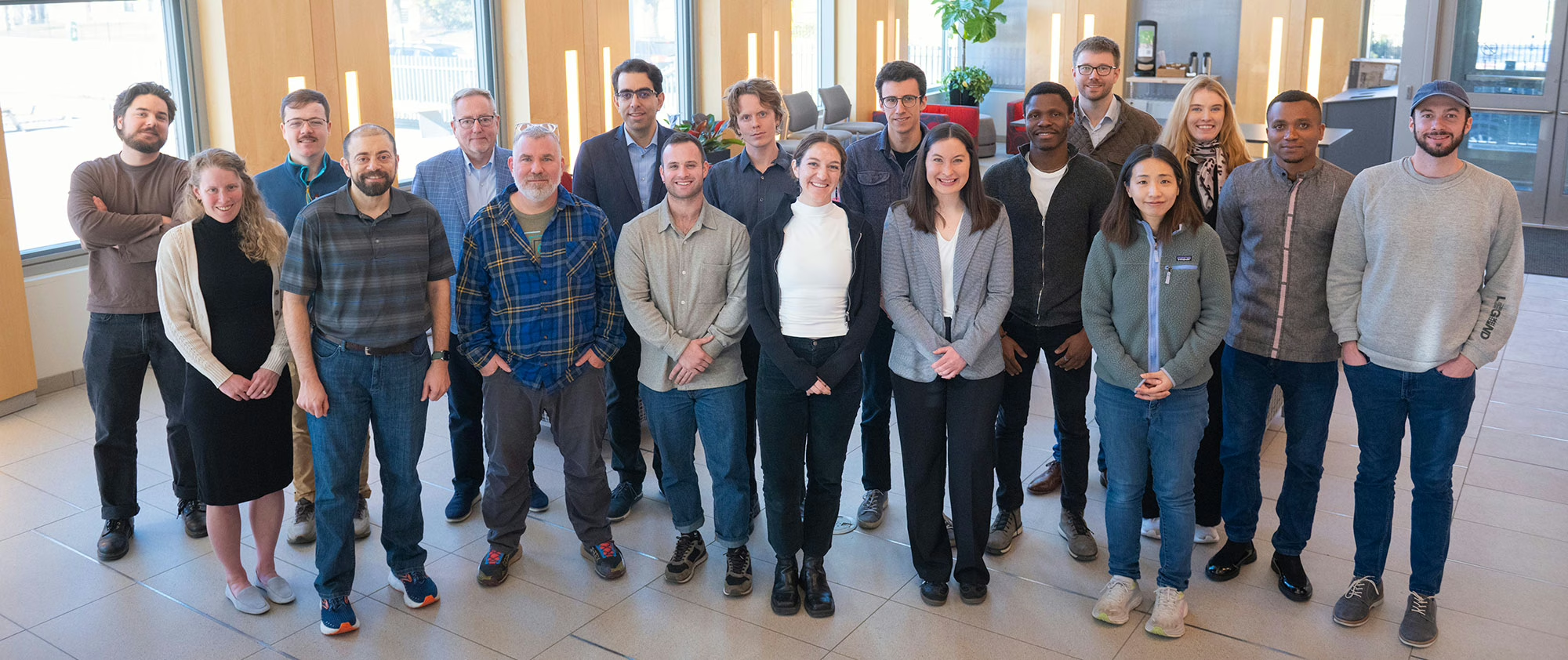
Kidd, Riseman, and their peers spoke on July 17 to a room full of stakeholders, including Clark faculty and graduate students, city officials and neighbors, and representatives from the Massachusetts Department of Conservation and Recreation (DCR).
Starting in June, the HERO team began surveying the health of 2,000 of the more than 3,500 trees planted on 700 acres in Leominster since 2016 as part of the DCR’s Greening the Gateway Cities program. Defined by the state as midsize urban centers that anchor regional economies, Gateway Cities have older housing stock and smaller tree canopies.
The students got the chance to get their hands dirty, helping the DCR plant more trees. They also interviewed Leominster residents, city officials, partners, and DCR foresters about their experiences with the tree-planting program. Most had positive perceptions, but some wanted more follow-up from the DCR.
“We were walking into businesses that had no idea we were coming. They’re working, and they’re busy. And I can understand why people would say, ‘I can’t talk right now.’ ”
— Julia Head ’26
The researchers found that Leominster’s heat islands can be 10.4 degrees hotter — and sometimes reach as high as 118.4 degrees Fahrenheit — compared with other parts of the city, according to Aidan Humphreys ’26, a geography major and global environmental studies minor.
“Heat island buildup could be due to a lack of cover or higher impervious surfaces that absorb a lot of that heat,” Humphreys explained. “We know that trees can have an impact on reducing that.”
To gauge the trees’ health, the students took measurements and recorded the condition of the bark, trunk, branches, leaves, and canopy. They noted where trees were planted and whether they had died, been removed, or gone missing.


Of the trees surveyed, 76 percent were alive and still standing, with 80.8 percent of those in good condition. The species with the best overall health, growth, and survivorship included the American yellowwood, American elm, London plane, and river birch trees; those with more issues included black tupelo, serviceberry, and crabapple. Trees planted at residences fared better than those on public greenways next to the street.
In another research project, students visited Worcester’s Green Island and Main South neighborhoods to interview 24 business and property owners about whether they might be interested in planting trees on their land.
“We stepped out of our comfort zone a lot,” said Julia Head ’26, an environmental science major. “We were walking into businesses that had no idea we were coming. They’re working, and they’re busy. And I can understand why people would say, ‘I can’t talk right now.’ ”

Half of those interviewed said their property lacked the space for trees, and 65 percent said they would accept trees to be planted but didn’t own the property. Meanwhile, 65 percent said that tax or policy incentives would encourage them to plant trees.
The data, which included checkups on trees in Leominster previously surveyed by HERO students in 2019, will be available to the DCR and future Clark student researchers. This year’s students suggested that future HERO cohorts continue the interviews with Worcester business and property owners.
The two other students participating in this summer’s program included Alicen Civilikas ’26, an environmental science major, and Jamie Young ’27, a double major in geography and international development and social change.

The program’s directors are Nicholas Geron, a graduate of Clark’s Ph.D. program in geography who now teaches at Salem State University, and geography professors Deborah Martin and John Rogan. Geography Ph.D. students Aidan Caron and Robert Moore served as program managers. The program is affiliated with Clark’s School of Climate, Environment, and Society and the Graduate School of Geography.
When the HERO program began, it focused on Worcester trees that needed to be removed and replaced due to invasive Asian longhorned beetles. Over the years, HERO researchers have returned to Worcester several times to conduct tree and other environmental research, and they have also ventured to Rhode Island and other Massachusetts Gateway Cities.

Photo at top of story: Alicen Civilikas ’26, Nate Kidd ’26, and Jamie Young ’27 plant a tree in Leominster, one of Massachusetts’ Gateway Cities.
All photos by Steven King, university photographer