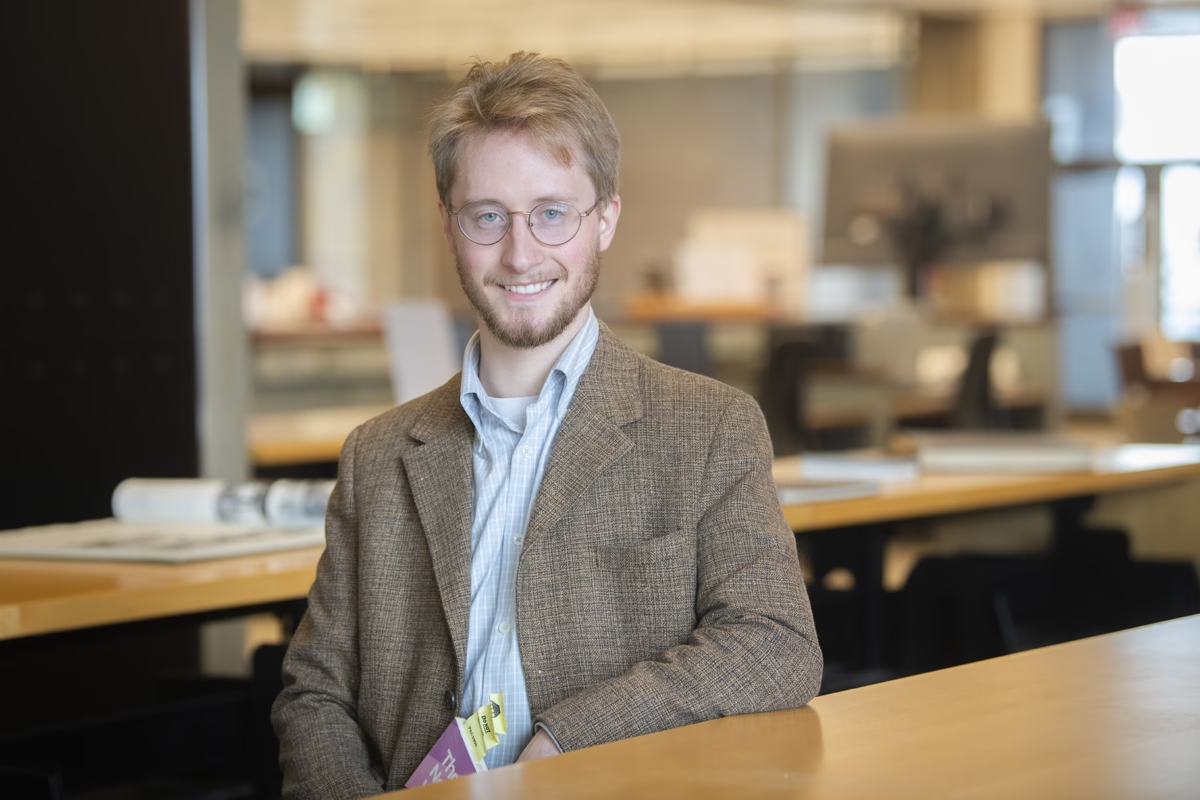
Every now and then, Lawrence Bolduc ’17 will wander over to the Center for Media Arts, Computing, and Design, head to the top floor, and look out at the Goddard Library. He enjoys this particular view because it offers a perspective of Clark’s signature brutalist structure that was unavailable until only a few years ago, when CMACD was officially opened.
“There are no gothic arches or stained-glass windows, as in many traditional libraries,” Bolduc says. “This building is oddly shaped and a little confusing, but its understated beauty is impeccable. It’s become such a place of comfort for me.”
Bolduc’s ongoing appreciation for Goddard Library has evolved over the course of his eight-year career there, and it undoubtedly continues to grow with the advent of his new job. On July 1, Bolduc assumed the position of university librarian, succeeding Laura Robinson, who left to become dean of the library at Fitchburg State University after six years at the Goddard helm. Bolduc had served as interim since February after having worked in a variety of capacities at the library since 2018, most recently as head of instruction, research, and access.
A native of Springfield, Vermont, Bolduc graduated from Clark in 2017 with a degree in psychology, then went on to earn his master’s in library science at Simmons University. At Clark, he has overseen access and research services and information literacy instruction, and is committed to continuing the work of the library as both a conduit for, and “a full intellectual partner with,” any member of the University community engaged in scholarly or academic pursuits.
“For a place like Clark, one of the library’s greatest strengths is that we’re small but we’re mighty, and we’re agile.”
Working with Clark students has been a central component of his career.
“My goal is to ensure that our students leave Clark confident in their ability to navigate an increasingly complex information environment with the new and exciting technologies available to them,” he says. Most importantly, Clark “attracts a certain type of student who has a lot of curiosity and asks really important questions.”
“They want to solve real-world problems,” Bolduc says. “And as a librarian, I want to make sure they leave here with both the skills and the comfort to do that work thoughtfully and make meaningful change in the world.”
Asked if he has ambitions for the Goddard Library, Bolduc smiles.
“I have thoughts; probably too many thoughts,” he says with a laugh. “I want to continue to grow the library’s ability to serve as a partner on campus — whether that’s with faculty, staff, campus leaders, students, or organizations — by promoting student success through our instruction, supporting projects and the process of inquiry through our collections and research services, and raising Clark’s reputation and visibility through our institutional repository.
“The goal is to figure out what we know and what we don’t know; what perspectives have we explored and what haven’t we yet? That’s the sort of work that motivates me and that I find really exciting.” He anticipates pursuing deeper partnerships with the Honors Program and with undergraduate students who are researching and producing their capstone projects, as well as with graduate students who are developing projects and research strategies.
“My goal is to ensure that our students leave Clark confident in their ability to navigate an increasingly complex information environment.”
The Goddard Library staff is “hands down, one of the best teams of librarians you could find anywhere,” Bolduc insists. “For a place like Clark, one of the library’s greatest strengths is that we’re small but we’re mighty, and we’re agile. We can be prepared for the things that are on the horizon, and position ourselves in the right spot to support our faculty, our leaders, and our students.
“The expertise of our staff is unmatched, and as a leader, you want to have people around you who know their stuff way better than you ever will. Any leader who thinks they’re going to lead because they know everything is doing it wrong. My job is to create the conditions for our team’s expertise to shape and strengthen our work.”
Bolduc acknowledges that he likes to think big.
“I don’t think that a small school should think small,” he says. “We should continue to leverage our strengths — like the close working relationship between faculty and students, and our students bringing us ideas, questions, and perspectives that are exciting and inspiring — to facilitate the process of discovery.
“Clark has taught me that.”