‘I want every kid in Worcester to be proud of this’
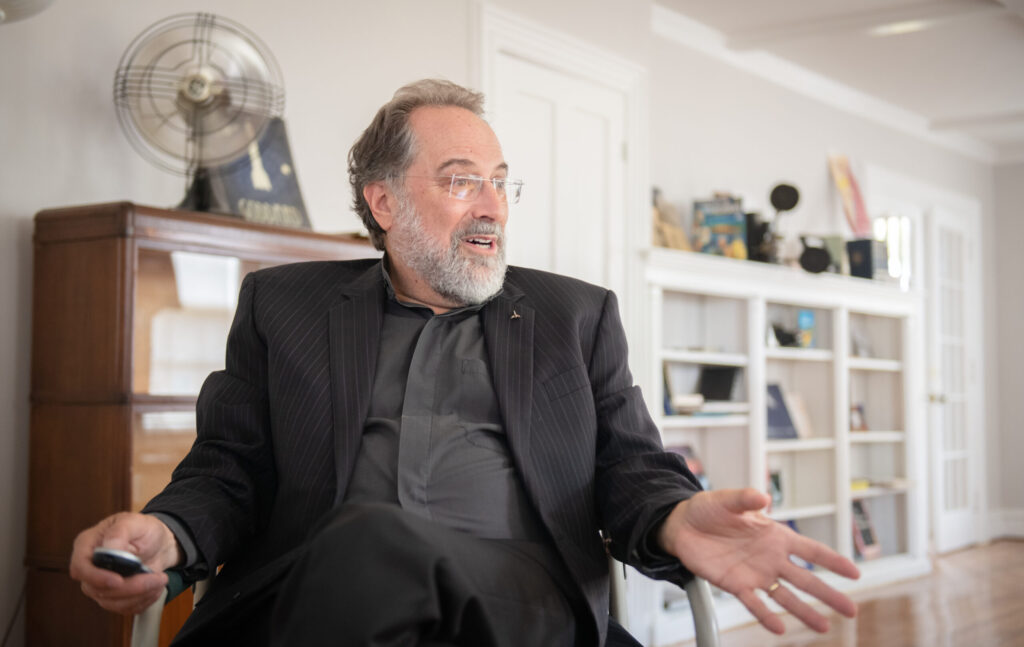
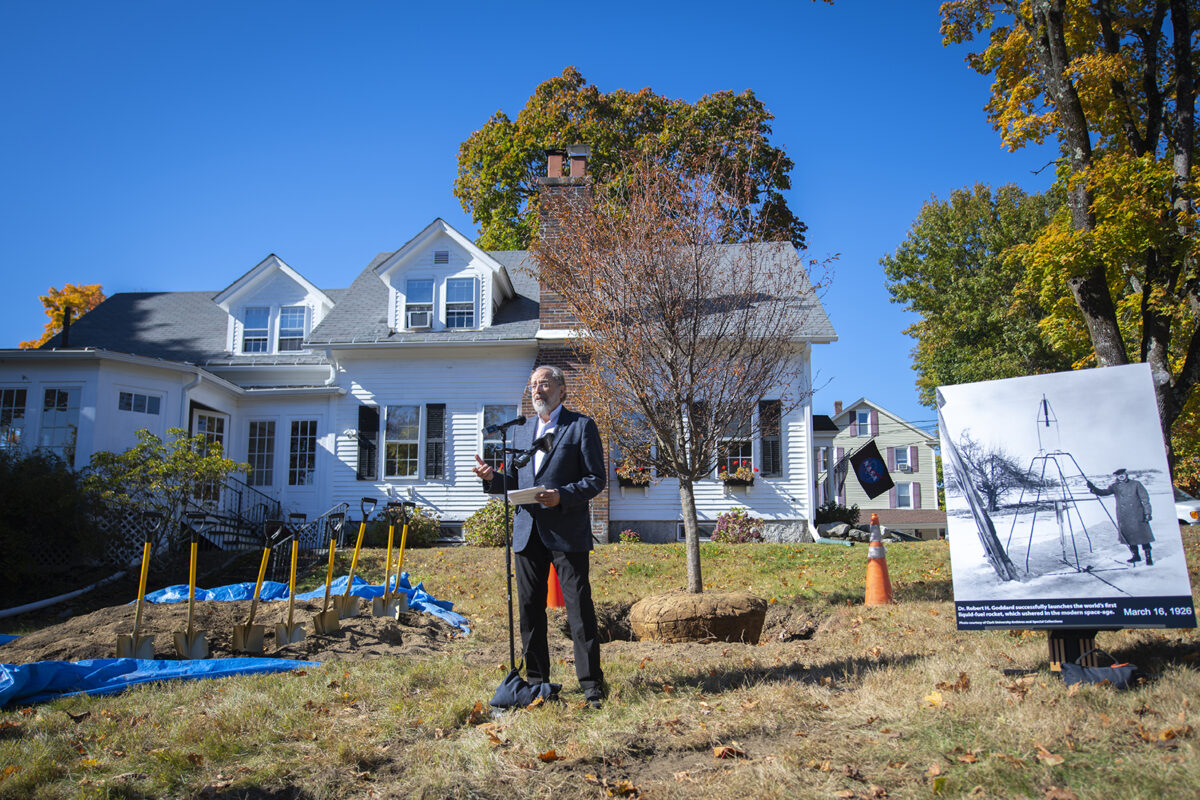
Not long after Charles Slatkin ’74 purchased the childhood home of fellow Clark alum and professor Robert Goddard, M.A. 1910, Ph.D. 1911, to save the dwelling from demolition, he gave himself a deadline: 1,000 days to generate local and national interest in the 100th anniversary of Goddard’s rocket launch. The countdown commenced.
Those 1,000 days have ticked by, and the anniversary is here.
Goddard launched the world’s first liquid-fuel rocket on March 16, 1926, an accomplishment that put a man on the moon just 43 years later. Slatkin has been the force coordinating a slate of events for the First Launch Centennial to celebrate Goddard’s legacy and inspire the next generation of innovators and scientists.
“Not only is this a chance to celebrate something that happened a hundred years ago,” says Slatkin, “it’s a chance to also celebrate how amazing humanity is, how amazing science and engineers are. We don’t necessarily pay a lot of tribute to them. I want every kid in Worcester to be proud of this.”
In the time that Slatkin hasn’t been busy renovating the Goddard house — which is evolving into a hub for science education and inspiration called the Robert and Esther Goddard Center for Innovation — he’s been traveling to aerospace conferences to make connections with people Slatkin describes as “today’s Goddards.”
ClarkU News caught up with Slatkin ahead of the anniversary.
As you’ve been sharing Goddard’s story across the nation, what has been the response?
Everyone absolutely loves it. We can go from Goddard to landing on the moon in 43 years. Isn’t that unbelievable?
Two advocacy groups, the AIAA (American Institute of Aeronautics and Astronautics) and the National Space Society, formed a Goddard 100 contest, inviting kids to create comic strips or write essays relating to Goddard and space.
These kids can try to imagine what their lives could be like 43 years from now. Because Goddard is somewhat unknown, that presents a great opportunity. People love discovering something amazing.
What impresses you most about Goddard?
What a visionary he truly was, beyond his focus on liquid propulsion and space exploration. In 1906, he wrote about something called ion propulsion, which NASA is using to this day. Even before he built a rocket, he was talking about nuclear propulsion, and there are arguments right now that if you want to get to Mars quickly, nuclear is the way to get there in half the time. He also wrote about collecting solar energy in space to beam it to Earth to power cities. China is building a one-kilometer array to do that.
He was so far ahead of his time, and so many of the things he wrote about have come to fruition. I find it really inspiring, and we need thousands of “Goddards” thinking that way if we’re going to innovate our way out of the challenges that we have.
Goddard’s story is one of innovation. What do you think the next big innovation should be?

Certainly, there’s been lots of talk about energy. Providing low-cost, theoretically limitless energy can be a great equalizer among countries and nations.
Artificial intelligence is a tool that can revolutionize how we do genomics, how we alter our DNA, how we come up with new materials and new drugs. I think people can’t fathom what the possibilities are. There is fear that goes with it — think of the tremendous fears of the Industrial Revolution. People were breaking machines and burning factories. I think AI will have ups and downs.
Human beings always search — they always go, “What’s behind that next hill? What’s behind the next mountain?” As we explore space, we find ways of making new materials. There’s helium on the moon and no one quite understands how significant that could be.
How can people new to Goddard’s story learn more?
Goddard’s biography that’s been out of print for 50 years is being republished. We tracked down Ann Lehman, the daughter of Milton Lehman, who published “This High Man: The Life of Robert H. Goddard” in 1963. She’s given us permission to republish with a new modern cover and title, “Goddard: Father of the Space Age.” It includes a foreword by Makenzie Lystrup, former director of the NASA Goddard Space Flight Center, and we got permission from the Sagan Foundation to include portions of Carl Sagan’s “A Cherry Tree to Mars” essay.
What’s next for you after the anniversary?
The long-term vision for the house is to get it on the National Register of Historic Places and then hopefully to form a preservation trust. We also want to expand the National Space Trail through Massachusetts.
My goal is at some point in the future to have an exhibit in Worcester County where kids can experience space at a billion pixels — a much bigger resolution and scale than just looking at a screen or projection of space. I’d like to have kids walk through an interactive gallery, especially with VR glasses — we need stuff like that to raise the bar in science inspiration.