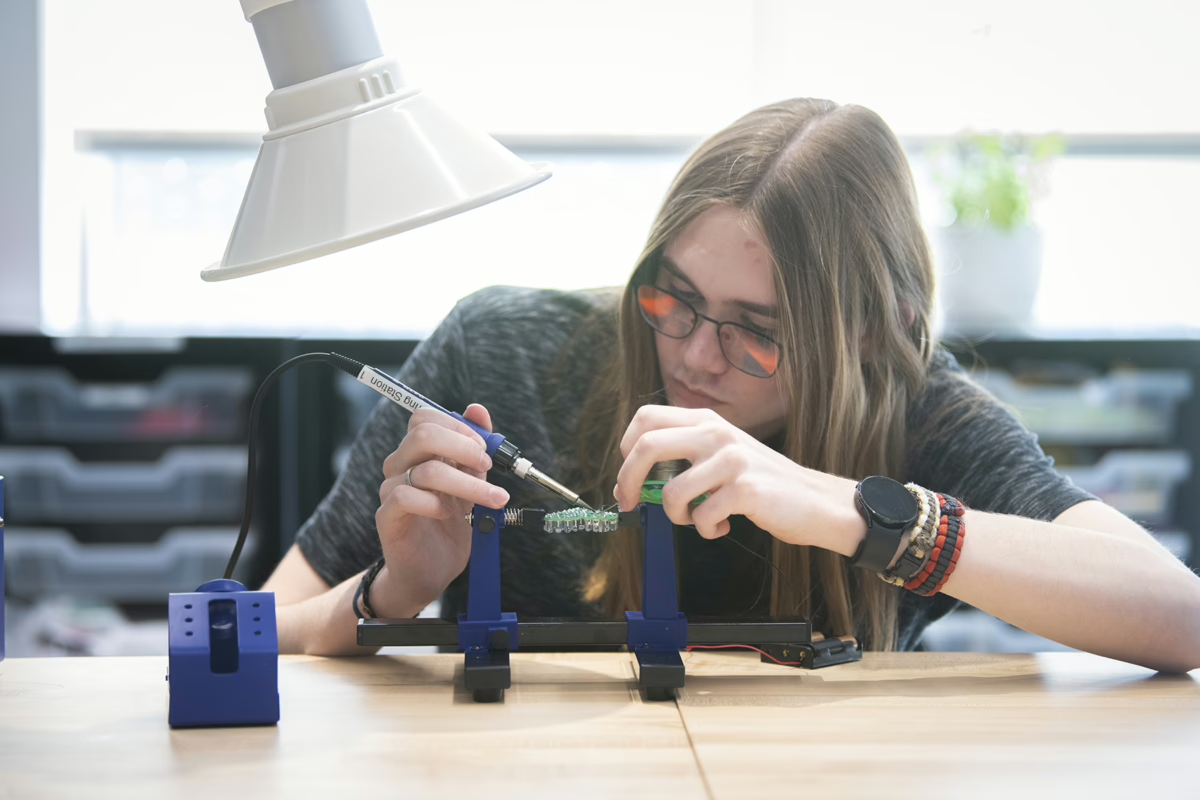
Computer science major Solan Homestead has had a busy fall. A student leader in the Lux Lab makerspace and an undergraduate researcher in Professor Gary Holness’ Laboratory for Intelligent Perceptual Systems, he is also a recipient, with fellow computer science major Sarina Talerico ’27, of an inaugural Clark AI Innovation Grant. Their project, a trash sorter designed to improve sustainability and waste management on campus, combines robotics, AI, and real-time feedback.
And in October, Homestead participated in his first-ever hackathon, HackHarvard, an annual three-day collegiate coding competition that brings students from around the world to Harvard University to collaborate and create innovative projects. Homestead was part of a team that developed ResQMe, a disaster-zone communications system that doesn’t rely on cell towers or the internet. They earned the event’s second-place overall hack award from a field of more than 150 projects.
“Things not working on the first try is part of the process.”
Solan Homestead ’27
Homestead followed up HackHarvard by attending Sauceathon (a robotics hackathon hosted by OpenSauce), where he worked with fellow Clark student Sarina Talerico ’27 and students from MIT and the University of Michigan; WHACK (Wellesley University), where he and Talerico, with Adam Cooper ’27, won a prize for Best Use of Vultr (a cloud platform); and Clarkathon, where he worked on his own and earned an honorable mention. He, Talerico, and Cooper are planning to participate in NexHacks at Carnegie Mellon University in January.
We asked Homestead to share his HackHarvard experience.
Can you tell us a bit about the project you worked on at HackHarvard? What does it do?
ResQMe is an ESP32-based mesh-network disaster-response device. It connects to nearby ESP32s [energy-efficient microcontrollers] and relays data back through a master node linked to a laptop at a disaster response center. This setup allows people to send and receive messages without relying on existing network infrastructure, which is crucial when cell or internet networks are down. It also includes an SOS feature that transmits GPS coordinates so responders can locate and assist people more efficiently.
Why did you choose to tackle this specific problem?
Disaster response is something that can always be improved, and its impact is huge. We wanted to build something that could realistically help people in critical situations.
What inspired you to participate in HackHarvard? Had you done hackathons before?
I wanted to challenge myself by working on a team and turning an idea into a functional project in a short timeframe. It was my first hackathon, so I was really excited to see what the experience would be like.
What was your team’s process like from idea to prototype, and what role did you play?
Once we agreed on the idea, we immediately started building. We split into two sub-teams — one focused on hardware and the mesh network, the other on the front-end and back-end software. My role involved working on the mesh communication system and access point functionality, as well as handling data exchange between the back-end and the master node.
Did you hit any unexpected challenges or roadblocks? How did you work through them?
Nothing was too shocking — things not working on the first try is part of the process. The hardest challenge was getting stable two-way communication across the mesh, especially with all the wireless interference at the event. We debugged by isolating signal bottlenecks and adjusting transmission intervals until it was consistent.
How did it feel to earn second place? Did you expect to place at all?
I was genuinely surprised. It’s hard to predict what the judges will value most, and there were so many great teams. We thought it had potential, but placing second felt incredible.
Do you plan to continue developing this project? What’s next for it?
I’d love to, but I have other projects and responsibilities right now. It’s something I’d definitely revisit later, maybe with a focus on making it more portable and field-ready.
What advice would you give to other students thinking about participating in a hackathon?
Just do it. You’ll learn so much — even if your project doesn’t go as planned, you’ll walk away with new skills, experience, and connections.
How has your experience at Clark helped prepare you for opportunities like this?
Having background knowledge from my work with Professor Holness in the Laboratory for Intelligent Perceptual Systems really helped. Beyond that, most of the skills I used were self-taught, but my time at Clark has helped me develop the ability to learn quickly and collaborate effectively.
What was the most rewarding part of the experience for you personally?
Working with a team and seeing everything come together under pressure. It’s satisfying to have something fully functional after such an intense sprint.
Is there anything you wish more people knew about hackathons?
Honestly, not really — they’re something you understand best by jumping in and experiencing one yourself.