Participants urged to ‘stay ambitious and drive progress’
Billed as the world’s second largest climate gathering, Climate Week NYC has drawn scholars, innovators, activists, and political leaders from across the globe to New York City Sept. 21-28 for workshops, discussions, and networking centered on a sustainable planet and a fairer future.
Clark faculty, administrators, and alumni are in New York contributing to the important global conversations, which center on the theme “Power On,” urging participants “to stay ambitious and drive progress — from clean energy and climate finance to technology and green jobs.”
The Climate Week NYC conversations will continue at COP, or the Conference of the Parties for the United Nations Framework Convention on Climate Change, the largest annual climate gathering in the world. It will be held Nov. 1-21 in Belém, Brazil.
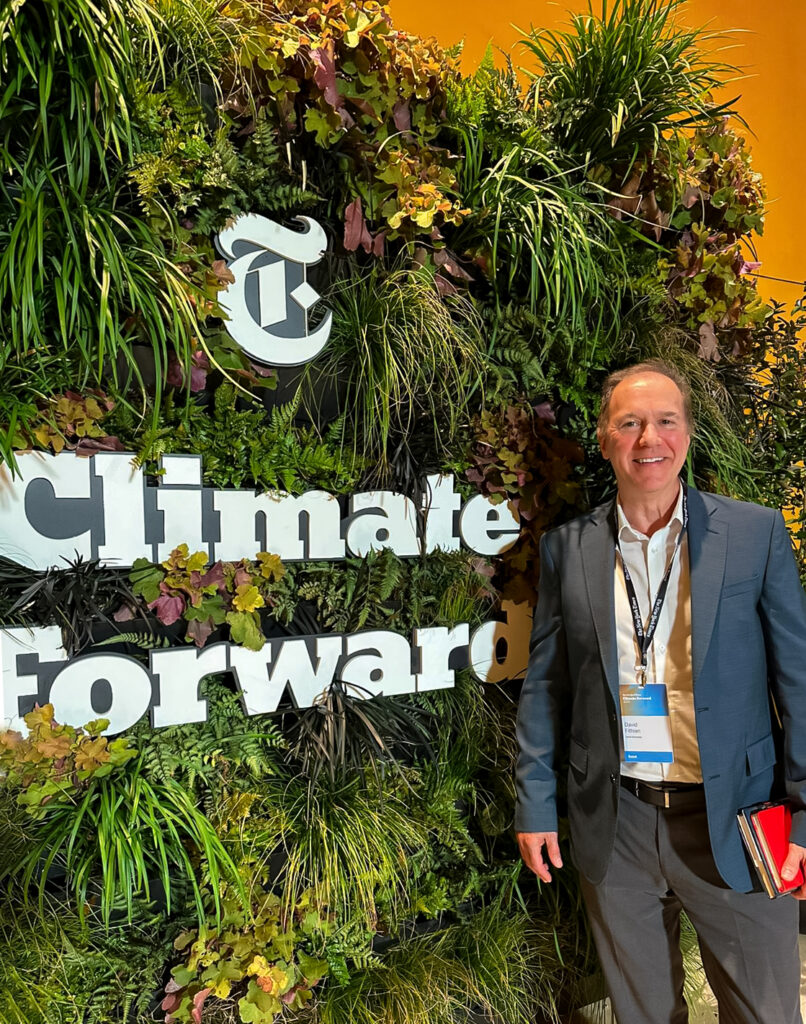
At this week’s gathering, President David Fithian attended the daylong New York Times Climate Forward events, where journalists, scientists, and government officials bore into the most urgent climate-change challenges.
Lou Leonard, the D.G.A. Spencer Dean of Clark’s School of Climate, Environment, and Society, has participated in events throughout Climate Week, including the Green Schools Conference 2025 and the Climate & Nature Hub presentation on the future of international conservations.
Clark faculty also have shared their expertise, participating in panels and conversations that identified research-based tools, best practices, and knowledge to address climate impacts.
Hamed Alemohammad: Earth observation and risk analytics
Hamed Alemohammad, director of the Clark Center for Geospatial Analytics, participated in a panel on “Mobilizing the Ecosystem: Co-creating Future of EO + Risk Analytics.” The panel was one of several held as part of the “Bridging Earth Observation and Risk Analytics” event hosted by Lunate AI, Geospatial Risk Events, and Earthmover.
Reflecting on the discussion, Alemohammad underscored the importance of building stronger cross-sector partnerships: “We need to strengthen the ties between scientists, entrepreneurs, investors, and practitioners by creating shared spaces where ideas and solutions are co-developed. Multi-disciplinary research centers, such as Clark CGA, can serve as neutral brokers to translate between these worlds and ensure science drives real-world impact,” Alemohammad said. He also highlighted the importance of training multi-disciplinary practitioners, which Clark is investing in with the establishment of the School of Climate, Environment and Society. The event emphasized the need to build sustained momentum beyond research labs, ensuring that Earth observation truly powers risk analytics at scale.
Denise Humphreys Bebbington: Extractives and ‘just’ energy
Denise Humphreys Bebbington, research associate professor in the Department of Sustainability and Social Justice and co-director of Center for the Study of Natural Resources Extraction and Society (Extractives@Clark), was slated to attend a range of events, including the panel “Can Carbon Projects be Community Led?” with Tracey Osborne of University of California Santa Merced, who leads the Climate Alliance Mapping Project.
Bebbington also was to attend events hosted by the Ford Foundation, including “Make the Polluter Pay: Environmental Genocide and Just Energy Transition” — which was to feature a report on the Niger Delta contamination — and the launch of the Jane Fonda Gender and Climate Justice Fund. Clark alumni Anna Bebbington, M.S.-GISDE ’22, and Lara Jordan, M.S.-GIS ’23, co-workers at Earth Insight, presented at the “Leveraging 30×30” event.
Last week in Dana Commons, Extractives@Clark hosted the panel, “Reflecting on the Energy Transition: Where Are We and Where are We Headed?” The event was tied to a three-day meeting at Clark of university-based and research center-based scholars focusing on mineral extraction, energy transition, and related justice issues.
Recently, Extractives@Clark received a Ford Foundation grant to support building a conversation between academia, policy centers, practitioners, and grassroots leaders around issues of natural resources extraction, environment, development, community rights, and sustainability.
Jim Murphy: Growing ‘green steel’ industries
Jim Murphy, director of the Graduate School of Geography, participated in a Sunday roundtable about U.S.-Zimbabwe business relations (not a Climate Week event) that included the country’s minister of foreign affairs and international trade. He followed that on Monday with a Climate Week roundtable on “Green Steel,” with high-level representatives from iron production, steel, equipment manufacturing, and data center sectors — all part of a value chain linking steel production to so-called “hyperscalars” that use steel products for data centers (IT, mechanical, electrical, and building equipment and materials).
“The conversation was very applied, pragmatic, and business-oriented,” Murphy says, “and it focused on how to overcome the barriers — finance, price, volume, access, and green energy availability in particular — limiting the ability to grow the green steel industry and thus ‘green’ data centers, which are currently major source of emissions and other kinds of pollution.”
Christopher Williams: Protecting forests to curb climate change
Christopher Williams, professor of earth system science within the Graduate School of Geography and director of the Environmental Sciences Program, is participating in two panels: “Avoided Forest Conversion: Building a Coalition for Targeted Policies and Protections for Forests at Risk” and “Carbon Credit Market Innovations: A Level-Setting Conversation with Corporates, Policymakers, Communicators, and Scientists.”
“Our research group at Clark has a long-standing partnership working with land trust and conservation practitioners to provide the data and tools needed to track deforestation in the U.S. and assess its climate impact,” Williams said of the first panel. “We are also developing communications and information platforms that prime it for impact, offering decision support for policymakers and land managers.
“This relationship has been fantastic. It is helping us to design our research so that it meets real-world needs, bridging from basic research to meaningful impact. The team has been collaborating for several years, with funding from various sources, but the current phase is made possible thanks to the generous support of the Doris Duke Foundation.”
The Avoided Forest Conversion initiative translates data and science on forest loss and related emissions into user-friendly maps, tools, and policies to advance forest conservation as a critical natural climate solution.
The panel on “Carbon Credit Market Innovations” will be held Sept. 26 in The Nature Conservancy’s New York office, with Williams as a roundtable participant and subject matter expert on carbon and climate science. Panelists are discussing applied research that can be rapidly adopted while improving quality and confidence in nature-based carbon markets.