
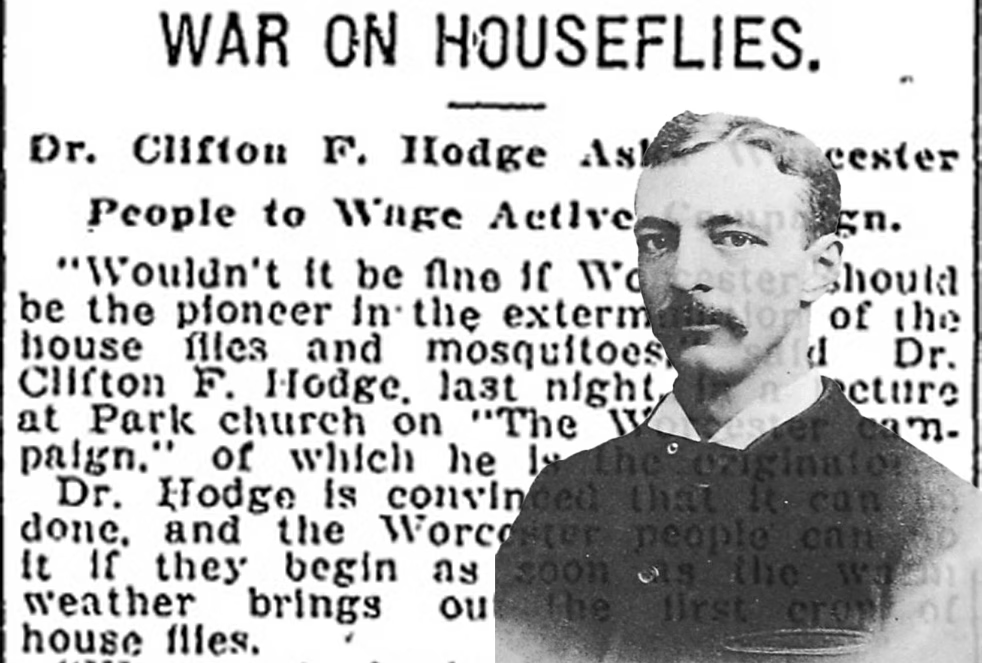
In the April 7, 1911, edition of the Worcester Telegram — sandwiched between reports on an Easter festival and a speech by a district nurse — readers were confronted by a provocative headline:
WAR ON HOUSEFLIES.
“Dr. Clifton F. Hodge Asks Worcester People to Wage Active Campaign,” the subheadline read.
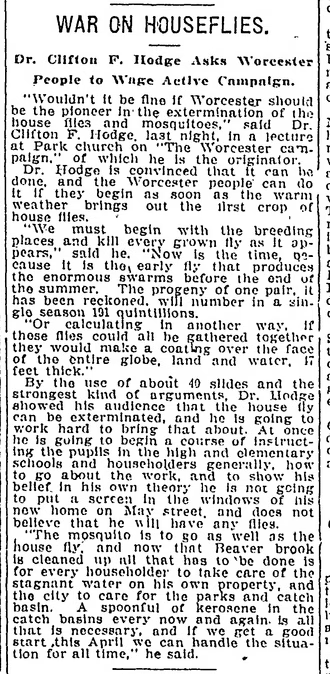
The short news item was about a lecture Biology Professor Clifton Hodge had given the night before, in which he shared his belief that Worcester could become a pioneer in housefly eradication.
“By the use of about 40 slides and the strongest kind of arguments,” the story notes, “Dr. Hodge showed his audience that the house fly can be exterminated, and he is going to work hard to bring that about.”
Hodge told his audience that the “early fly” produces enormous swarms by the end of summer. “The progeny of one pair, it has been reckoned, will number in a single season 191 quintillions.”
“If we get a good start this April we can handle the situation for all time,” he added.
The following is adapted from “Clark University: A Narrative History, 1887–1987,” by William Koelsch (Clark University Press, 1987).
Clifton F. Hodge, a young University of Wisconsin neurologist who had earlier been a fellow in psychology at Clark University, joined the Clark biology faculty in the 1890s. When the college was established, Hodge taught in that also, and proved to be a popular undergraduate teacher.
Hodge also became interested in the pedagogy of biology, developed educational programs in cooperation with the Worcester public schools, and, along with President G. Stanley Hall, became a leader in the nature study movement of the 1910s. His enthusiasm was such that he even wrote nature study skits for the Youth’s Companion in order to interest the largest possible youthful audience. He served on the original editorial committee of the Nature Study Review and wrote a widely used manual for teachers, Nature Study and Life (1902).
In 1909, Hodge coordinated a national effort to find an undisturbed passenger pigeon nesting site in a vain attempt to preserve the bird (the species entered extinction in 1914). In 1911, in cooperation with the Worcester Telegram, he organized the city’s schoolchildren in a widely publicized effort to make Worcester the first fly-free city in America (apparently, he was convinced that flies spread typhoid). Prizes were awarded for killing and bringing in the most flies.
By the close of the contest, Worcester had 16,267,088 fewer flies.