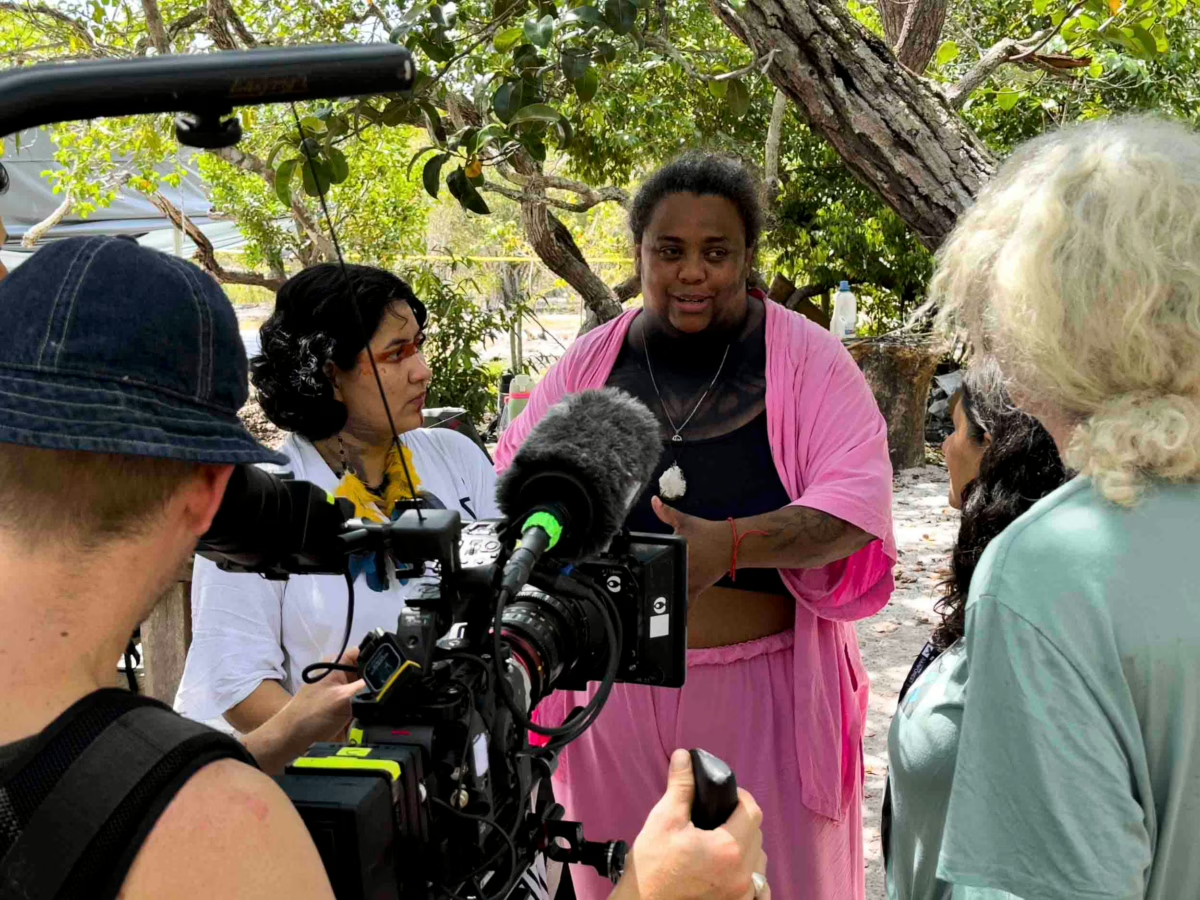
Marina Mura, left, an Indigenous scientist, joins Kamila Camilo, director of Insituto Oyá, for an interview during team ETH BiodivX’s portion of the 2024 XPRIZE Rainforest competition. Mura and Gabriel Nunes are co-chairs of the Indigenous Peoples and Local Communities Science Endowment Fund, announced at COP30. (Photo courtesy of team ETH BiodivX)
At COP30, Clark supports Indigenous peoples’ fight to be heard
A key takeaway from the United Nations’ COP30 climate talks this month in Brazil has been the essential involvement of Indigenous peoples in protecting forests and public health, according to representatives from Clark University’s School of Climate, Environment, and Society who attended the conference.
“Indigenous peoples are not a side note; they are the frontline protectors of forests and community health, and an integral part of achieving Paris Agreement goals,” according to Lou Leonard, inaugural D.J.A. Spencer Dean of the School, and Geography Professor Florencia Sangermano, whose takeaways were posted to social media on Nov. 17. The next day, Geography Professor Abby Frazier also joined the conference, held in the city of Belém.
At COP30, Sangermano and her colleagues on the global research team ETH BiodivX announced the establishment of the Indigenous Peoples and Local Communities Science Endowment Fund (IPLC Science Fund), which supports Indigenous and local communities in addressing conservation issues in the Amazon rainforest.
The initiative “represents a fundamental shift in conservation financing by placing Indigenous Peoples and Local Communities (IPLC) at the forefront of funding decisions,” according to the team members’ Nov. 17 statement.
“By announcing this fund at COP30, where Indigenous communities are fighting for their inclusion in climate actions and decisions, we convey that we hear them, see them, acknowledge them, and are with them,” Sangermano says.
Co-chairs of the fund include ETH BiodivX team members Marina Mura, an Indigenous scientist, and Gabriel Nunes, a science lead at the international nonprofit organization GainForest who was born and raised in a community on the Río Negro, a major tributary of the Amazon River.
“We decided to create this endowment fund to empower Indigenous and local communities to lead conservation projects on their own, or in collaboration with other scientists.”
— florencia sangermano
The fund allows for the creation of an Indigenous Data Council, through which “IPLC representatives will evaluate submitted projects and approve only those that align directly with their community’s values and priorities,” according to the team.
“For too long, conservation funding has operated through grant-based models that make it nearly impossible for nature stewards to compete with global universities and well-resourced institutes,” Nunes says. “Even when Indigenous communities receive funding, financiers often impose their own priorities on conservation activities, creating misalignment with the priorities of Indigenous people doing the actual conservation work. This fund changes that by putting financial power directly in the hands of nature stewards.”
The effort is supported by a $250,000 bonus award that team ETH BiodivX — which has included members of Indigenous and local communities — won in 2024 as part of the five-year, $1 million XPRIZE Rainforest competition. Starting with 300 teams, the competition was narrowed to six finalists who headed to Brazil’s Amazon rainforest in summer 2024. Each used technically advanced techniques to rapidly survey a 38.6-square-mile area and produce reports on tropical forest biodiversity in just 72 hours.
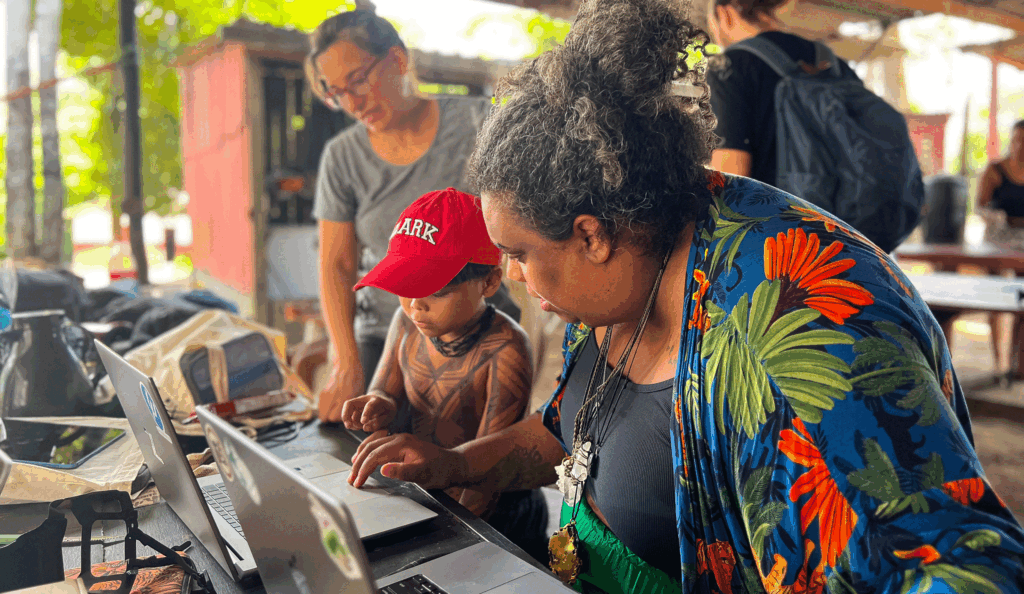
“During the XPRIZE Rainforest competition, our team recognized that successful conservation requires the active participation of Indigenous and local communities, and that their knowledge is essential for conservation science,” Sangermano says. “We decided to create this endowment fund to empower Indigenous and local communities to lead conservation projects on their own, or in collaboration with other scientists, by providing financial support, technology, and research and capacity-building networks.”
ETH BiodivX has shared cutting-edge technologies — including AI, machine learning, acoustics, and drone imaging — with Indigenous and local communities in the Amazon so they can “monitor natural resources vital for local economic resilience and territorial permanence, exploring the crucial socioeconomic dimensions of biodiversity data,” according to team members.
“There is a lot of talk about funds to save, protect, or reforest the Amazon, but those who live here are rarely included,” co-chair Mura says. “To understand a territory, you must listen to those who were born and breathe in it. Projects made about the Amazon, but without the Amazonians, end up being superficial … views from the outside, from above the trees. We want to change this.”
Protecting Indigenous lands and public health
In the opening days of COP30, Sangermano and Leonard attended a key meeting on “nationally determined contributions,” or NDCs, the targets and actions agreed to by governments signing the Paris Agreement, the legally binding international climate treaty.
“Indigenous communities have been protecting the Amazon for centuries, and the way of managing the land has been successful, so what Indigenous communities want is their voices to be heard and incorporated into the NDCs, their knowledge, and also their way of managing the forest,” Sangermano said in a video interview from COP30.
She attended a panel by Indigenous and local community members — including Clark geography alum Mireya Bravo Frey, M.A. ’14, Ph.D. ’16, now with the Instituto del Bien Común (Institute for the Common Good) in Lima, Peru — who discussed incorporating Indigenous knowledge, participation, and practices in implementing climate strategies in the Amazon.
Conservation of Indigenous Territories in the Amazon not only protects the rainforest, which plays a significant role in regulating the global climate and harbors 10 percent of the known species on Earth, it also can help humans, according to Sangermano.
In a study published recently in the Nature group journal Communications Earth & Environment, she and her research collaborators in Brazil reported that Indigenous Territories in the Amazon rainforest can help ward off forest fire-related illnesses and, in many cases, animal- and insect-borne diseases in people.
“What we found is a relationship between Indigenous territories that are legalized, or have secure land tenure, and a decrease in respiratory and cardiovascular diseases,” Sangermano says. “And in the Brazilian Amazon, this can be reflected in 15 million cases of respiratory and cardiovascular diseases that are avoided every year by protecting the Indigenous territories.”
Inclusion of Indigenous voices in Hawai‘i and the Pacific Islands
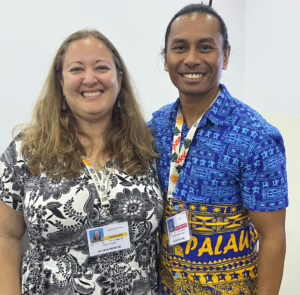
During the second half of COP30, Frazier connected with one of her NOAA Pacific RISA climate research collaborators, Xavier Matsutaro, national climate change coordinator for the government of Palau in the Pacific Islands. He moderated a COP30 panel on “Resilient Blue Futures: Pathways for Island Climate Action and Prosperity,” emphasizing the importance of international partnerships and ensuring that communities receive the economic resources they need for climate adaptation.
Frazier has long advocated for involving Indigenous and local communities in adaptation efforts in Hawai‘i and the Pacific Islands, where she studies the changing climate and severe weather events. She was lead author of a regional chapter in the United States’ Fifth National Climate Assessment, which in 2023 emphasized the importance of centering Indigenous peoples and their knowledge systems in climate-resilience plans for Hawaiian and Pacific Island communities.
“Indigenous knowledge systems and stewardship are foundational in responding to climate change, but generations of knowledge have been undervalued, suppressed, and ignored by Western science and were only recently recognized as valid knowledge sources at the federal level,” researchers report in the chapter on Hawai‘i and the Pacific Islands. “Filling these data gaps could better enable data-driven decision-making and improve climate services in the region.”