Day of events celebrates the opening of the School of Climate, Environment, and Society
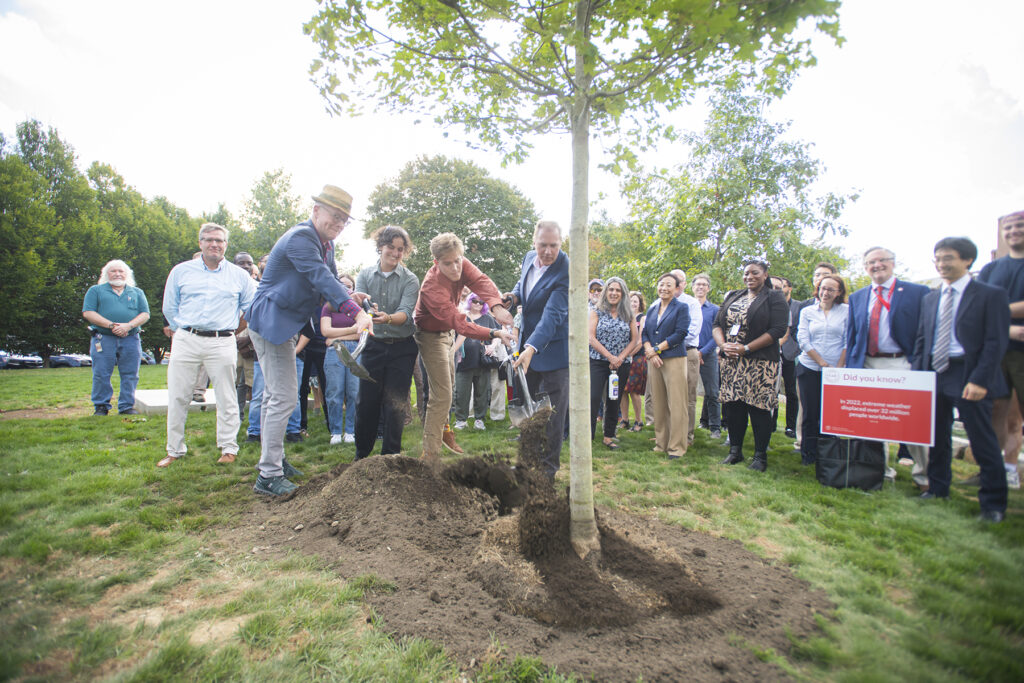
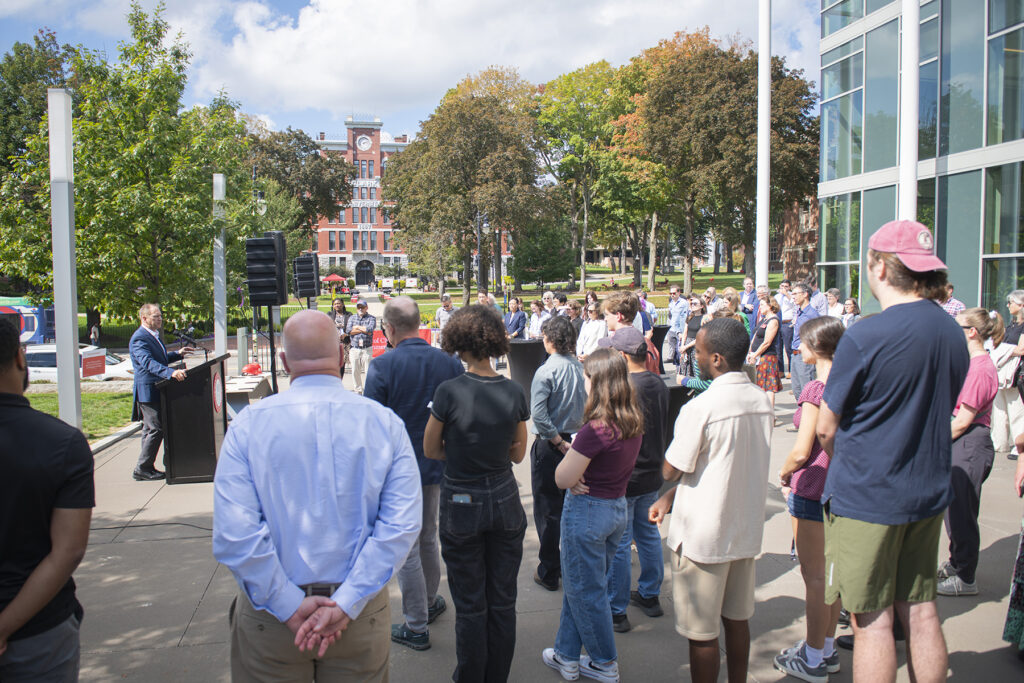
With two shovelfuls of dirt applied to the base of a red maple that now grows beside the Shaich Family Alumni and Student Engagement Center, Clark University on Monday signaled its enduring commitment to confront the most pernicious threats to the health of the planet.
The tree-planting ceremony was part of a daylong series of events to celebrate the launch of the School of Climate, Environment, and Society.
The School advances integrative research, education, and engagement to understand and sustain Earth’s systems, and seeks equitable and just solutions to those threats through intensive academics and deep collaborations with communities and organizations on the frontlines of change.
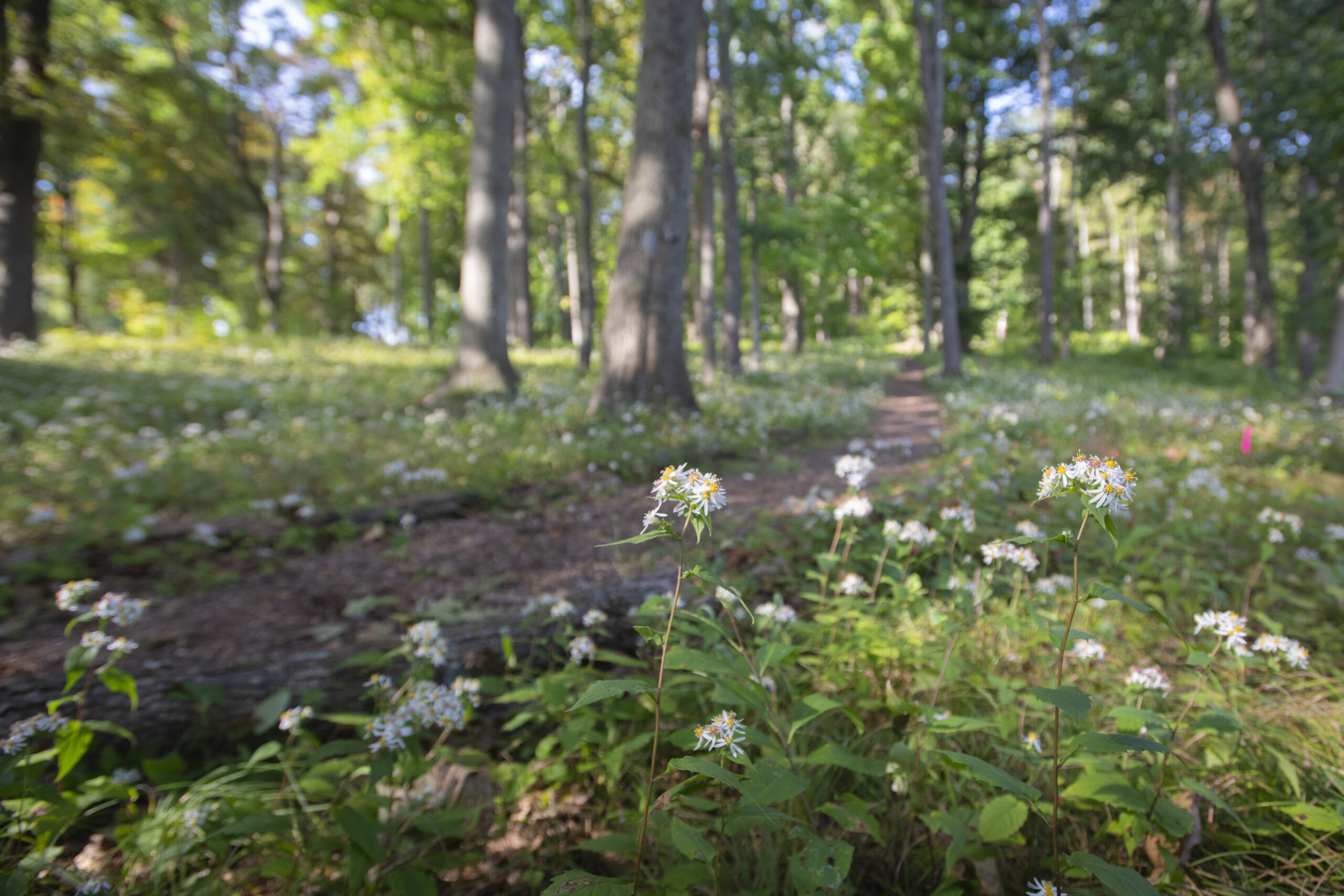
To acknowledge the School’s mission and highlight its offerings, Monday’s kickoff began with a guided tour of Clark’s 26-acre Hadwen Arboretum, moved onto campus with student-oriented activities and information sessions, and concluded with a bat observation and walk at nearby Coes Pond.
In his remarks before a gathering of students, faculty, and staff in the ASEC plaza, President David Fithian cited Clark’s deep legacy of work in the climate-and-environment sphere, including its focus on human ingenuity and impact. Clark, he said, “makes the most of our strengths and our opportunities, and we do everything we can to contribute directly to teaching, research, and community impact.”
Clark faculty, he added, have conducted relevant research across the globe.
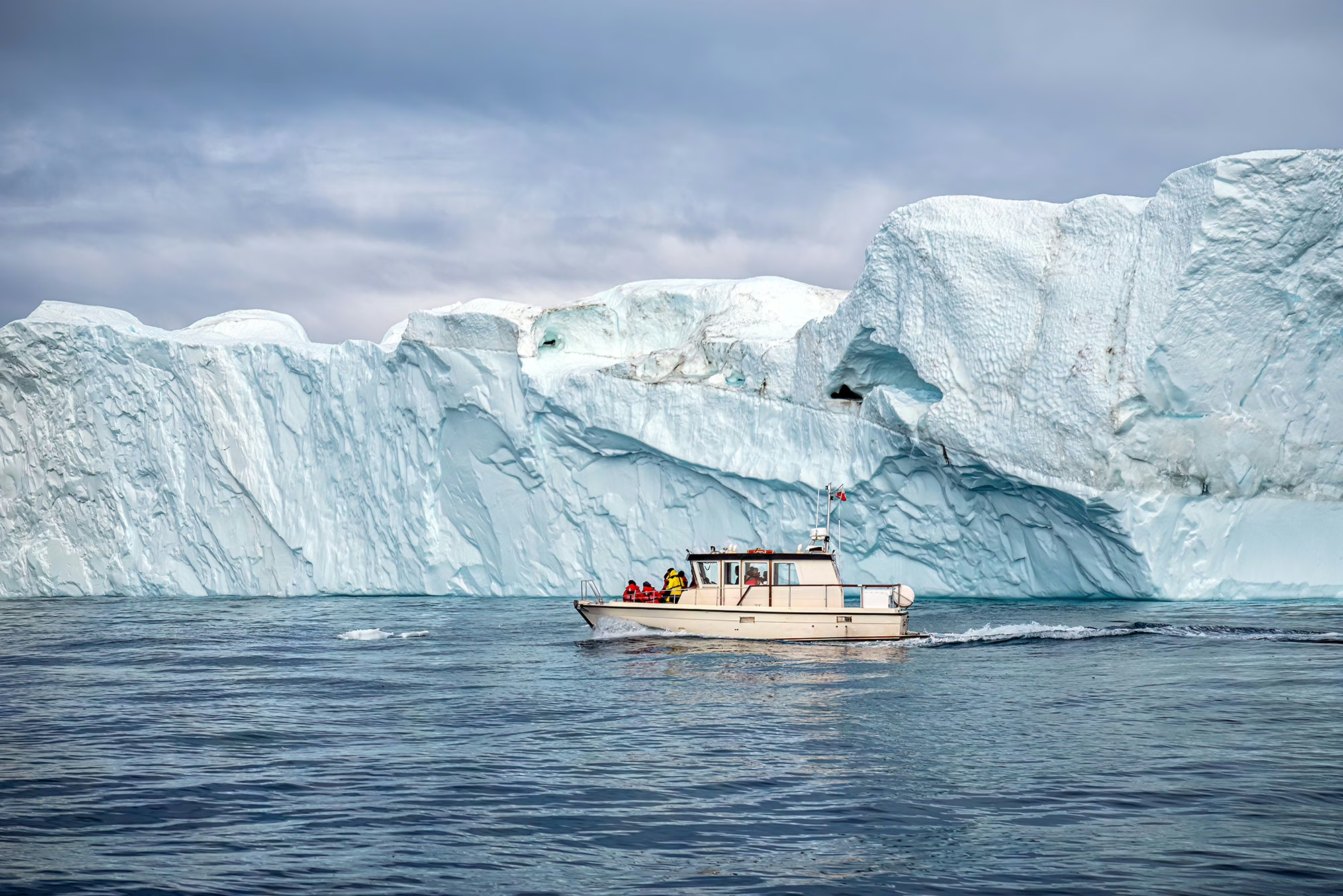
“We’ve been in the Arctic on the ice; we’ve been in farms in Southeast Asia and Central America. We’ve been in forests in the Midwest. For an institution of our size and scale, the impact that they have is truly impressive,” Fithian said.
Crucial to the School’s elevation from concept to reality was a $10 million gift in 2024 made by philanthropist and former trustee Vickie Riccardo and her daughters, Jocelyn and Alyssa ’17 Spencer, he said. The cornerstone gift, which established the position of D.J.A. Spencer Dean and facilitated the creation of the Vickie Riccardo Climate Catalyst Fund to help support the School’s development and growth, is emblematic of Clark’s obligation to reassert itself in the battle against climate change.
“Whatever else our students do with their professional careers or their personal lives, climate change is something they will confront over the course of their lifetime,” President Fithian said.
He noted that Clark has funded the planting of 75 trees in the Main South neighborhood, and now has three LEED (Leadership in Energy and Environmental Design) Gold-certified buildings — ASEC, the Center for Media Arts, Computing, and Design, and the Lasry Center for BioScience. These internal efforts, Fithian said, will continue to be amplified, beginning with the reestablishment of the University’s Sustainability and Climate Committee to help ensure that Clark takes decisive local action.
The School of Climate, Environment, and Society emerged as a signature recommendation from the planning and development of Clark’s strategic framework, Clark Inspired. The proposal for the School was developed over two years by working groups, subcommittees, and an implementation team comprising faculty across various disciplines as well as several staff members, and with input from students. The implementation team presented the formal proposal on July 3, 2023.
Clark is meeting the climate moment, said Lou Leonard, the D.J.A. Spencer Dean of the School of Climate, Environment, and Society, but “the world needs us to be an even better version of who we are.”
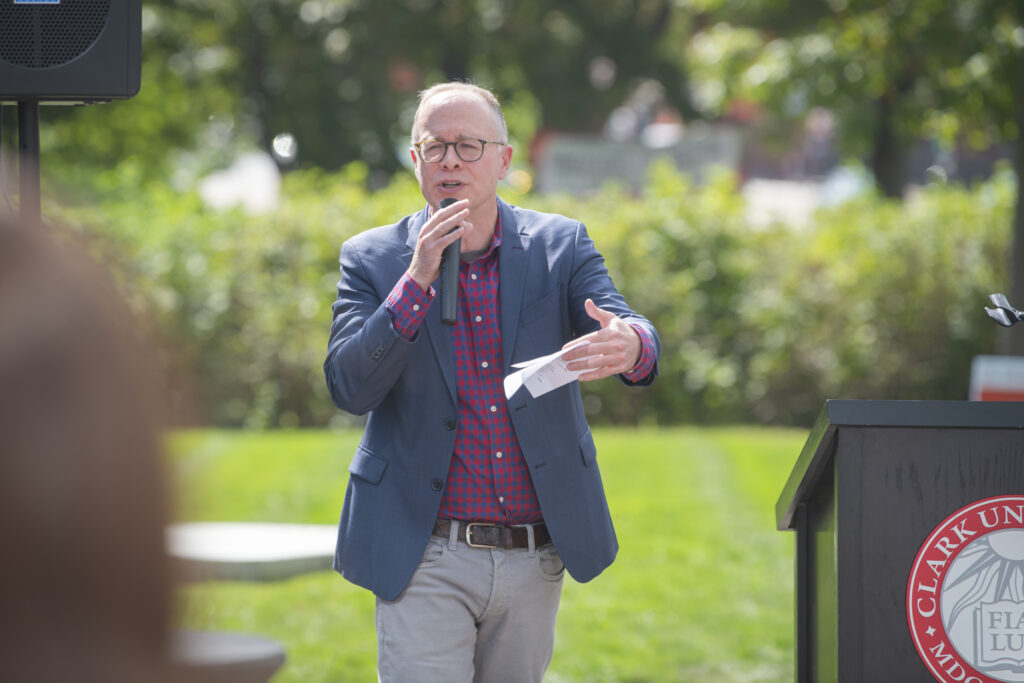
The School is informed by Clark’s “experience-based, applied work with partners to get after real challenges facing this world,” Leonard said. “It’s a moment to engage more with each other here on this campus. It’s a moment to engage with others from the Worcester area. And it’s a moment to engage partners around the world.
“When everything feels broken, and we try to approach problems this big individually, we can get discouraged and walk away. But when we act collectively, when we see the potential of each other and what we each bring to the table, that’s what gives us both the ideas and the energy and the optimism to keep going.
“Hope is a verb; it’s not something that is passive. And we need to generate the energy that leads to more optimism, hope, and action.”
Finding the answers to our most pressing climate problems does not mean handing off the responsibility to the next generation, Leonard said. Intergenerational cooperation will be required to effectively work toward solutions, “and that’s something we have here at Clark.”
The event concluded with Fithian and Leonard, joined by juniors Ruby Lichtman and Zach Rutherford and ringed by Clark onlookers, tossed the soil around the base of the red maple. As that ceremony took place, a serviceberry tree was also being planted near the Clark Community Garden located behind Harrington House.