



When Writing Is the Best Medicine
As a physician, Carolyn Roy-Bornstein ’87 devoted her career to treating the medical needs of patients.
But it’s as an author that Roy-Bornstein has practiced another form of care: using words to inspire, reveal, and heal.
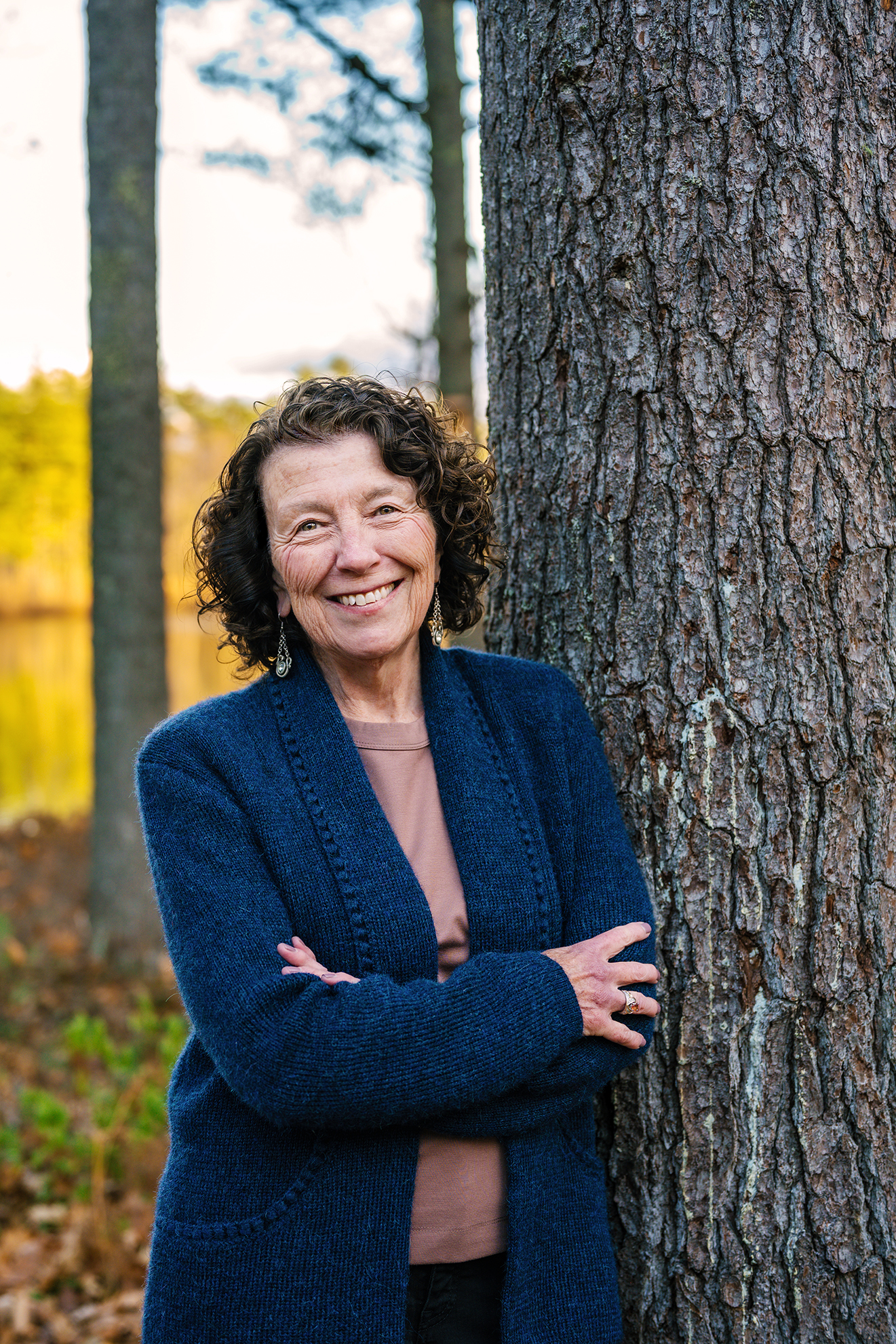
And she’s helping other doctors find their own literary voices. Sometimes, to heal themselves.
Roy-Bornstein has published her fourth book, A Prescription for Burnout: Restorative Writing for Healthcare Professionals (Johns Hopkins University Press). In it, she introduces healthcare professionals to the power of “reflective writing to reconnect them with their deepest selves and renew their sense of meaning and purpose in their work.” Roy-Bornstein is convinced that if writing could help her recover from her own trauma and loss, it can also be an effective tool for her fellow physicians to fend off professional burnout.
“The genesis for writing this book did not come from my own experience with burnout, but rather from my personal revelation that words heal,” she recalls. “In 2003, my teenage son, Neil, was hit by a drunk driver in Newburyport, Massachusetts, in a crash that killed his girlfriend and left him with a traumatic brain injury. Through that painful time, writing helped me process my anger and my disenfranchised grief.” She eventually wrote a memoir about her family’s ordeal, Crash: A Mother, a Son, and the Journey from Grief to Gratitude.
“I have always used writing to process things,” Roy-Bornstein says. “One day after Neil was discharged and home recovering, he got ahold of my journal. It freaked me out a little bit, but what became clear was that the book was filling in memory for him, and he was able to use it like a shorthand to reconstruct that time.”
She has also penned the memoir Through Thick and Thin, about the challenge of dealing with her now-adult foster daughter’s eating disorder.
Her career path included a meaningful stop at Clark. Roy-Bornstein was a nurse in the pediatric ward at Worcester City Hospital, married with two young children, when she enrolled in Clark’s pre-med program. Fascinated by the “puzzle-solving” aspect of medicine, she believed practicing front-line medicine as a physician was her destiny.
She had her doubters — co-workers and others who insisted she was neglecting her family or that her medical aspirations were simply beyond reach. Roy-Bornstein proved them wrong.
“I have memories of going to Clark with those kids in tow,” she laughs. Pre-med advisor Ed Trachtenberg was a supportive ally at every step. “He always had my back.”
Roy-Bornstein went on to practice pediatrics for more than a decade at the Greater Lawrence Family Health Center in Lawrence, Massachusetts, before leaving for private practice, from which she eventually retired. Five years ago, she returned to the Health Center as a writer-in-residence, teaching bimonthly Narrative Medicine workshops that give physicians a communal forum to write and share about their professional journeys.
“Writing helped me get through tragic, deeply personal experiences.”
A Prescription for Burnout addresses some of the same issues Roy-Bornstein tackles in her workshops such as personal vs. professional identity, bearing witness to enormous suffering, and writing to regain agency.
“Books about medical burnout, I feel, are either coming at it from someone who has burned out themselves and wants to share what they have found helpful, or someone who’s done research into it and has some wisdom to impart,” Roy-Bornstein says. “Whereas my perspective is how writing really helped me get through tragic, deeply personal experiences and obstacles. Journaling gave me a place to process all these emotions that I was struggling with on the page.”
“This is what I’m passionate about: bringing that tool to other people in healthcare, whether it’s doctors or nurses, social workers or psychologists.”
Roy-Bornstein sees physicians grappling with the “moral distress” of navigating an inefficient and inequitable medical-delivery system, which can leave them emotionally exhausted, cynical, and questioning their effectiveness. Chronicling their experiences, observations, and perspectives can “help them find meaning and joy while building resilience and empathy,” she says. “The book has chapters about self-confidence and self-compassion, because extending compassion to ourselves is not something we’re very good at.”
Each of Roy-Bornstein’s workshops is centered on a particular theme (grief was a recent focus), the teacher encouraging her students to be mindful of the story taking shape both within them and around them. “Listen for the white spaces” when talking to patients, she advises — those pauses and silences in the conversation as the patient shares their personal medical narrative with the doctor.
“This is what our patients bring to us,” she says. “We invite them to fill that space with the story they need to tell us.”