



From time capsule to space capsule
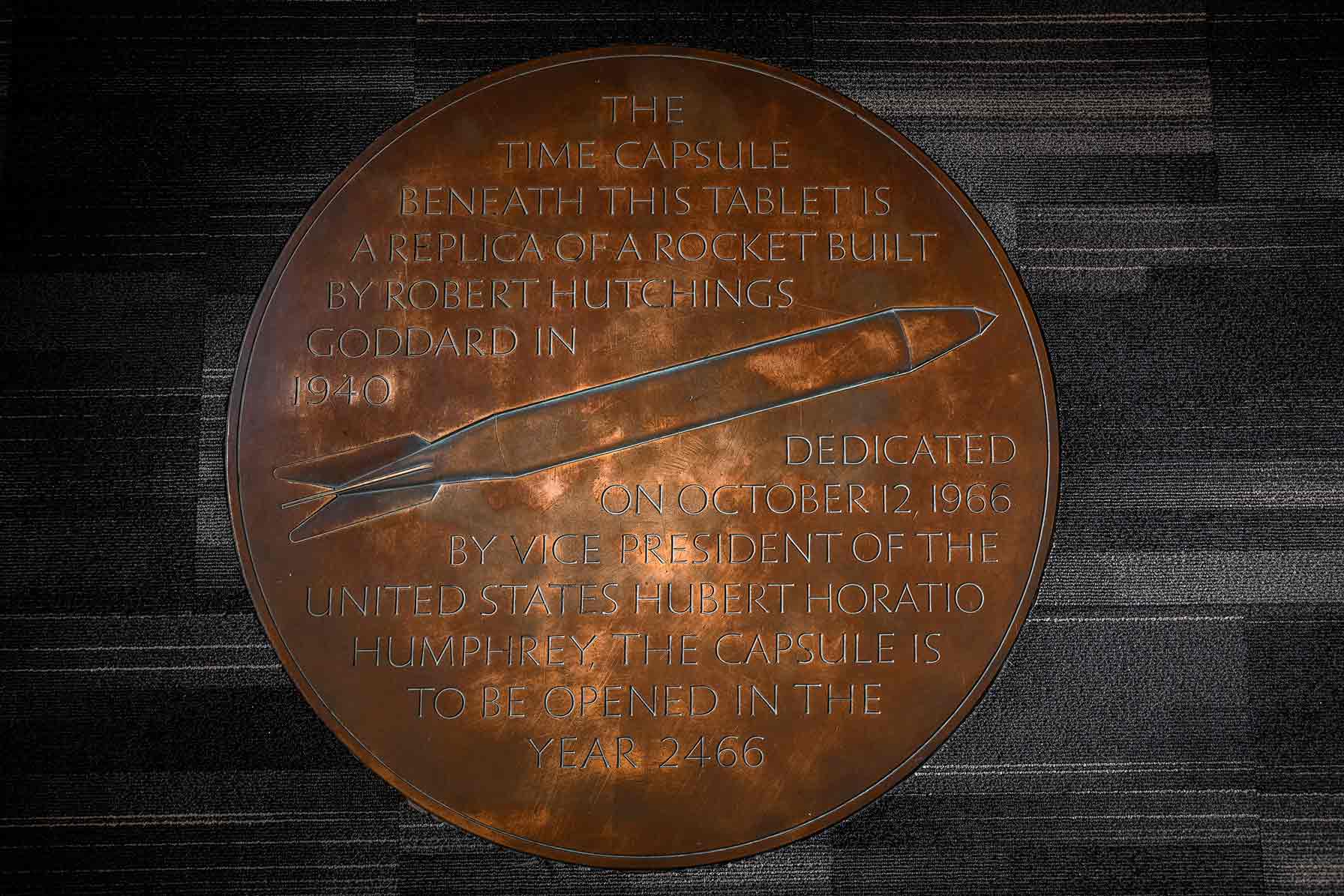
Robert Goddard is responsible for sending rockets far away from the Earth. But 60 years ago, to honor him, Clark buried one deep within it.
On October 12, 1966, in a convocation ceremony at the site of the soon-to-be-constructed Robert H. Goddard Library, a 10-foot stainless steel time capsule shaped like a replica of a 1940s-era Goddard rocket was lowered into the ground, not to be opened until 2466.
The placement of artifacts in the capsule “reminds us of how our culture will be seen by civilizations of future centuries,” said U.S. Vice President Hubert Humphrey, who delivered the convocation address.
It’s difficult to imagine how we’ll be viewed 440 years from now based on the nearly 100 items placed in the capsule. What will a future generation make of a road atlas, or a TV Guide? Or the famous photo of Sigmund Freud at Clark?
Can we at least hope that somehow, someway, the music of the Beatles will have endured, even if no one can quite figure out how to extract sound from the black vinyl disc carrying the voices of John, Paul, George, and Ringo?
“What will a future generation make of a TV Guide?”
A 55-member committee selected the items that were buried, and took care that they covered four distinct categories: Goddard Memorabilia (eight of the scientist’s patents are included), the Space Age (a retro rocket from the first Apollo mission, cloth from a spacesuit), Clark History (Jonas Clark’s will, copies of The Scarlet), and Contemporary Life (a miniskirt, Batman comics, a box of breakfast cereal).
Among the more meaningful inclusions are a vial of soil from Pakachoag Hill in Auburn, Massachusetts, where Goddard executed the first successful launch of a liquid-fuel rocket, and a vial of sand from Roswell, New Mexico, where he refined his rocketry technologies. Three years later, astronaut Buzz Aldrin would cut the ribbon on the new library and, shortly after that, leave footprints in moon dust.