


Curating a legacy, and a legend
In the storage area of Clark University’s Archives and Special Collections, shelf after shelf is lined with boxes that hold the life’s work of a man who dreamed of the stars. Letters, diaries, patent filings, archival boxes bursting with newspaper clippings—the Robert H. Goddard Collection is vast, irreplaceable, and unique to Clark. And for the past year and a half, two dedicated Clark employees have been working to bring that collection into the digital age, one scanned page at a time.
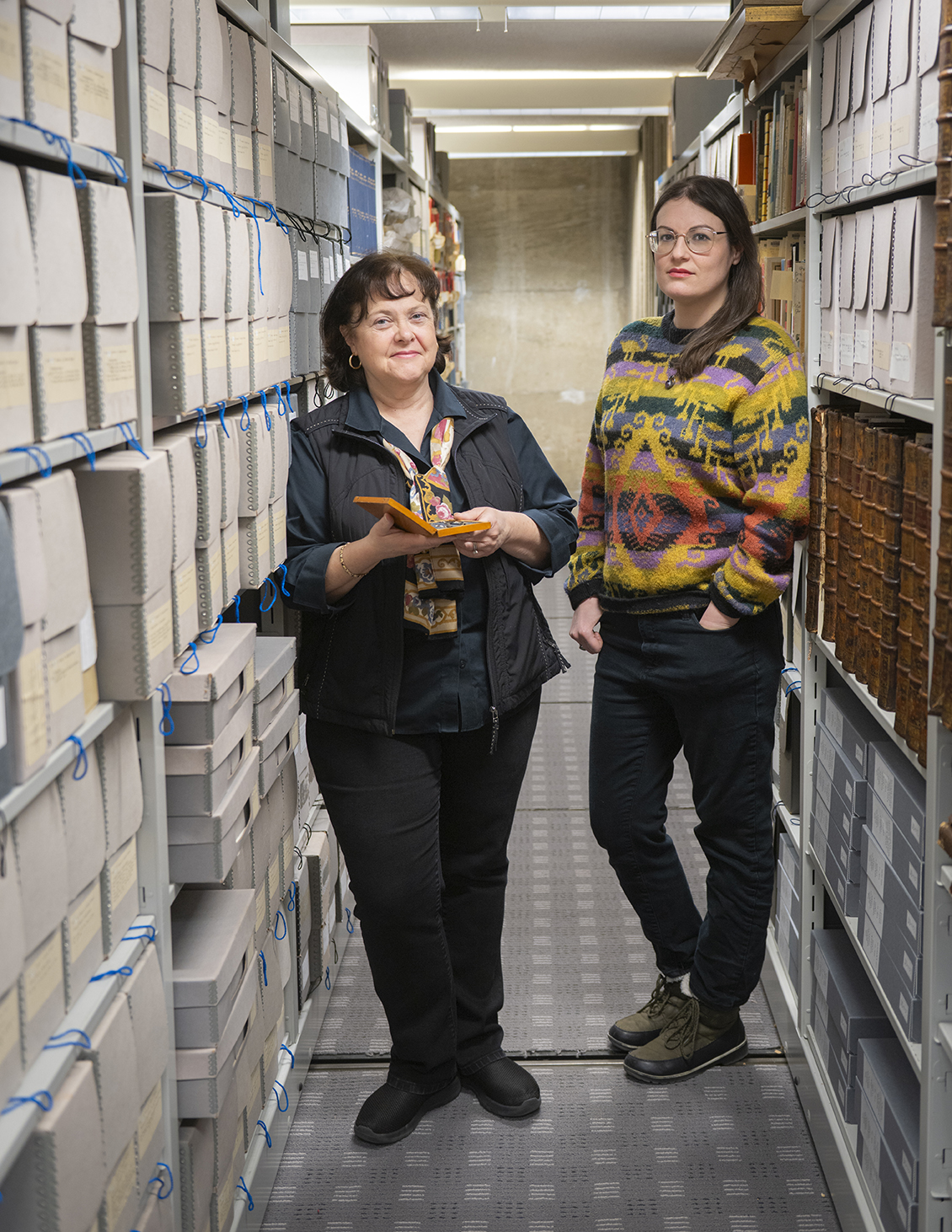
Cynthia Shenette, head of archives and special collections, and Catherine Stebbins, digital projects librarian, began their deep dive into the Goddard materials about 18 months ago. The centennial of Goddard’s pioneering liquid-fueled rocket launch on March 16, 1926, was approaching, and they knew the moment called for something ambitious. What they found when they turned their full attention to the collection far exceeded their expectations.
Before they began their quest to digitize portions of the collection, the only resource available on Clark’s Digital Commons repository was the finding aid to the Robert H. Goddard Papers, an index to everything in the collection, which is more than 100 pages long. None of Goddard’s actual papers or materials were accessible online. They were starting from scratch.
The work has been painstaking—flatbed scanning one delicate page at a time. Students helped with the scanning, but “we wanted to do it right, to provide enough context,” Stebbins says. “Visitors are given the space to understand what they’re looking at and where it fits in the collection. We’re not just dropping a picture and giving a date.”
The digitization has drawn researchers from around the world, from Singapore to England, and has generated a steady stream of information requests, particularly in the months leading up to the anniversary.
Stebbins notes that Shenette’s expansive knowledge of the collection’s contents and her handling of research requests have been crucial to determining the most impactful digital assets—such as Goddard’s early press coverage. The collection includes boxes filled with editorial cartoons from the early 1920s, when the media latched onto a single passage in a 1919 research paper in which Goddard posited the idea of sending flash powder to the dark side of the moon. “All of a sudden, it’s being printed as fact that he’s going to the moon, that there are passengers, that people can volunteer, that we’re going to Mars,” Stebbins says. “None of it was true. And yet it was everywhere.”
Shenette and Stebbins are quick to point out that another collaborator has shaped this project: Esther Goddard, who spent decades after Robert’s 1945 death meticulously organizing, transcribing, and curating her husband’s papers, diaries, patents, and more. Her official collection of his papers, a three-volume set published in 1970, totals more than 1,700 pages. All of Robert’s materials came to Clark later that decade, and her own papers were willed to the University after her 1982 death (read more about Esther beginning on page ##).
Esther photographed and filmed his experiments, and Clark has those photos and film reels in the collection. “She was the curator, the image-builder, the manager of his life,” Stebbins says. “We look at him as this larger-than-life figure, and that’s because of Esther.”
“If she wasn’t there, where would all of this have gone?” Shenette wonders. “Some might have been saved, but it certainly wouldn’t be in the shape it is.”
The librarians hope to ensure that Goddard’s world-changing work will not be lost to history. “He’s a gateway,” Stebbins says, “to Clark, to science, to space, to innovation in general. To curiosity.”