

No Animal Left Behind
Sue Furtado ’85 did not plan to become an animal rescuer. She planned to retire. But life, as it tends to do, intervened — in the form of a conference, a plane ride, and a sudden, clear conviction that something had to be done to help thousands of animals find homes.
Furtado’s solution is WAGS (Waiting Animals Getting Support), a foster-based animal rescue based in Dighton, Massachusetts. The name was deliberate. “We never wanted to be limited to helping only certain kinds of animals,” Furtado says. True to that promise, WAGS has since helped donkeys, pigs, horses, parrots, gerbils, hamsters, cats, chickens, a very large snapping turtle, and—in a story Furtado tells with a measure of pride—two-day-old kittens she drove to safety, at high speed, with both animals tucked inside her bra.
“If I get pulled over by an officer right now,” she remembers thinking, “what are the chances I’m going to pass the mental status assessment?” She made it. The kittens, named Tater and Tot, made it, too.
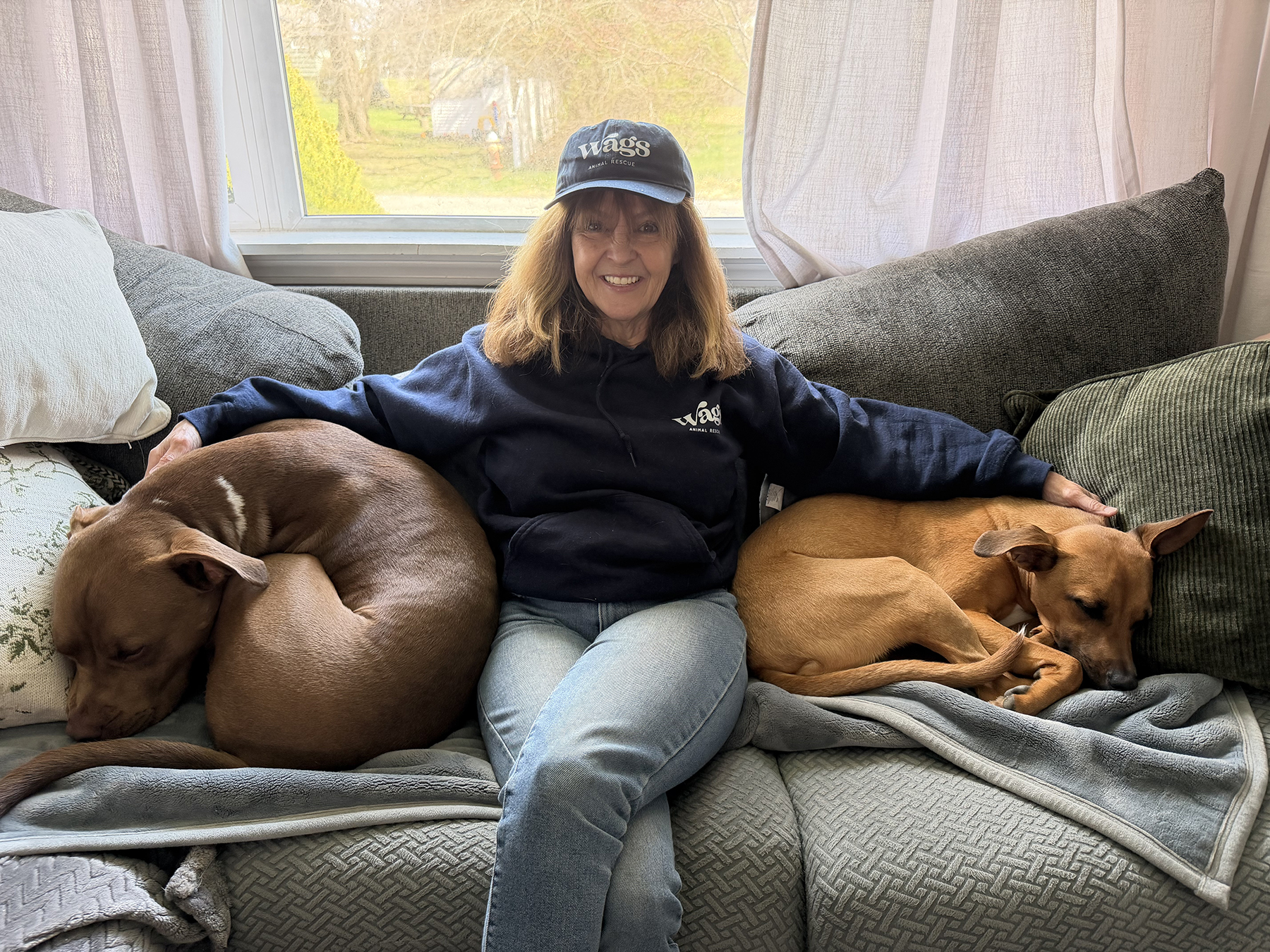
Her own two dogs reveal a similar story. Oliver, a pit bull, was 32 minutes from euthanasia at Brooklyn Animal Control when Furtado drove down from Massachusetts to rescue him (she picked him up on the same trip she’d taken to collect her daughter from Clark for spring break). Bella, a 95-pound Coonhound-shepherd mix, was born in a chicken coop in winter and surrendered by an owner who just wanted his coop back.
“Clark attracts a certain person, then builds a certain person. We all go there because we belong there.”
Before WAGS, Furtado spent 22 years working with adolescents in state care —children placed in custody because of abuse, neglect, and trauma. She built residential continuums, as well as educational and vocational programs, when public schools and other community institutions wouldn’t, or couldn’t, serve the kids. Furtado now serves as director of quality management for a large social justice agency, overseeing 150 programs, from housing for people experiencing homelessness to programs for survivors of sex trafficking and residential schools for youths in care. It is not a small job, and she runs WAGS — which is funded solely by donors and fundraising — “in the hours that are left over,” she says.
The through-line between her two callings, she says, is unmistakable. “Both populations are somewhat invisible,” Furtado explains. “The majority of the world doesn’t even realize there are group homes and residential schools in every community. And the same thing with the rescue community.” She cites a figure that stops most people cold: more than 3,500 healthy dogs are euthanized every day in the United States, and twice as many cats.
“Dogs never get a voice,” she says. “There is no one to say ‘That dog is being starved in a crate.’ ” It is the same sentiment she has expressed about children for decades.
WAGS was born somewhere over the Atlantic, on a flight home from a Humane Society International expo. Furtado had attended the conference partly for her agency, which uses therapy animals in several programs, and partly out of personal curiosity. Her daughter Alexandra ’19, then finishing her first year at Clark and following in her mother’s footsteps as a psychology major, came along on a free voucher. They split up the sessions, compared notes, and boarded the plane home.
“On the plane ride back,” Furtado says, they made the decision to open their own animal rescue. “We were like, ‘OK, let’s just do it.’”
They were saving dogs before the paperwork was even filed. Today, WAGS is licensed in Massachusetts, New Hampshire, and Maine, with Rhode Island on the horizon. It has placed animals in 32 states and rescued animals from just as many.
There is no physical shelter; every dog that comes through WAGS lives with a foster family, which is both the model’s greatest strength and its most persistent constraint.
“I think often people think we’re much bigger than we are,” Furtado says, “because we’ve had some great successes.” People regularly show up at her front door expecting a shelter, and are greeted instead by Oliver and Bella at the window.
WAGS is known in certain circles for an extensive adoption process that some prospective adopters insist is more rigorous than adopting a human child. Furtado is proud of that. Every WAGS adoption comes with a contract stating that if the adopter can no longer keep the animal, at any time and for any reason, they must return it to WAGS. They will then look for a new placement and conduct the same rigorous vetting process for the next home.
She asks engaged couples which of them gets the dog if the relationship ends. She asks older adopters what happens to the animal if they become unable to care for it. She asks families expecting children whether they have genuinely thought through how their dog will adapt. These are not comfortable questions, but they are necessary ones, Furtado says.
In the few cases where she has had needed legal advice, she turned to Jeremy Cohen ’92, aka the Boston Dog Lawyer.
“Of course, he would be a Clarkie fighting for the rights of dog owners,” Furtado says. “Where else would he have gone to school?”
If WAGS has an unofficial institutional affiliation, it’s Clark. Furtado graduated in 1985 with a double major in psychology and sociology, and a minor in French. Her French, she notes, was mostly wine and cheese shared with “very cool professors,” and her ability to speak the language has not survived the intervening decades. Alexandra helped build the organization’s early marketing infrastructure from her dorm room and still designs promotional materials from her home in Maine, where she works with people experiencing homelessness and manages three dogs on 35 acres of land that Furtado suspects will eventually become WAGS North.
Two of WAGS’s five board members are Clark alumni. A third Clark friend helps when her schedule allows, bringing expertise in corporate sales and sponsorship. Furtado went into real estate with two of her Clark roommates. Half her donors, it seems, went to school at 950 Main Street.
“It attracts a certain person,” she says of Clark, “and then it builds a certain person. We all go there because we belong there.”