


Norway Maple
Acer platanoides
Introduced to North America in the mid-1700s, the Norway maple is now considered an invasive species in New England, the Great Lakes, and the Pacific Northwest. It is thought that combined with rapid seed dispersal, the tree releases toxins into the soil that inhibit the growth of other plants.
History at Hadwen
The striped red and sugar maples are documented on the Hadwen estate as early as 1882, but the Norway maple is not recorded until 1900 when Hadwen documented the Norway maple as one of the most prominent of his 20 varieties of maple trees. He writes that the maple family is one of “great beauty, and its members are in the front rank of deciduous trees.” He planted many along the streets and roads which gave an “abundance of shade, and are the glory of the autumn.” Little did he know that by the early 1900s, the plant would be identified as an invasive species.
Detailed species information
Norway maple is a species of maple in the family Sapindaceae native to eastern and central Europe as well as parts of Iran. It was introduced to North America in the mid-1700s and was a popular replacement for the American elm (Ulmus americana) following its decline due to Dutch elm disease in the 1950s and 60s. Since then, the Norway maple has become invasive in New England, the Midwest, and the Pacific Northwest.
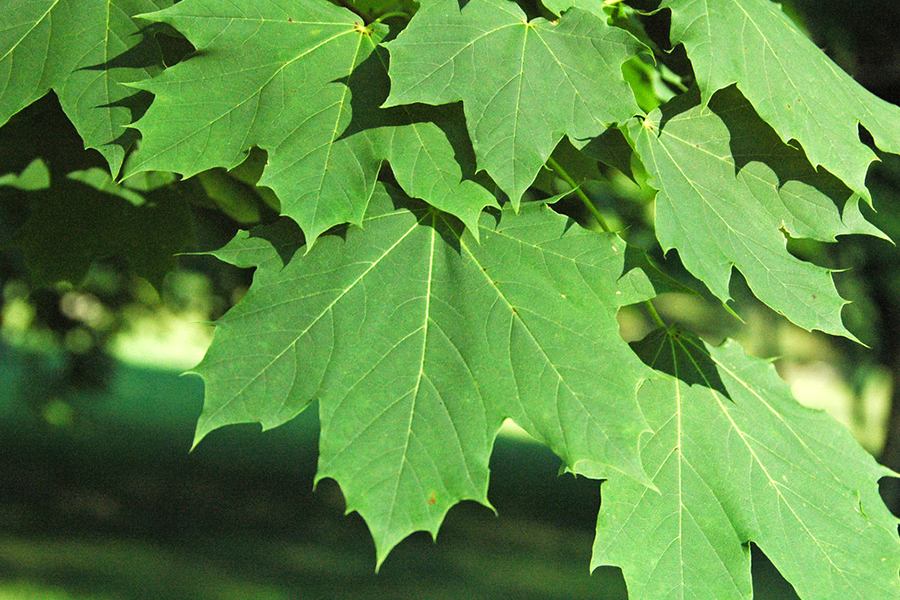
This large deciduous tree grows up to 65–100 feet (20–30 meters) tall and up to 5 feet (1.5 meters) in diameter making it an ideal shade tree. The bark is grayish-brown and considerably smoother than other mature maples native to North America. The leaves are oppositely arranged with five lobes which each feature one to three jagged teeth on the lobe tips. In spring and summer, the leaves are green and fall leaves typically turn yellow or sometimes red or orange. When broken, the leaf releases a white, milk-like liquid not seen in other North American species of maple. The yellow, five-petal flowers emerge in early spring before the leaves and grow in clumps of 15 – 30. The Norway maple typically produces a large volume of wind-dispersed seeds which are contained in the “double samara” characteristic of many maples. This high seed production is considered to be a key factor in the Norway maple’s invasiveness in North America.
Other factors likely contributing to the Norway maple’s invasiveness are its ability to tolerate low light conditions and high germination rates. Further, the majority of Norway maples in North America are believed to be descending from specimens brought from Germany which has similar environmental conditions to areas where Norway Maple is invasive. Despite its widespread invasive status in North America, Norway maple continues to be widely used in landscaping in many urban areas due to the species’ stress tolerance and rapid growth rate. Fortunately, education to spread awareness about the damaging effects of Norway maples is ongoing and the sale of the species is banned in some states, including Massachusetts.