

Black Locust
Robinia pseudoacacia
Black locust is a deciduous tree found throughout temperate North America. It has the ability to fertilize soils by forming a symbiotic relationship with nitrogen-fixing bacteria.
History at Hadwen
There are no records of Hadwen planting black locust at the arboretum. However, a survey conducted from 1974 to 1978 noted that black locusts were numerous, especially along Appleton Trail. Today these trees remain abundant throughout the arboretum and likely were not planted but established naturally due to their hardy nature.
Detailed species information
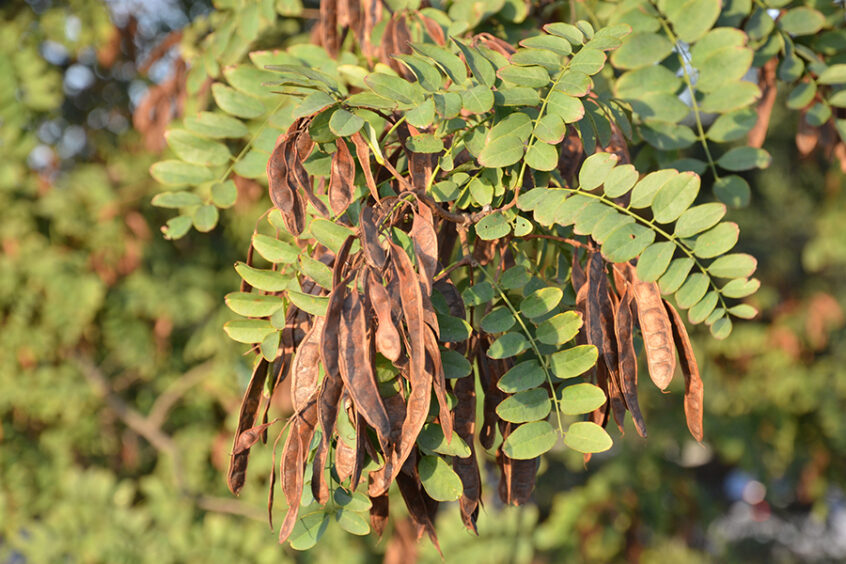
Black locust, also known as false acacia, is a deciduous tree in the family Fabaceae. Originally native only to a small area of the United States, black locust has been introduced and naturalized throughout temperate North America, as well as parts of Europe and Asia. This medium-sized tree typically reaches 80 feet (24 meters) in height. The black locust is typically upright and narrow in form with gray to reddish-black, deeply furrowed bark. The leaves of the black locust are pinnately compound and alternately arranged, with each leaf having thirteen egg-shaped leaflets. The flowers of the black locust emerge in early to mid-spring in large drooping groups of white flowers with yellow centers. They resemble the imperfect shape typical of legume flowers, are very fragrant, and produce large quantities of nectar. Black locusts produce fruits that ripen in autumn in brown pea-like pods. The black locust also features short pairs of prickles along the trunk. The black locust has the ability to form nodules on its roots, allowing it to form symbiotic relationships with nitrogen-fixing bacteria.
This species is intolerant of shade but is otherwise extremely tough. Thickets of black locust can often be found pioneering the edges of roads and disturbed areas. The tree proliferates easily by spreading through underground suckers and producing a large quantity of seeds each season. Its ability to “fix nitrogen” allows it to colonize areas that lack nutrients. These attributes contribute to black locusts being generally considered “weedy” or even invasive in some areas. The black locust is an important source of nectar and pollen and hosts many insects, squirrels, and birds.
Due to its tough nature, black locust is often planted for erosion control and harvested for durable wood. The large quantities of nectar produced are considered to make high-quality honey. The species is also widely cultivated, more so in Europe than in North America. Several cultivars are available, which are selected for thornless and more regular-shaped specimens.