
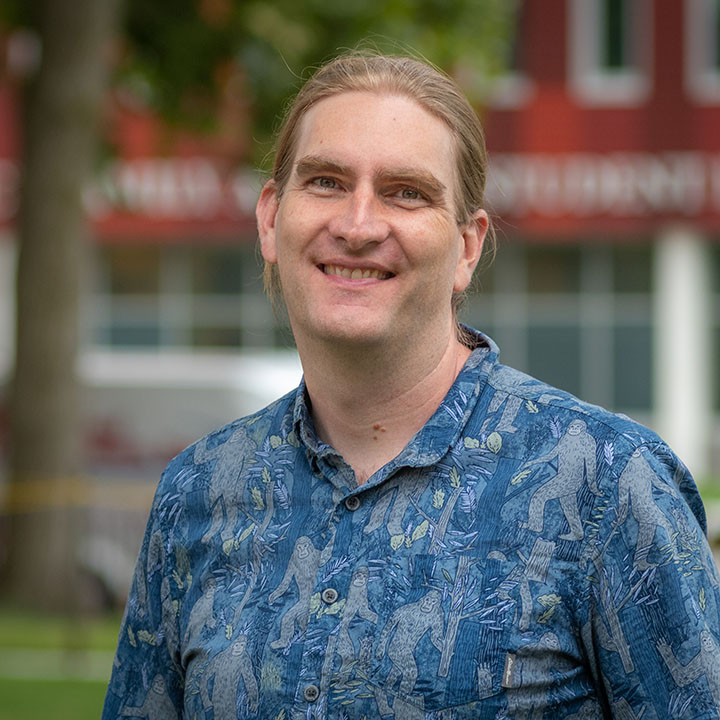
Professor Ahlgren is a marine microbial ecologist. He is interested in understanding how environmental factors and interactions between microbes and viruses shape the evolution, diversity, and structure of microbial communities. Marine microbial communities are extremely diverse and control globally important cycles in the flow of nutrients and carbon on our planet. A fundamental component to understanding their importance to our planet is knowing what factors control and maintain the diversity and structure of these communities. Professor Ahlgren uses traditional culture isolation and laboratory studies along with cutting-edge DNA sequencing and bioinformatics approaches to elucidate key abiotic and biotic microbial interactions, including the impact of viruses on microbial communities. As such, his work addresses a variety of topics such as biogeographic patterns of microbial populations, models of microbial speciation, virus-host interactions, and the development computational tools for studying virus-host interactions.
Nathan Ahlgren
Associate Professor, Biology
- About
- Scholarly and creative works
- Awards and grants
Degrees
- Ph.D. in Biological Oceanography, University of Washington, 2008
- M.S. in Biological Oceanography, University of Washington, 2004
- B.S. in Biology, Massachusetts Institute of Technology, 1999
Affiliated Department
Scholarly and creative works
-
Cyanophage Dynamics at the San Pedro Ocean Time Series: Generalists, Specialists, and One-shot-wonders
-
Diverse Marine T4-like Cyanophage Communities Are Primarily Comprised of Low-Abundance Species Including Species with Distinct Seasonal, Persistent, Occasional, or Sporadic Dynamics
Viruses2023Vol. 15Issue #2 -
New tRNA-targeting transposons that hijack phage and vesicles
Trends in genetics : TIG2023 -
Unraveling the functional dark matter through global metagenomics
Nature20232023Vol. 622Issue #7983 -
Multiple measures of structural racism as predictors of US county-level COVID-19 cases and deaths
Ethnic and Racial Studies2022Vol. 46Issue #5 -
Kettle and Non-kettle Ponds Harbor Distinct Microbial Communities Reflecting Their Underlying Physiochemical Differences
Joint Aquatic Sciences Meeting 2022Grand Rapids, MichiganMay2022 -
Multiple Measures of Structural Racism as Predictors of County-Level COVID-19 Cases and Deaths Across Counties in the United States
Presidential InaugurationPresidential InaugurationApril2022 -
Genomic mosaicism underlies the adaptation of marine Synechococcus ecotypes to several, distinct oceanic iron niches
ProSynFest2020Cordoba, SpainMarch2022 -
Multiple Measures of Structural Racism as Predictors of County-Level COVID-19 Cases and Deaths Across Counties in the United States
Ethnic and Racial Studies2022 -
Genome Sequence of Estuarine Synechococcus sp. NB0720_010
Microbiology Resource Announcements2022 -
Genome Sequence of the Estuarine sp. Strain NB0720_010
Microbiology resource announcements2022Vol. 11Issue #8 -
County-level societal predictors of COVID-19 cases and deaths changed through time in the United States: A longitudinal ecological study
PLOS global public health2022Vol. 2Issue #11 -
The Effect of Residential Segregation on Rates of COVID-19 Cases and Deaths Across Counties in the United States
Journal of Racial and Ethnic Health Disparities2021 -
Niche partitioning of low‐light adapted Prochlorococcus subecotypes across oceanographic gradients of the North Pacific Subtropical Front
Limnology and OceanographyJanuary2021 -
United States County-Level Data Reveal Apparent Disparities in COVID-19 Burden Among Asian Subgroups
2021 -
Long-term stability and Red Queen-like strain dynamics in marine viruses
Nature MicrobiologyFebruary2020Vol. 5Issue #2 -
Genomic mosaicism underlies the adaptation of marine Synechococcus ecotypes to distinct oceanic iron niches
Environmental MicrobiologyDecember2020 -
Identifying viruses from metagenomic data using deep learning
Quantitative BiologyJanuary2020 -
Genome sequence of Synechococcus sp. MIT S9220 and co-cultured cyanophage SynMITS9220M01
Microbial Genome Resources2020 -
A network-based integrated framework for predicting virus-host interactions
NAR Genomics and Bioinformatics2020 -
Comparing chemical properties and microbial communities across Walden and Cape Cod kettle ponds
Cape Cod National Seashore’s Atlantic Research Learning Center (ARLC) 2019 Science SymposiumEastham, MassachusettsSeptember2019Sponsored by Cape Cod National Seashore National Park -
Multi-year dynamics of fine-scale marine cyanobacterial populations are more strongly explained by phage interactions than abiotic, bottom-up factors
Environmental microbiologyAugust2019Vol. 21Issue #8
Awards and grants
-
Building STEM identity and participation at Columbus Park School
Clark University, Collaborative for Community Engagement
Apr. 18, 2024 – Dec. 31, 2024 -
Collaborative research: Characterization of Synechococcus-cyanophage interactions across phylogenetic and temporal scales
NSF
Sep. 1, 2020 – Aug. 31, 2023 -
Using the study of urban impacts on water quality, frogs,and microbial communitiesin Worcester waterways to integrate student research, classroom learning, and local STEM outreach
Clark University
Feb. 1, 2022 – Jan. 1, 2023 -
How does urbanization, including urban gardens, impact ant microbial diversity?
Clark University, Faculty Development grant
Mar. 3, 2020 – Mar. 2, 2021