
Ph.D. in Social Psychology

Research

From studying the psychology of activism to politically motivated intergroup conflict and violence, Clark’s social psychology graduate students analyze some of the day’s most pertinent issues using quantitative and qualitative research methods. Our graduate program ensures students receive extensive research training that builds cumulatively from foundational and more heavily mentored experiences to more independent activities, like building a research portfolio and dissertation research. Much of our faculty and student research takes place within community settings, locally or internationally.

Through lab work, graduate students collaborate among faculty, their cohorts, and undergraduates. Graduate students present their work at external conferences such as the Society for Personality and Social Psychology, the International Society of Political Psychology, or the Society for the Psychological Study of Social Issues and at Clark’s Graduate Student Multidisciplinary Conference, and publish in journals like Feminism and Psychology, the Journal of Social Issues, and Psychology of Men and Masculinity.  Graduate students’ scholarship, along with our faculty’s research, is diverse both in theory and method, which is a mark of distinction and strength across our department’s three programs.

Our faculty has guest-edited special issues in the Journal of Social Issues as well as the European Journal of Social Psychology and founded the Journal of Social and Political Psychology. Their research and expertise have been recognized with funding from the U.S. Centers for Disease Control and Prevention, the American Psychological Association, and the Robert Wood Johnson Foundation, among others.

At the heart of our research are the program and department’s research groups, forums, and lab meetings where faculty, graduate, and undergraduate students discuss common theoretical concerns and research interests. In fact, graduate students are encouraged to work closely with one another, with advanced undergraduate students, and with faculty colleagues in developing their program of research with the goal of growing as an independent researcher.
Recent dissertations

Faculty research areas


  • This group consists of graduate and undergraduate students examining different aspects of peoples’ experiences of collective violence and oppression as well as responses to it, above all different forms of resistance. We work on different social and political contexts across the group and use different methods ranging from qualitative analyses of survivor testimonies to surveys and experiments, as well as number of other quantitative and qualitative methods.


  • The Ideology and Intergroup Violence Lab at Clark University investigates the ideological foundations of violence at multiple levels of analysis (e.g., the individual and society), while also identifying ways to reduce violence and discrimination through protest, collective action, and social psychological interventions. We explore the complex dynamics of ideology and violence across a variety of intergroup relations, including gender, race, nationality, and sexual orientation.


  • The Intersectionality, Stigma, and Health Lab examines the connection between stigma and health on an individual, interpersonal, and structural level. We focus on stigmatized attributes that are visible, such as race and gender, and those that are concealable, such as mental illness, sexual minority status, and HIV/AIDS. Through an intersectionality framework, we explore how intersections of race, class, gender, and sexual oppression can be used to address important issues in psychology.


  • The Beyond Binary Social Cognition Lab conducts research that challenges norms and common assumptions that people hold about social categories (e.g., gender, race, sexual orientation, etc.), such as the assumption that gender is binary, that racial categories are discrete, or that everyone experiences sexual attraction. We draw from social, developmental, and cognitive psychology as well as feminist and LGBT studies to explore the implications of these and other assumptions and to characterize the experiences of people who defy assumptions about social categories.


  • This is a forum on research and theory in social psychology, in which members (all social graduate students and faculty, joined by several graduate students from other programs) discuss theoretical and methodological issues, plan new research, share updates on ongoing projects, and receive feedback on manuscripts in preparation for publication.

Recent publications

    • Davis, G. E., Hines, D. A., & Reed, K. M. P. (2021). Routine activities and stalking victimization in sexual minority college students. Journal of Interpersonal Violence, 0886260521991879
    • Vollhardt, J. R., & Twali, M. S. (in press). The aftermath of genocide: Divergent social psychological processes among victim and perpetrator groups. In L. Newman (Ed.), “Why are they doing this to us?” The social psychology of genocide and extreme intergroup violence. New York: Oxford University Press.
    • Ünal, H., Uluğ, Ö. M., & Blaylock, D. (2020, June 11). Understanding the Kurdish Conflict Through the Perspectives of the Kurdish-Turkish Diaspora in Germany. Peace and Conflict: Journal of Peace Psychology. Advance online publication.

Frances L. Hiatt School of Psychology

Jonas Clark Hall, 3rd floor
950 Main Street
Worcester MA 01610

508-793-7274

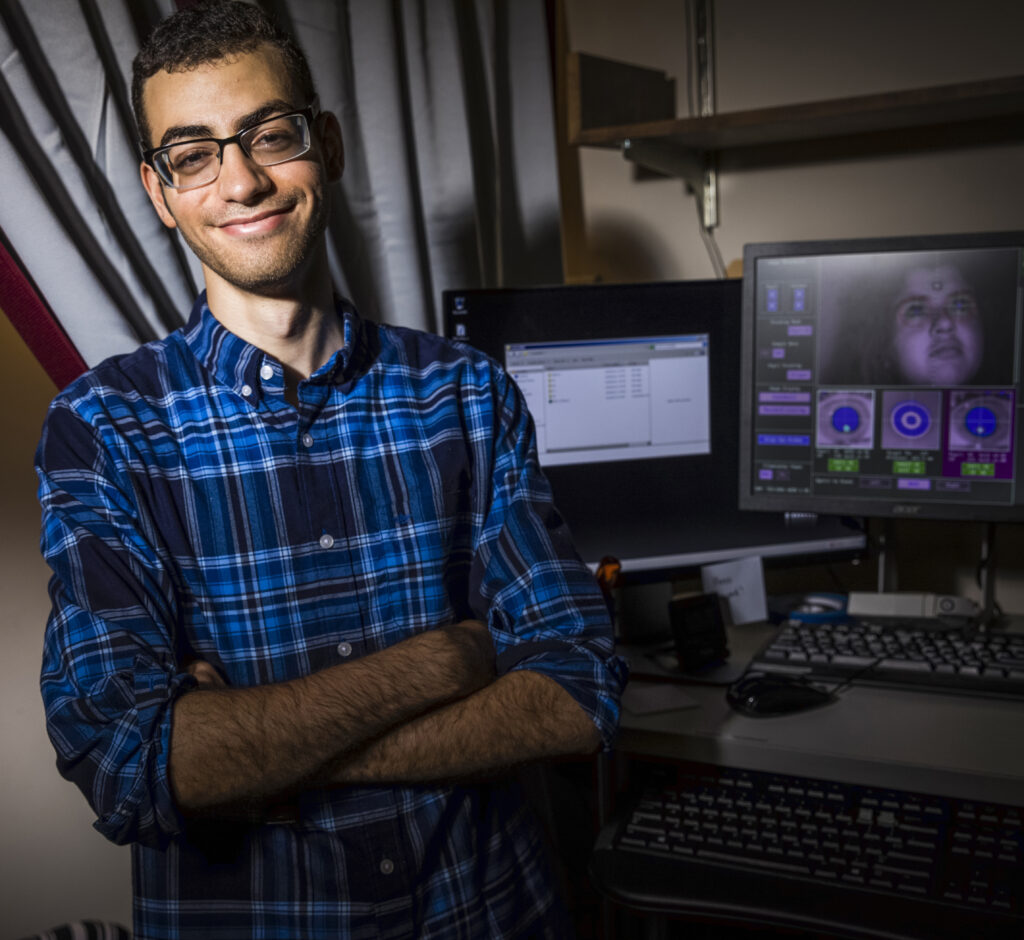
Sherief Eldeeb ’18 assists research team in examining sleep patterns of children and teens on the spectrum