Mathematician’s research into black holes traces back to Einstein
The Event Horizon Telescope research collaboration captured the first images of supermassive black holes within the last seven years. But scientists have been trying to unlock the mathematical mysteries behind black holes since Albert Einstein published his theory of relativity in 1915.
Clark mathematician Aghil Alaee Khangha continues down a path laid by physicists from Robert Oppenheimer and Hartland Snyder in the 1930s to Stephen Hawking in the ’70s, as well as 2020 Nobel laureates Roger Penrose, Reinhard Genzel, and Andrea Ghez. According to the Mathematics Genealogy Project — an online tool tracing the Ph.D. advising “roots” of mathematicians back to the 14th century — Alaee, in fact, is directly “connected” to Hawking.
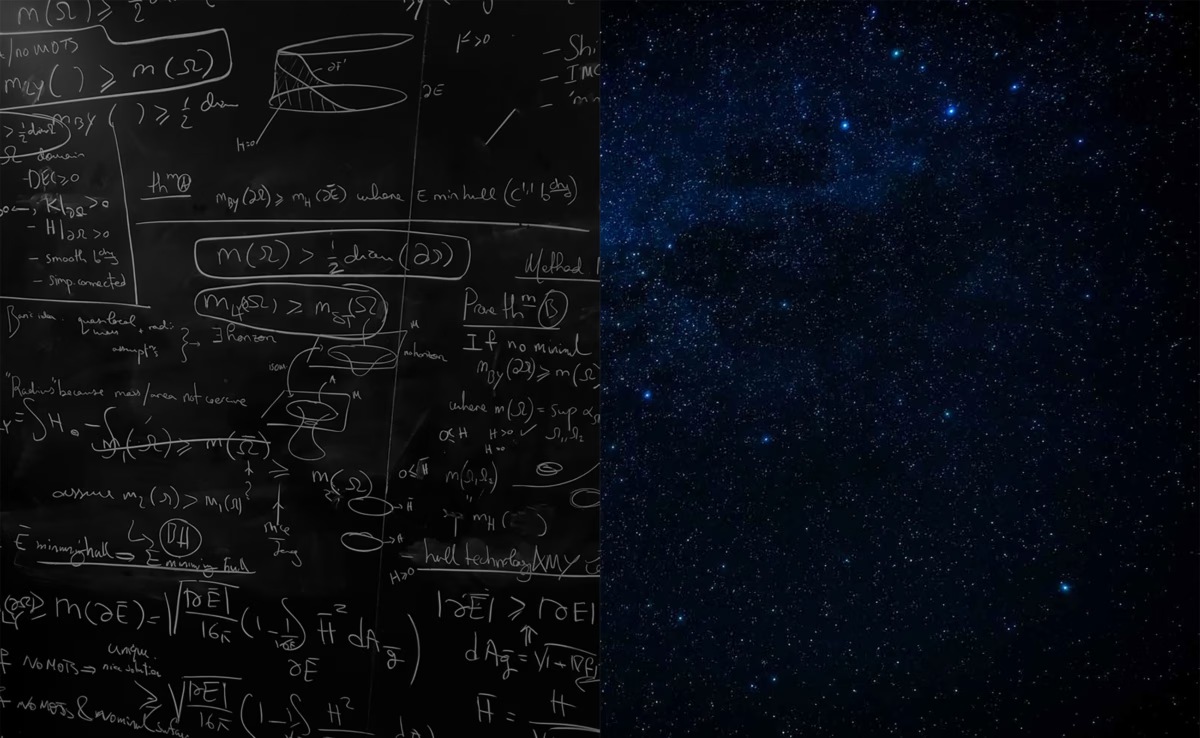
Applying differential geometry and geometric analysis (as seen in his calculations above), Alaee studies the relationship among a black hole’s energy, spin, charge, and its boundary, called the “event horizon.” A “point of no return,” this boundary has “a gravitational pull so strong that nothing, not even light, can escape it,” according to NASA.
“If the density of matter is very large in a very small region of space, it creates a kind of well — you can call that a gravity well — and that’s a black hole,” explains Alaee, who served as a fellow for Harvard’s Black Hole Initiative and Center of Mathematical Sciences and Applications before joining Clark’s Mathematics Department. A black hole’s extreme curvature “will bend space and time so much that even if you’re moving at the speed of light, if you are very close to that well, you will just go inside.”
Since childhood, Alaee has been fascinated by space and black holes. But it wasn’t until college that he determined that mathematics — specifically, geometric analysis, which applies rigorous mathematical calculations to prove the conjectures of physicists — could best answer his questions.
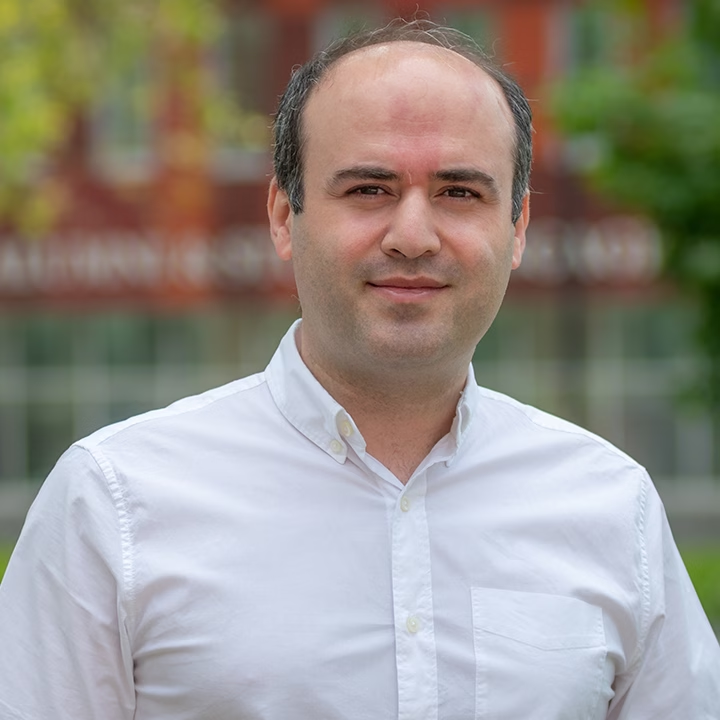
“The universe around us has a very particular language, and I believe that language is math,” says Alaee, who has been funded by a National Science Foundation LEAPS-MPS grant. “Mathematicians say, ‘If you impose these assumptions, then the claim is correct or the claim is false.’ ”
Alaee has studied and published six articles with Shing-Tung Yau, the Harvard professor emeritus and Black Hole Institute researcher credited with developing the field of modern differential geometry and geometric analysis.
In 1979, Yau, with his student Richard Schoen, “solved a longstanding question in Albert Einstein’s theory of relativity by proving that the sum of the energy in the universe is positive; their proof has provided an important tool for understanding how black holes form,” according to Harvard. For that, Yau received the Field Medal, the highest award in mathematics. In 2022, he left Harvard to establish the Yau Mathematical Sciences Center at Tsinghua University in China.
Alaee and a new generation of mathematicians aim to investigate the existence, uniqueness, stability, geometric inequalities, and evolution of black holes, continuing Yau and Schoen’s positive energy theorem.
More recently, Alaee and his collaborators — Yau, along with Marcus Khuri of Stony Brook University in New York — have studied mathematical questions about quasi-local energy and mass.
“These quantities are designed to measure how much energy and mass are contained in a finite region of curved space, rather than in the entire space,” Alaee explains.
The researchers introduced a new notion of quasi-local energy “with several important properties: It is nonnegative, it detects when the geometry is flat, and as the region becomes larger and eventually fills the whole space, it approaches the total energy of the system,” he says. Unlike many earlier definitions, the new definition of energy can also be applied to more complicated boundary shapes and surfaces such as “tori,” which are doughnut-shaped, according to Alaee.
Published in the article, “A Quasi-Local Mass,” in Communications in Mathematical Physics, their work also provided “a genuinely quasi-local proof of positivity, addressing an open problem posed by Richard Schoen in 2018,” he adds, “and may provide an answer to Penrose’s longstanding problem in 1982 of finding the right notion of quasi-local mass and energy.”
In his research, Alaee says, he is especially interested in applying the tools of geometric analysis “to the problem of energy minimization — identifying the lowest-energy states in general relativity and extending these ideas to higher dimensions and theories such as string theory.”
Last summer, two undergraduate students — mathematics major Reevu Majumdar ’27 and mathematics and computer science major Rahban Yoftahe ’27 — got a taste of this research when they worked with Alaee to unpack these fundamental questions: How does spacetime bend around an object of enormous mass, and what can the geometry of that curvature tell researchers about the object’s mass and other properties?
They also took a directed study with Alaee on differential geometry, which Majumdar described as “the hardest thing ever” and “truly, truly mind-bending.” Once they began studying geometric analysis and tackling black-hole computations, they better understood the material.
“It’s very nice to see the math that we’re doing has a tangible application,” said Majumdar, who presented a poster with Yoftahe at Clark’s “Summer of Science” event in July. “We can see how it’s working, and it makes sense.”