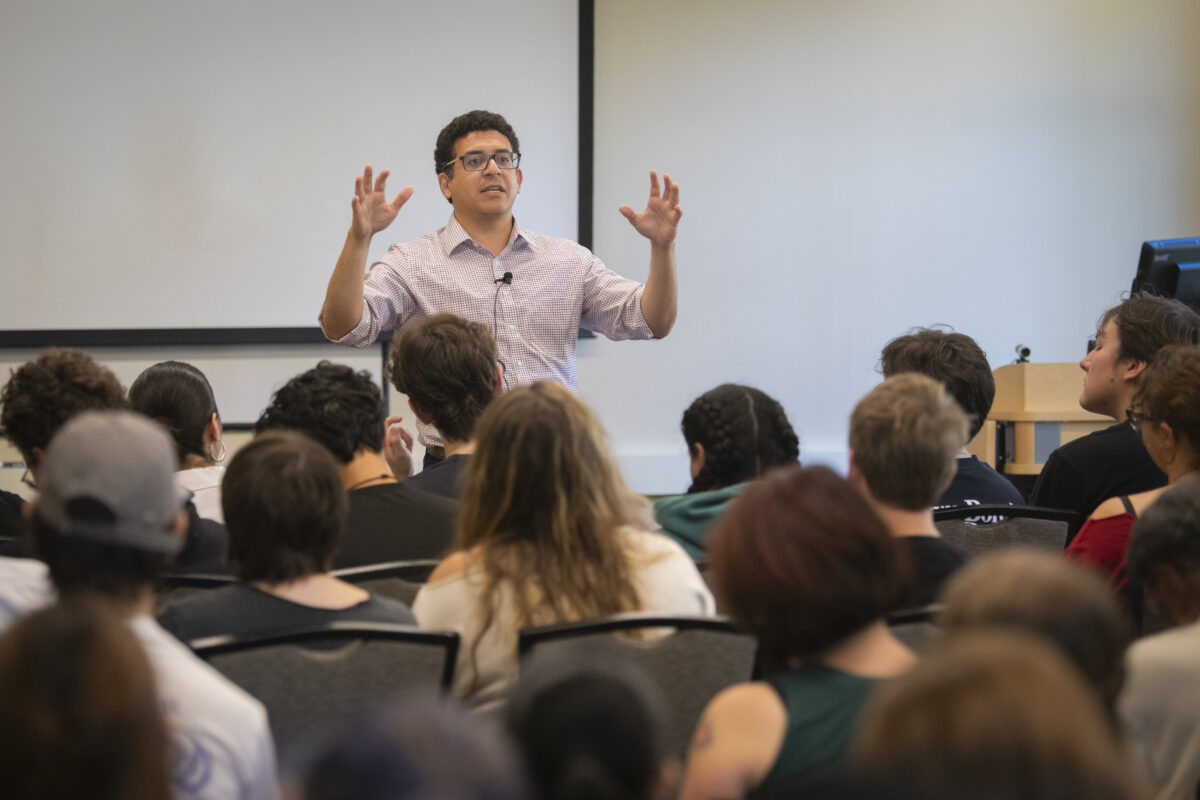
The strengths and weaknesses of our system of government were brought under close examination at the annual Constitution Day lecture, delivered by Aziz Rana, professor of law at Boston College Law School.
During his Sept. 18 address to an audience of students and faculty in the Grace Conference Room, Rana traced how America’s constitutional system, designed to offset majority rule with checks and balances, gradually fused with other ideological responsibilities, including market capitalism, civil libertarianism, and maintaining belief in the American global authority. This fusion, Rana argued, produced a powerful but fragile political compact that defined the mid-20th century.
“The U.S. Constitution is perhaps the hardest in the world to formally amend. You need to have two-thirds in both houses and then three-fourths of the states to ratify an amendment. What that has meant in the U.S. is that most change takes place not actually through writing a new document,” he said. “What you can do is pass what some legal scholars call ‘landmark’ pieces of legislation.”
Rana unraveled constitutional questions in his first book, “The Two Faces of American Freedom”(Harvard University Press, 2010), which contextualizes modern America in the history of colonialism. His latest book, “The Constitutional Bind: How Americans Came to Idolize a Document that Fails Them” (University of Chicago Press, 2024), explores the modern emergence of “constitutional veneration,” especially against the backdrop of growing American global authority.
“We tend to think of our document as this thing that is the same from its founding and has meant the same thing across time,” Rana said. “But in truth, the meanings that have been given to the text have changed quite dramatically.”
Rana led the audience through a sweeping historical analysis, from how the Great Depression and New Deal reforms of the 1930s redefined the meaning of constitutional change without rewriting the document, to how World War II and the Cold War further solidified America’s self-image as a bastion of freedom and global leadership.
That mid-century order, Rana explained, depended on two key conditions: strong labor movements that provided social welfare-focused political supermajorities and the Cold War’s demand for internal social cohesion to combat the feared rise of communism. But when the popularity of the industrial unions began to wane and the Soviet Union collapsed, the structural and ideological glue holding that consensus together began to corrode, he said.
The decades that followed saw the economy become more rigid, inequality rise, and partisanship become more extreme. Rana called this proof that the Constitution had deep, innate flaws that historically made it hard for majorities to reform. In the 21st century, Rana said, this appears as minority rule through the Electoral College and Senate representation, an increasingly politicized Supreme Court, and the erosion of institutional checks on executive power.
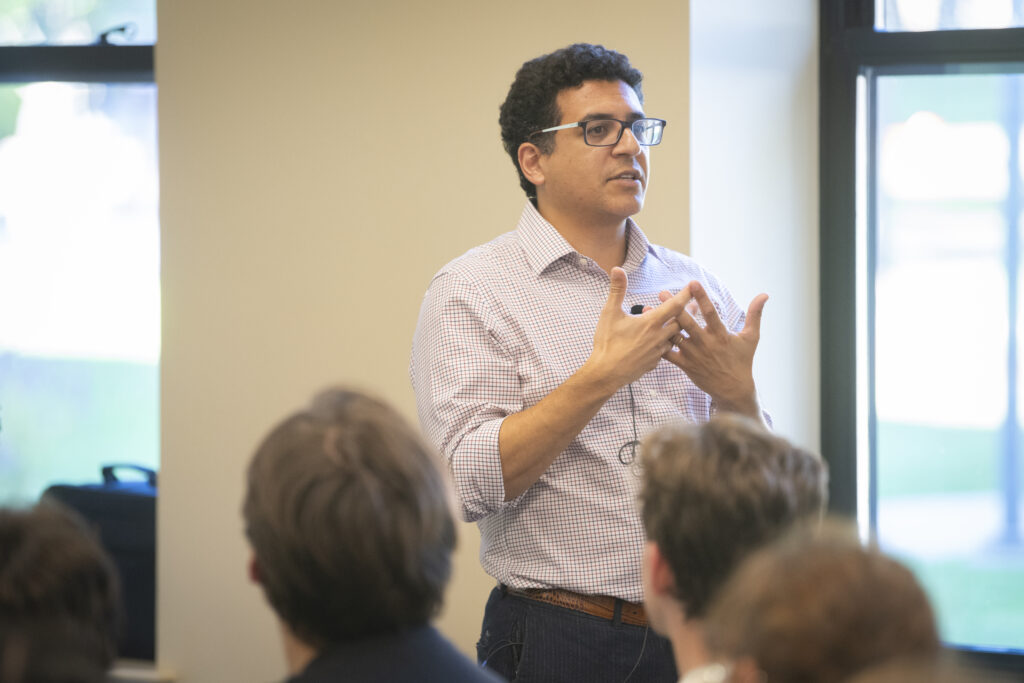
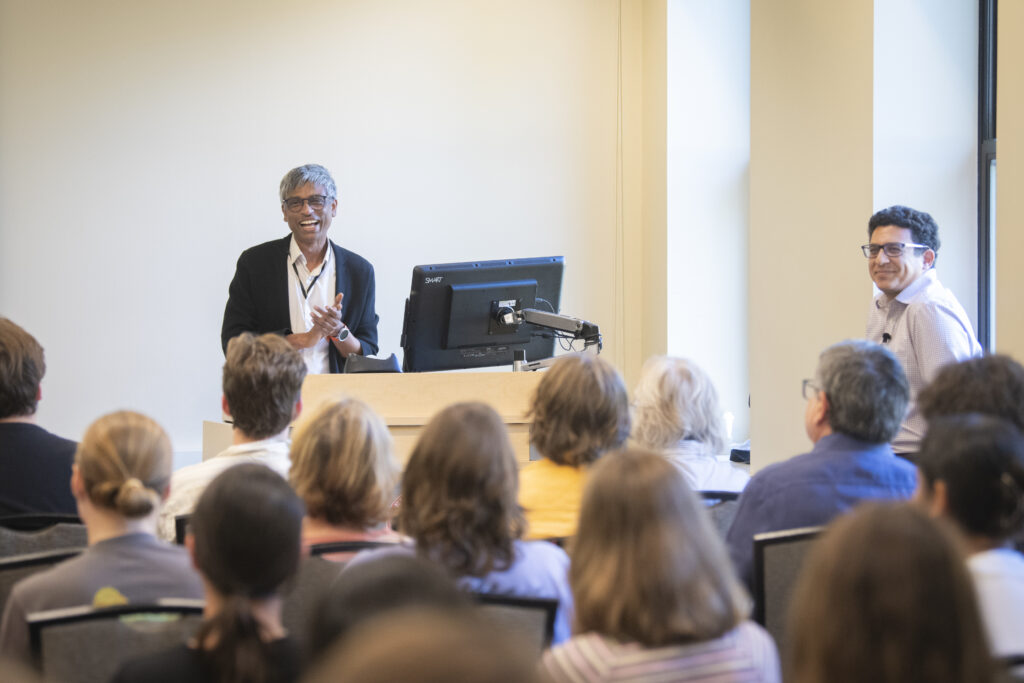
“Since 1988,” he noted, “Republicans have won the popular vote only twice, yet have frequently held the presidency and shaped the Court for generations.” Rana contended that this has enabled a single party to exert an excessive amount of influence and power over every branch of the government.
This dynamic could allow for a reimagining of the nation’s democratic institutions, Rana said.
Rana urged the audience to think beyond formal and familiar constitutional amendments and more toward rebuilding the “intermediate institutions” that sustain civic life — such as labor unions, tenant associations, professional organizations, and campus worker coalitions — because without such collective bases of power, he said, neither party will be able to sustain genuine democratic reform.
“We are in a different political universe,” he said, “but that doesn’t mean the story is over. It means we have to decide what kind of political order comes next.”