Deep-dive pioneer lectures on her historic ocean descent
As a young girl growing up in Hawaii, Dawn Wright acquired a love of the sea. But she was inspired to one day explore the ocean’s deepest reaches not by diving down, but rather, by looking up.
All the way to the moon.
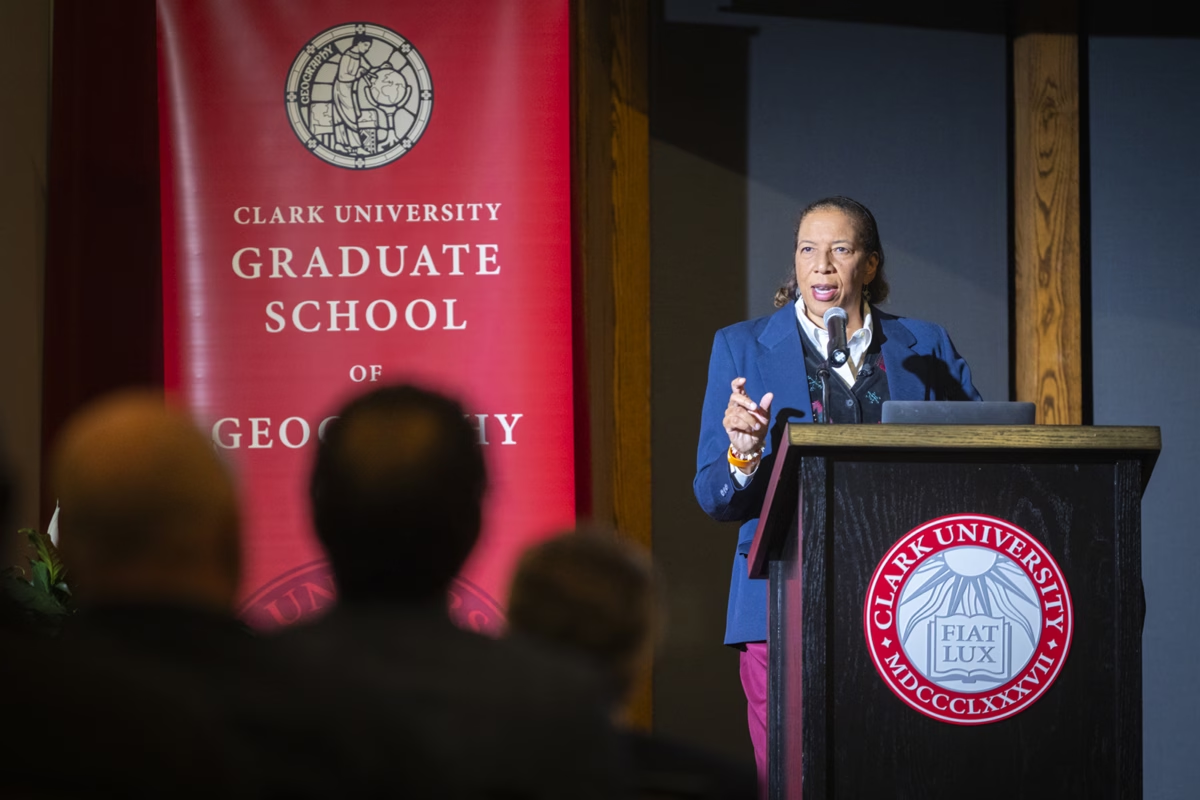
During her October 8 Atwood Lecture in Tilton Hall, Wright described how the wonder of watching astronaut Neil Armstrong take humankind’s first steps on the lunar surface spurred her to pursue a career investigating the mysteries of the ocean.
“So many oceanographers admire astronauts,” Wright said. “The connection between outer space and inner space encourages us to find out about our own planet.”
Wright, chief scientist at the Environmental Systems Research Institute (Esri), has gone to great lengths — well, depths more accurately — to do just that. In the summer of 2022, Wright made history by becoming the first Black person to dive to the deepest spot on the entire planet, known as Challenger Deep, in the western Pacific Ocean. She dove in a submersible developed and piloted by private equity investor and undersea explorer Victor Vescovo and his Caladan Oceanic team.
From the Tilton stage, Wright showed slides of her deep-water expedition and shared some dramatic statistics, including the fact that while the ocean is responsible for absorbing 90% of the world’s heat and about 30% of its carbon dioxide emissions, vast stretches of it have gone unexplored. Especially beneath the surface. She noted that 92% of the ocean is below 200 meters deep, and of that only .001% has been visually observed.
Located in at the southern end of the Mariana Trench off of Guam, Challenger Deep is the deepest known point of the Earth’s seabed. Wright and Vescovo descended 10,935 meters into inky blackness, secured inside the Triton 36000/2, a two-occupant, spherical titanium submersible designed to reach the bottom as quickly as possible while withstanding pressure of up to 16,000 pounds per square inch (Wright described it as the equivalent of an elephant sitting on your big toe).
The Challenger Deep adventure was part of an international mission to map the ocean floor, Wright said. The environment was “cold and dark, but not lifeless,” and the 10.5 hours from launch to surfacing was “exhilarating.”
Observing the ocean bottom,, Wright described evidence of erosion in the tectonic plates and vast fields of angular boulders. Small invertebrates and tubed anemones were illuminated during the descent, and a small “bait arm” attracted snail fish that were composed entirely of cartilage. When Triton flashed its lights at a passing jellyfish, the bioluminescent creature “flashed back,” Wright laughed.
Mapping the ocean floor using geospatial and imaging technologies is critical to understanding one of Earth’s great enigmas, she said.
“I was excited about Artemis going to the moon, but in terms of our own planet we don’t always know what in the world we’re talking about,” Wright said. With the federal administration pulling back research funding, scientists have been left relying on private funding sources, like Vescovo, to continue essential investigations into the workings of our planet, Wright said.
The Triton expedition contributed to the Seabed 2030 Initiative, which aims to map the world’s entire seafloor (the current total mapped stands at about 29%). People don’t realize the importance of knowing the contours of this uncharted terrain, Wright said, noting that endless amounts of data are transmitted via cables draped along the ocean floor that need to be laid, maintained, and sometimes moved.
During the question-and-answer segment, Wright said she’s opposed to data being used for “nefarious purposes” like deep-sea mining, something many in the science community oppose and which some Indigenous communities have decried as a violation of their territorial waters.
Earlier in the presentation, Wright warned against defiling our oceans. She showed photo of a beer bottle at rest at one of the deepest points in the ocean. “We’re trashing our planet,” she said. “We’ve got to do better.”
Dawn Wright’s lecture was sponsored by the Graduate School of Geography and the School of Climate, Environment, and Society.