NYT’s Thomas Friedman, Ceres CEO Mindy Lubber to serve on panel
Like any complex challenge, the global climate crisis demands collaboration and collective action. Clark University’s School of Climate, Environment, and Society (CES) is a bold response to the urgent realities of climate and environmental change, designed to inspire and mobilize a community of leaders, scholars, and partners to challenge the status quo and help redesign a more sustainable future.
To that end, the School is hosting a special climate forum on Monday, April 13, at 4 p.m. in Tilton Hall at the Higgins University Center. New York Times columnist Thomas Friedman will moderate a discussion with Mindy Lubber, president and CEO of the sustainability nonprofit Ceres, and Lou Leonard, the D.J.A. Spencer Dean of the School of Climate, Environment, and Society. Clark President David Fithian will offer introductory remarks.
Friedman, Lubber, and Leonard will discuss their perspectives on where we are today in terms of climate progress, interdisciplinary climate solutions, the role of universities in driving environmental change, community-centered climate action, and preparing future leaders to address complex global challenges.
“This panel is just one example of how CES brings together diverse perspectives to address the interconnected climate, environmental, societal, and economic crises shaping the 21st century,” Fithian said.
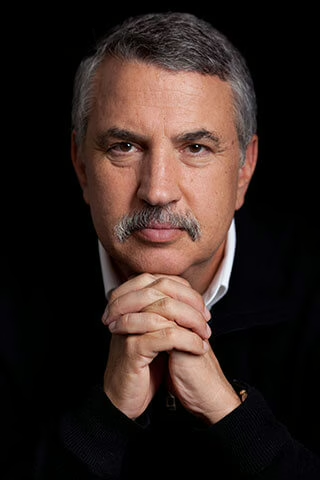
Thomas L. Friedman is an internationally renowned author, reporter, and columnist. He joined The New York Times as a reporter in 1981, going on to serve as the Beirut bureau chief, Jerusalem bureau chief, the diplomatic correspondent in Washington, D.C., and later the White House correspondent and economic correspondent. He began writing the paper’s foreign affairs column in 1995.
Friedman is the author of seven New York Times bestsellers, including “From Beirut to Jerusalem: One Man’s Middle Eastern Odyssey,” “That Used To Be Us: How America Fell Behind in the World It Invented and How We Can Come Back” (with Michael Mandelbaum), and “Hot, Flat, and Crowded: Why We Need a Green Revolution—And How It Can Renew America,” in which he proposed that the solutions to global warming and the best method to regain the United States’ economic and political stature in the world are to embrace the sustainable energy and green technology industries.
Friedman has won three Pulitzer Prizes: for international reporting (from Lebanon) in 1983, for international reporting (from Israel) in 1988, and for distinguished commentary in 2002. In 2004, he was also awarded the Overseas Press Club Award for lifetime achievement and the honorary title Order of the British Empire (OBE) by Queen Elizabeth II. In 2009, he was given the National Press Club’s lifetime achievement award.
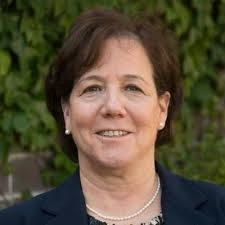
Mindy Lubber has been CEO and President of the Boston-based sustainability nonprofit Ceres since 2003. The advocacy organization shows investors and multinational corporations how to factor sustainability risks, such as climate change, water pollution, and deforestation, into their operations and investments. Under her leadership, Ceres has proven that it is possible to be both profitable and environmentally and socially responsible.
Previously, Lubber was a senior policy advisor at the U.S. Environmental Protection Agency, and was appointed regional administrator under President Bill Clinton in 2000. She has received numerous honors for her leadership, including the United Nations’ highest honor, the Champions of the Earth Entrepreneurial Vision award, in 2020. She also has made Barron’s list of the 100 most influential women in U.S. finance for four consecutive years, and The Boston Globe named Ceres one of the top 100 women-led businesses in Massachusetts for five years in a row.
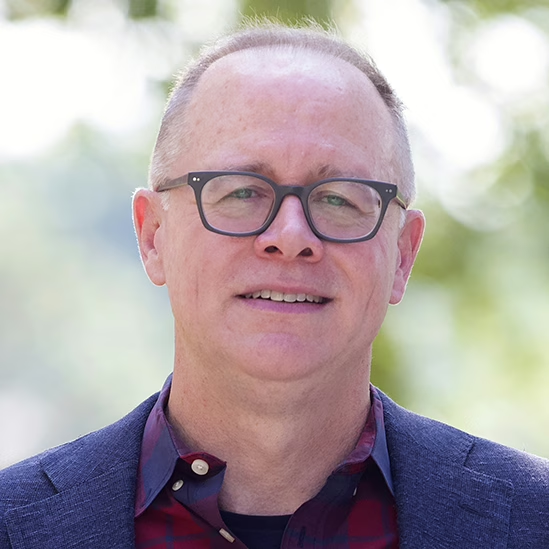
Lou Leonard joined the School of Climate, Environment, and Society as the inaugural D.J.A. Dean in 2025, bringing with him more than 25 years of leadership in climate policy, environmental law, and ecological change. He came to Clark from Chatham University, where he served as dean of the Falk School of Sustainability & Environment. Previously, as senior vice president for climate and energy at the World Wildlife Fund, he participated in negotiations leading to the Paris Climate Change Agreement. An environmental lawyer, Leonard has served as special counsel to the U.S. Secretary of the Interior, negotiating water agreements for tribal nations, and has taught and practiced energy and conservation law in the U.S. and abroad.