Perhaps it’s the iceberg that brought down the Titanic off Newfoundland in 1912.
Or maybe it’s A-23A, the “megaberg” that broke off an Antarctic ice shelf in 1986 and became a media sensation as it traveled 1,500 miles across southern oceans for 40 years. This month, Iceberg A-23A finally disintegrated in warmer South Atlantic waters, NASA reports.
As ocean waters have warmed under climate change, scientists have recorded increased ice-melting in both polar regions, including “calving” of glaciers and ice shelves that launch icebergs on their ocean journeys. Floating icebergs can disrupt oceanic environments and wreak havoc on shipping.
“What is interesting to me is that something as common as melting, floating ice can have unexpected and potentially large consequences,” says Clark Physics Professor Arshad Kudrolli, co-author of a recent scientific study that describes the momentum behind floating icebergs.
Editors at Physics Magazinefeatured the study — published recently in the peer-reviewed journal Physics Review Fluids — by co-principal investigators Kudrolli and the University of Paris Cité’s Michael Berhanu. Their co-authors included Clark physics Ph.D. student Amit Dawadi and the University of Paris Cité’s Jérôme Jovet and Martin Chaigne.
“These findings suggest that melting-driven propulsion may be relevant to the motion of icebergs in sufficiently warm oceanic environments.”
— “Self-propulsion of floating ice blocks caused by melting in water,” physical review fluids
Replicating the physics of iceberg movement, their experiment revealed that, in addition to being pushed by wind, ocean currents, and surface waves, the chilled blocks can be propelled by their own melting in warmer water.
Most icebergs are found in 32- to 41-degree Fahrenheit seawater, but the experiment used 50- to 86-degree Fahrenheit water, because icebergs can travel thousands of kilometers and warmer waters, according to the scientists.
“Icebergs have been reported drifting in warmer waters near Newfoundland … in spring, where the ocean temperature can reach 10 degrees Celsius,” or 50 degrees Fahrenheit, they explain. “These findings suggest that melting-driven propulsion may be relevant to the motion of icebergs in sufficiently warm oceanic environments.”
Oceanic icebergs typically are around 328 feet — just over the size of a football field — irregularly shaped, and “composed of frozen freshwater, formed by the calving of ice sheets in Antarctica and Greenland,” according to the scientists.
Video courtesy of co-principal investigators Michael Berhanu (University of Paris Cité) and Arshad Kudrolli (Clark University).
In the lab, they floated prism-shaped ice blocks, up to 6-1/2 inches long, in water, which cooled as the ice melted. Through a process called “thermal convection,” the more dense, cooled water sank, creating a flow that pushed the ice. But water resistance (drag) slowed it down.
Calculating the balance between the two factors, the team could determine an ice block’s speed. They discovered “that floating ice blocks with asymmetric shapes can self-propel with significant speeds due to buoyancy-driven currents caused by melting.”
The scientists tested the floating ice blocks in both salt- and freshwater to emulate ocean water and the icebergs’ melting freshwater.
They discovered how the ice is propelled forward.
“The process is not similar to rocket propulsion, where the fluids coming out of the back of the rocket propel it forward,” Kudrolli explains. “The ice is not driven by the meltwater itself. Instead, the melting of the ice acts as a heat sink, and the propulsion results from the cooling‑driven density current in the surrounding ocean waters. We didn’t realize this till we fully analyzed the problem.”
The study was funded, in part, by the French Research Agency.
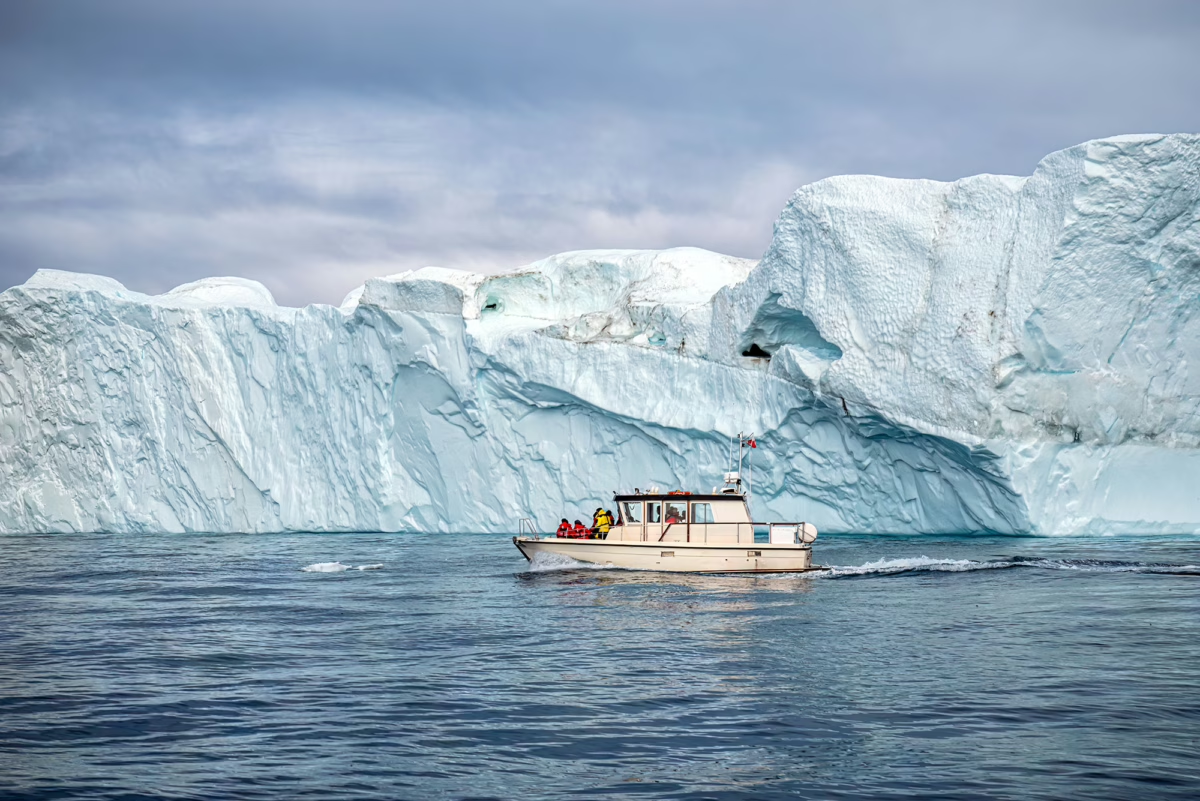
Photo at top of story: A tourist boat moves through “Iceberg Alley” off Greenland.