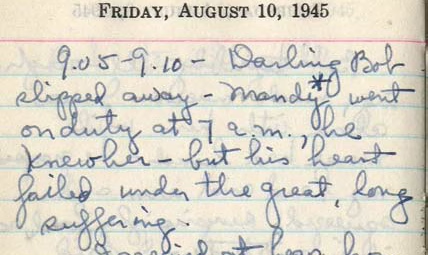
On Friday, August 10, 1945, Esther Goddard opened a pocket-sized diary and turned to the day’s page.
Picking up her pen, she carefully wrote, “Darling Bob slipped away.”
The journal was not her own. Her husband, rocketry pioneer Robert Goddard, was a compulsive diarist, recording his work and activities over nearly 50 years. That summer, when worsening esophageal cancer and hospital visits had made it impossible for him to keep the diary current, Esther did it for him. She would not let his story sit unfinished.
Her husband’s life was over, but Esther’s work had just begun.
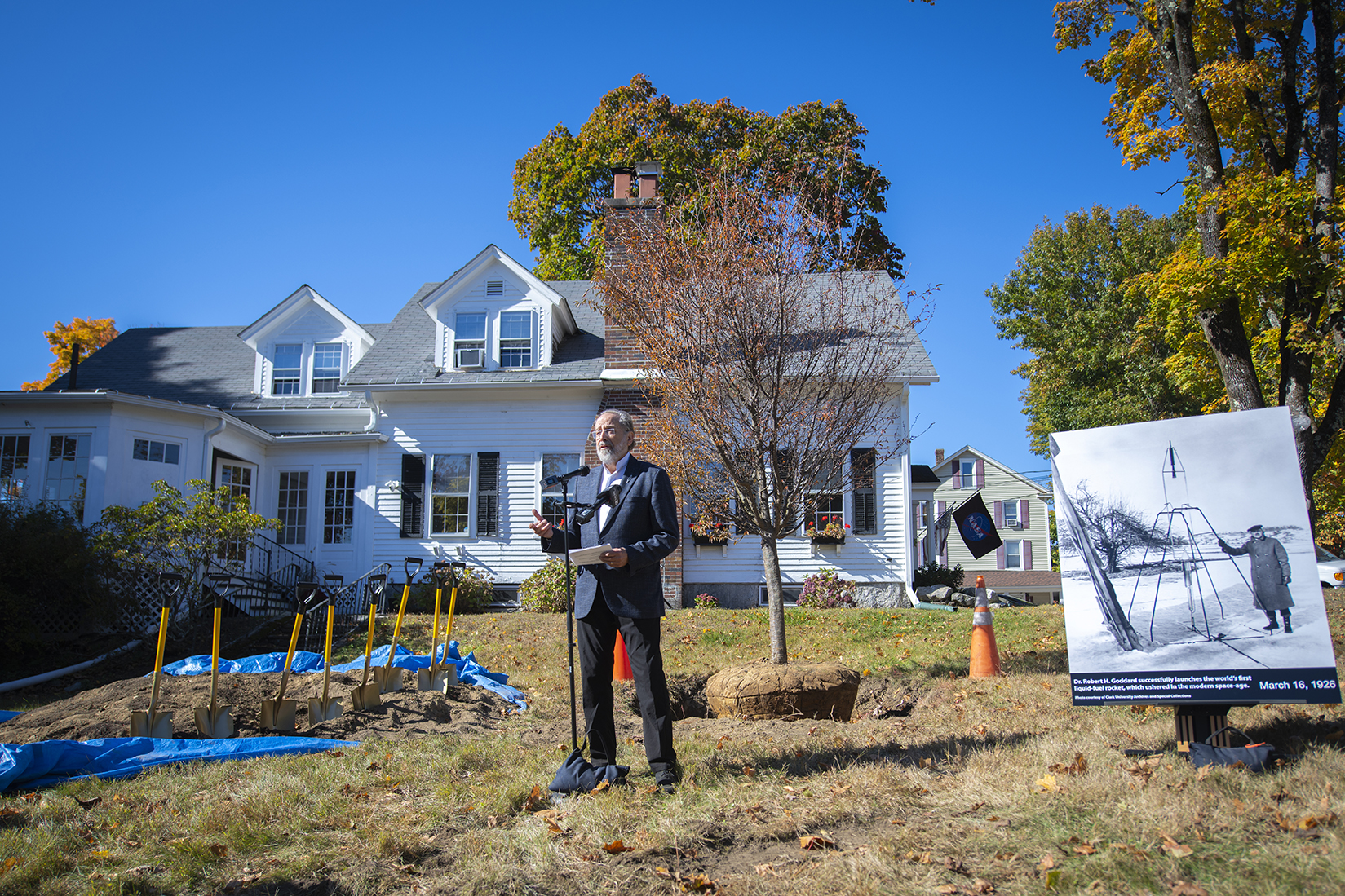
This small, private act of grief is also a window into who Esther Goddard was: meticulous, devoted, and fiercely in control of the narrative. Because while Robert Goddard is remembered today as the father of modern rocketry—the pioneer who launched the world’s first liquid-fueled rocket on March 16, 1926, from a snow-covered field in Auburn, Massachusetts—a key reason we remember him at all is because of her efforts to ensure he never be forgotten.
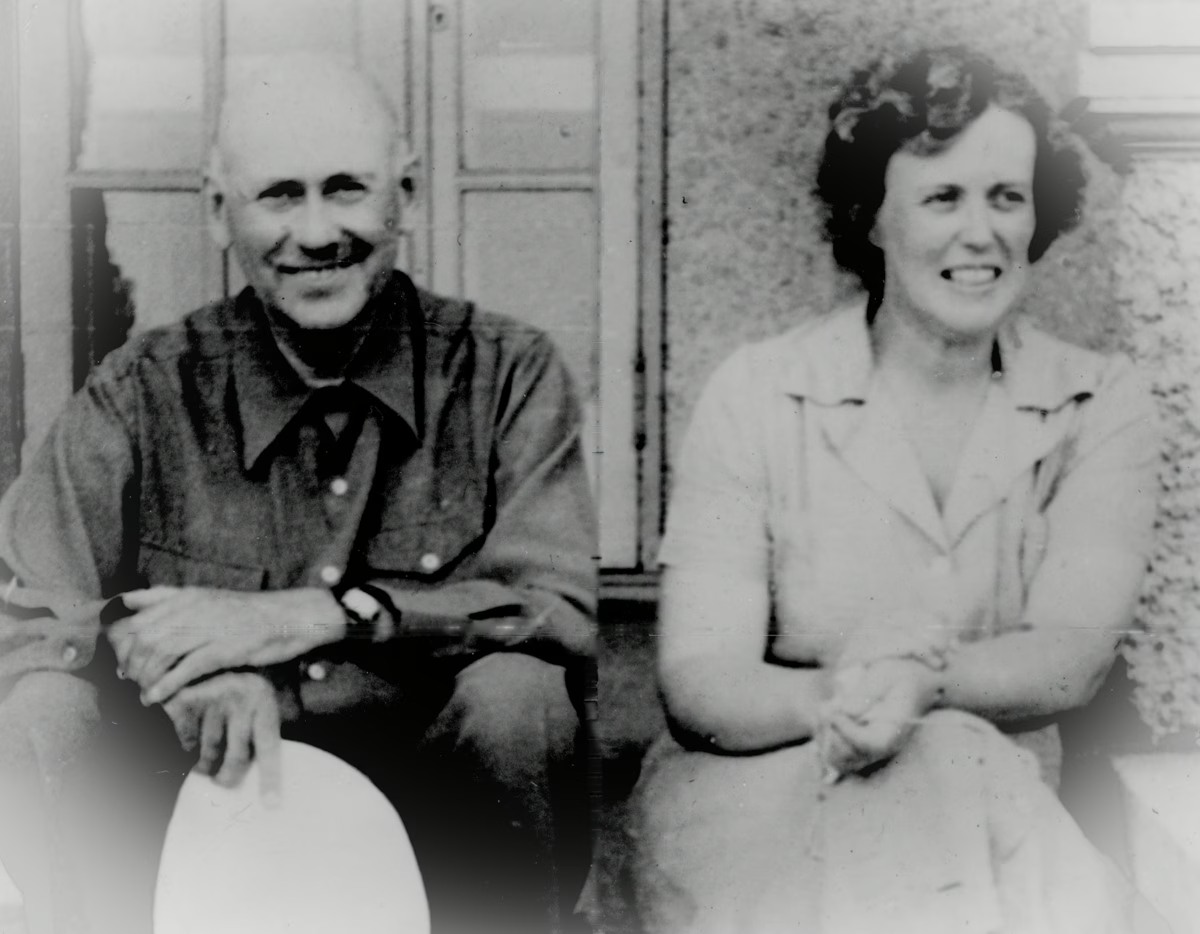
In 1919, Esther Christine Kisk, then 18 and a recent high-school graduate, was working as a typist in the office of Clark College President Edmund Sanford, earning money for her own college tuition. Robert Goddard was a professor and the chair of the Physics Department.
Robert and Esther began seeing each other frequently. He visited her at home, where he would play the piano for her, took her for walks and ice cream, and “wrote gushy letters,” according to David A. Clary, author of Rocket Man: Robert H. Goddard and the Birth of the Space Age.
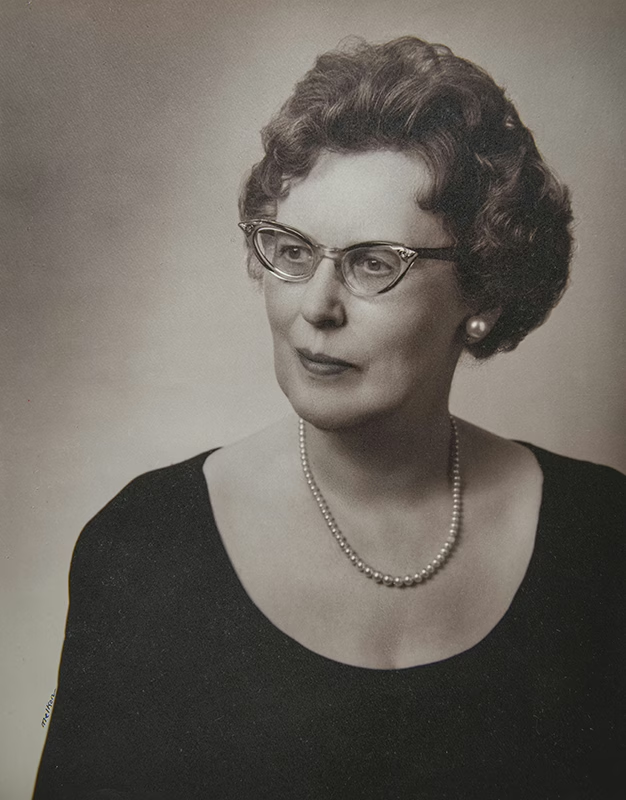
It was a perfect match. Esther was intelligent, strong-willed, energetic yet reserved, and physically striking. She was passionate about cultural disruptions, like new books and fresh theories. Clary notes a Clark biologist at the time describing Esther as “not a common person.”
They married in 1924.
“She managed his life for him”
Robert Goddard was raised with an overattentive mother and grandmother who catered to his every need, and Esther continued the tradition of a strong woman taking charge of his well-being, and of the image he projected to the world. She often accompanied her husband to work, documenting his experiments through photography and, later, film. Those photos are now part of Clark’s Robert and Esther Goddard Collection, portions of which have been digitized and are now accessible online.
“She is the curator, the image builder, the facilitator,” says Katie Stebbins, digital projects librarian at Clark. “She managed his life for him. She was a patent-getter, a documenter, a photographer, a filmmaker. Basically, any photo or video we have of him, whether it’s here or New Mexico, was taken by Esther.”
“She lived it—and was always by his side.”
catherine stebbins, digital projects librarian
In Milton Lehman’s This High Man—a biography written after Robert’s death under Esther’s supervision—a family friend notes, “Esther’s job was to see that he was effective and happy; and in her lifelong modeling of Bob’s façade as that of a ‘great man,’ she would certainly see that he was constantly encouraged about his own achievement and his qualities, his stature.”
When Robert launched the historic liquid-fueled rocket on March 16, 1926, Esther was there, as she always was, movie camera in hand. She didn’t capture the actual rocket flight, but did take photos of Goddard and his team before and after the launch, memorializing the occasion for posterity.
Stebbins and Cynthia Shenette, head of the Clark University Archives, say that Esther’s dedication was evident as they prepared materials for the launch centennial. “She was there. She lived it—and was always by his side,” Stebbins says.
“She had an emotional attachment to the work that nobody else would have,” Shenette adds.
“The shining image that is Goddard today”
After Robert’s death in 1945, Esther’s made it her mission to secure his legacy. Less than a year after he died, she delivered a speech, “The Life and Achievements of Dr. Robert H. Goddard,” in which she described a boy from humble beginnings who dreamed big dreams and pursued them throughout his life. She painted a picture of a distinguished but absentminded professor who refused to give up, even in the face of ridicule.
She gave the same speech for 30 years.
Shortly after Robert’s death, Esther’s friend (and her husband’s stalwart supporter) Harry Guggenheim urged her to secure patents for any inventions not yet applied for. She did, with some administrative help and all expenses paid by the Guggenheim Foundation. The long and arduous process resulted in 131 additional patents in Robert Goddard’s name, bringing the total to 214.
She also joined Guggenheim in a patent-infringement claim against the U.S. government, eventually agreeing to a settlement that paid her $400,000 over 20 years. When that news broke, United Press International reported, “Now he is generally credited with being the ‘father of modern rocketry,’ the German V-2 missile, the American bazooka of World War II, and eventually the entire family of U.S. space and military rockets.”
“The patents were my primary goal,” Esther told Guggenheim. “To me, they are quite simply the whole foundation upon which you and I have built the shining image that is Goddard today.”
“Building his legacy from the ground up”
While the patent negotiations were happening, Esther decided it was time for a biography, and Milton Lehman was hired to write it—but Esther was in control.
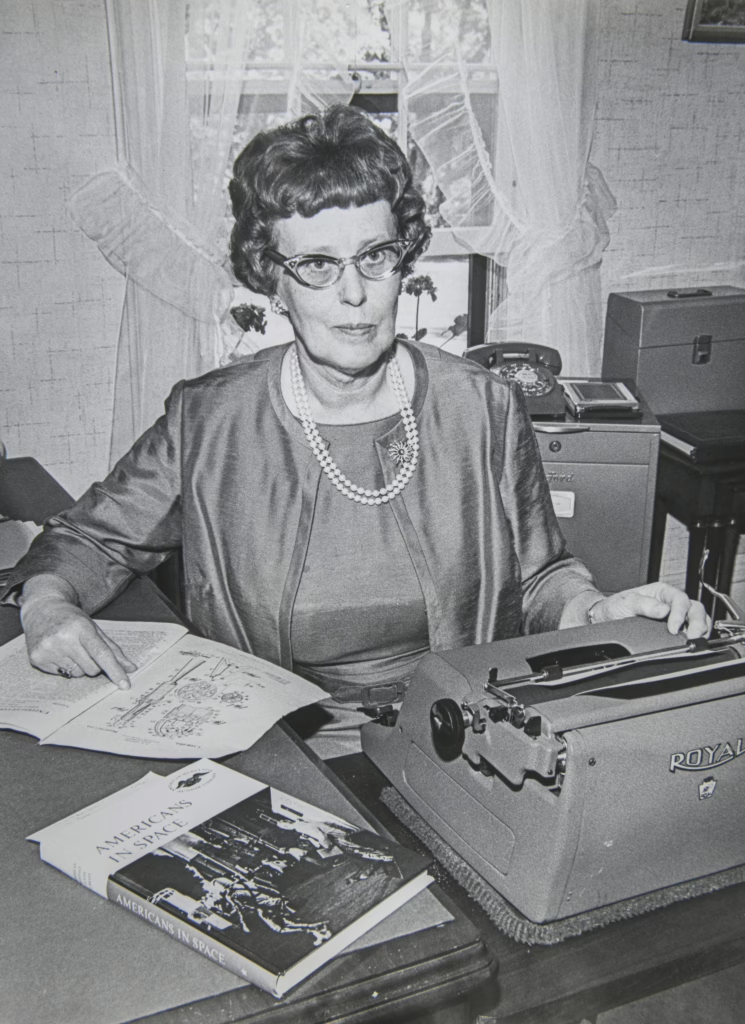
She gave Lehman only those papers she wanted him to see, and edited the manuscript to ensure the biography, published in 1963, presented the Robert Goddard she wanted the world to know. Her edited copies of the book’s drafts are housed with her papers at Clark.
Clark also has a 22-volume set of Goddard’s research notes, drawings, and photos that Esther collected, curated, and presented to Clark, the Smithsonian, the Library of Congress, and the Roswell Museum and Art Center in New Mexico. Later, Esther worked with longtime friend G. Edward Pendray to curate a three-volume set of her husband’s papers—more than 1,700 pages of diary entries, notes, and correspondence—published by McGraw-Hill in 1970. She left out personal papers and anything that put him in a bad light. Anything that Esther considered significant and worth preservation was included.
Along with those multivolume sets, Esther gave all of her husband’s (and later, her own) papers to Clark. She had originally intended for those to go to the Library of Congress but changed her mind in 1964 when she learned of the University’s plans to build the Robert Hutchings Goddard Library.
“She documented everything meticulously. And then, posthumously, she curated everything — one project after another, making sure different institutions had copies of the work,” Stebbins says. “She was essentially building his legacy from the ground up.”
“I share your pride and excitement”
Along with securing patents and organizing papers, Esther made sure that Robert Goddard received proper recognition from those in power. He was awarded the Congressional Gold Medal in 1959, the Smithsonian’s Langley Medal in 1960, and the Daniel Guggenheim Medal, the highest honor in aeronautics, in 1964 (Orville Wright received the first Guggenheim Medal in 1929). In 1964, he was honored with a U.S. postage stamp. And NASA’s Goddard Space Flight Center opened in 1959.
Since 1958, the National Space Club has given the Robert H. Goddard Memorial Trophy to individuals or groups who made the most impact on space activities in the previous year. It is presented at the club’s Robert H. Goddard Memorial Dinner, which Esther attended for many years.
Esther was also invited to attend a 1970 presidential dinner celebrating the Apollo 11 space mission, whose astronauts stepped on the moon just two months after the dedication of Clark’s Robert Hutchings Goddard Library. Apollo 11 Lunar Module Pilot Buzz Aldrin, whose father, Edwin Aldrin Sr. 1915, was Goddard’s student, had helped cut the ribbon at the opening ceremony.
Esther invited President Richard Nixon to attend the library dedication, but he was unavailable. Instead, he wrote to Esther, “I share your pride and your excitement,” and noted that the mission to the moon was made possible “by the vision, courage, and generous talent of your late husband.”
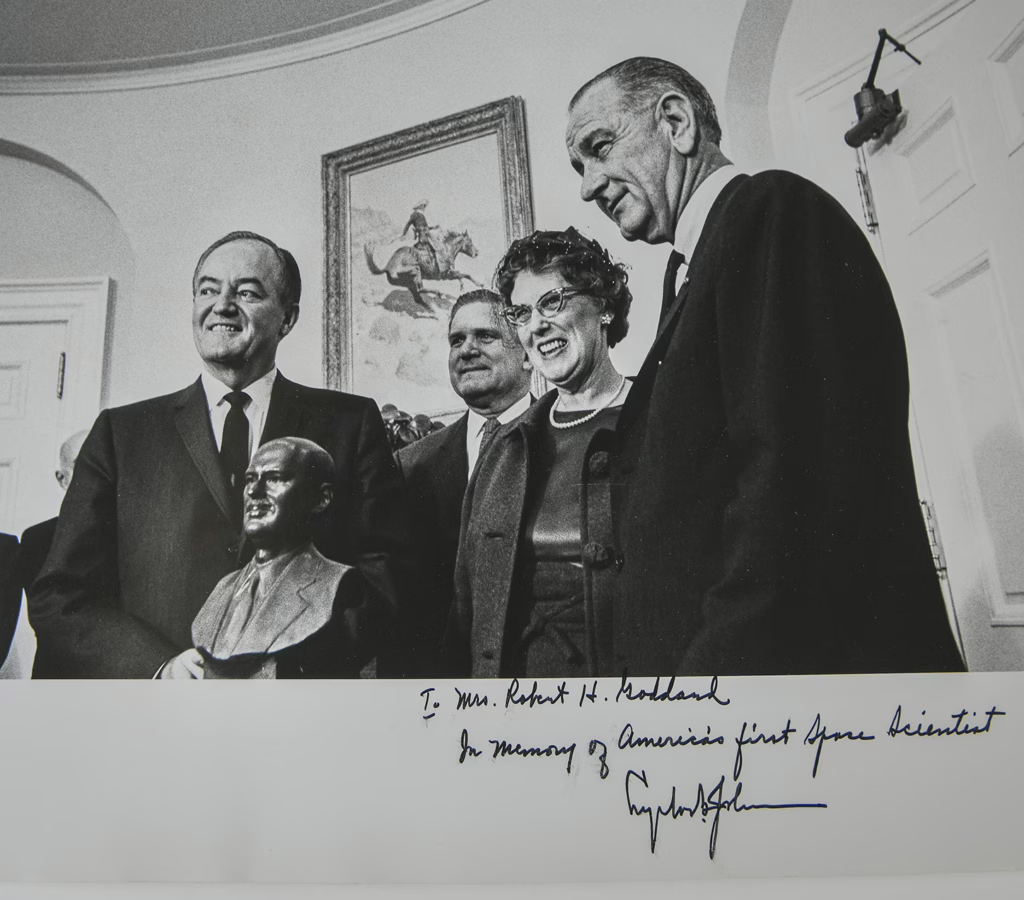
In 1965, when President Lyndon Johnson declared March 16 “Goddard Day,” Esther said, “I am deeply proud and grateful for what we have done for his memory. It is far more than he, or I, might have dreamed of.”
Esther Goddard with President Lyndon B. Johnson (right) at the presentation of the first Robert Goddard Memorial Trophy
“Like an empty boat drifiting toward shore”
The Robert and Esther Goddard Collection holds more than most people realize. There are pressed flowers from Esther and Robert’s wedding. Boxes of press clippings and editorial cartoons from the 1920s. Photos and film reels. Shelves and shelves of patent files—the legal foundation of a legacy Esther refused to let anyone else claim.
And then there are the diaries, in which Robert recorded the daily texture of his life beginning in 1898: movies attended, books read, rockets launched (both successfully and failed). In June of 1945, the pages include Esther’s additions, where she described his coughing spells and doctor’s recommendations.
On June 14, she observed:
When I woke, Bob was awake, and said “I’ve been lying here watching you. I didn’t know anyone could be so beautiful.”
At the bottom of the page, she added, “I loved him. R was tired to death.”
Robert stopped writing in the diary around that time. Esther continued to record their activities; some entries are simply “very ill,” or “at hosp.,” but others share stories of visitors, treatments, and other interactions.
August 9
Bob terribly ill. I was alone with him while nurse had lunch—he grasped my hand and arm and squeezed, surprisingly hard, as if in gratitude—I said “You’re trying to tell me you love me? I love you too, Bob.”
He drifted all afternoon—like an empty boat drifting toward shore. At 5 p.m. he motioned he wanted something—glasses? Clock? All no—it was newspaper—not for news, but ran his finger roughly along date line. Had lost track of time until then.
The next morning, while Esther was at home, Robert died. “His heart failed under the great, long suffering,” she wrote.
Esther did not include those final diary entries in her curated set of Robert’s papers. They were too personal to fit into the “Robert Goddard” image she was building.