Emond, a former NASA analyst, will return to Clark on March 17 to reflect on Robert Goddard’s achievements and struggles
Clark is known for uncommon trajectories. A student may set forth with a particular career direction in mind, then pivot into something totally unexpected, where they’ll find success and meaning. It happens all the time.
Consider John Emond ’74.
What appealed to Emond about Clark was its strong liberal arts profile and that it was a university large enough to provide diverse experiences and attract a student population from across the country and throughout the world, yet small enough to foster a close-knit student body and interaction with professors.
He entered Clark with a passion for history that, for him, was a logical progression to earning a bachelor’s degree in that subject. What is perhaps less logical, but fascinating, is the path he followed to become an analyst with NASA.
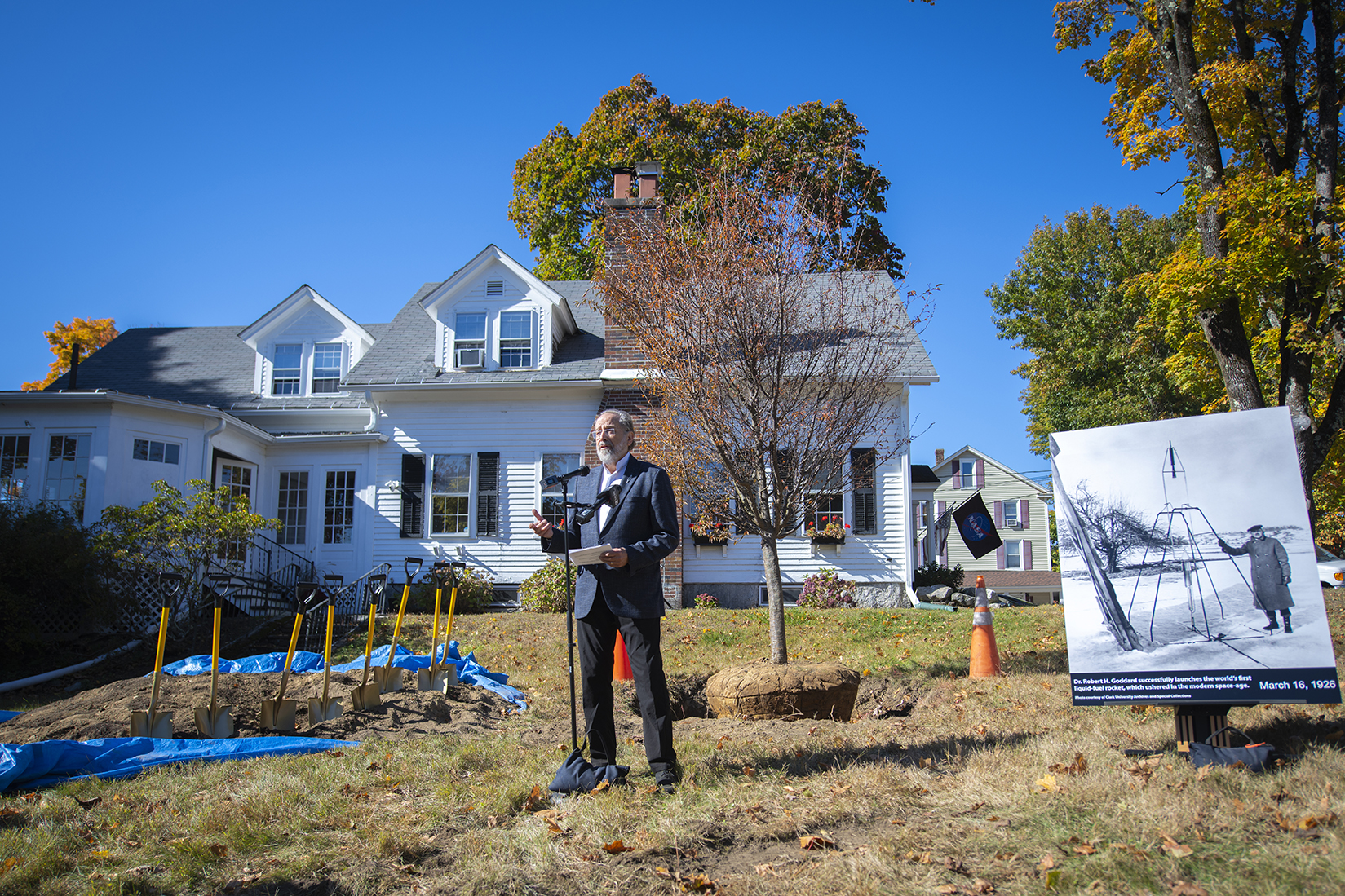
It’s also a path that will lead him back to Clark on March 17, when he will present “Robert Goddard: A Vision. A Reality. A Hope.” in honor of the 100th anniversary of Goddard’s March 16, 1926, first successful launch of a liquid-fueled rocket. The talk will be held at 7 p.m. in Johnson Auditorium of the Sackler Sciences Center, and will also be available to watch live online.
In recounting the professional journey that eventually brought him to NASA, Emond recalls a particular opportunity at Clark that was literally life-changing. In January 1973, as part of the “Society in Conflict” program, he lived for the month with a family in Creggan Heights, Derry, Northern Ireland, during the very heart of The Troubles. At that time, Derry was literally a war zone, yet Emond remembers meeting warm and courageous people on both sides of the divide. That experience made a profound impact on him, and he returned to Derry the summer after his 1974 Clark graduation to engage in youth work. “This included bus trips bringing Derry children away from scenes of armored cars, soldiers on patrol, and bomb scares, to quiet, pastoral locations where children could just be children,” he recalls.
Emond’s early career post-graduation was in youth work. He spent a year as a VISTA volunteer at Trapper Creek Job Corps in Montana, teaching at a residential treatment center for troubled youth, and later served as a milieu therapist at a day treatment center for youth.
He’d reached a career plateau and knew further growth would require a master’s degree. But he’d also arrived at a crossroads: continue in social service through a master’s degree in social work or broaden career opportunities through a master’s in public administration. He chose the latter, which was a departure from the social service career track he had been on.
Emond earned his MPA at the University of Connecticut in 1982, and through that program, he was nominated and accepted into the Presidential Management Intern program that placed recent advanced graduates into positions within the federal government. This led to an appointment at NASA’s Goddard Space Flight Center in Greenbelt, Maryland. He later accepted a position at NASA HQ in Washington, D.C. Through his 29-year NASA career, until his retirement in 2011, Emond held positions as a contract specialist, policy analyst, and program manager.
His early NASA contract work brought him into contact with a number of aerospace companies that owe their very existence to pathfinders such as Robert Goddard.
Through his position as a NASA HQ program manager, Emond had the opportunity to witness a number of research and development efforts using microgravity and other aspects of orbital missions to explore the development of new or improved products and services on Earth. This arena of endeavors in low Earth orbit was something Robert Goddard dreamed of, but which earned him criticism from the public and many professional peers alike, Emond notes.
“In the years prior to Goddard’s breakthrough launch of a liquid-fuel rocket in 1926, his research was ridiculed as attempting the impossible,” Emond says. “Labeled ‘Moon Man,’ Dr. Goddard was criticized as taking fantasy crafted by the likes of Jules Verne and H.G. Wells and attempting to turn it into what was deemed far-fetched and doomed-to-fail reality.”
In his March 17 presentation, Emond will reflect on Goddard’s achievements and struggles.
Even Goddard’s early success was not given the appreciation it deserved, he says, given that his historic launch seemed humble compared to the subsequent breakthrough the world witnessed on July 20, 1969, with the lunar landing and Neil Armstrong’s first steps onto the surface of the moon. “Though he did not live to see it, this moment was the full vindication of the life’s work of Dr. Robert Goddard, ‘Moon Man,’ ” Emond says.
Emond also will highlight the legacy of Goddard’s pioneering efforts as seen in the space endeavors of today, including international collaboration and rocket technology advances that can be the conduit for even greater human achievement or act as weapons of great destruction.
“Through this presentation,” he says. “Dr. Goddard’s life and his dedication to turn dream into reality, despite challenges, perhaps can encourage Clark students of today to be open to challenge, be open to opportunity, and be open to change.”