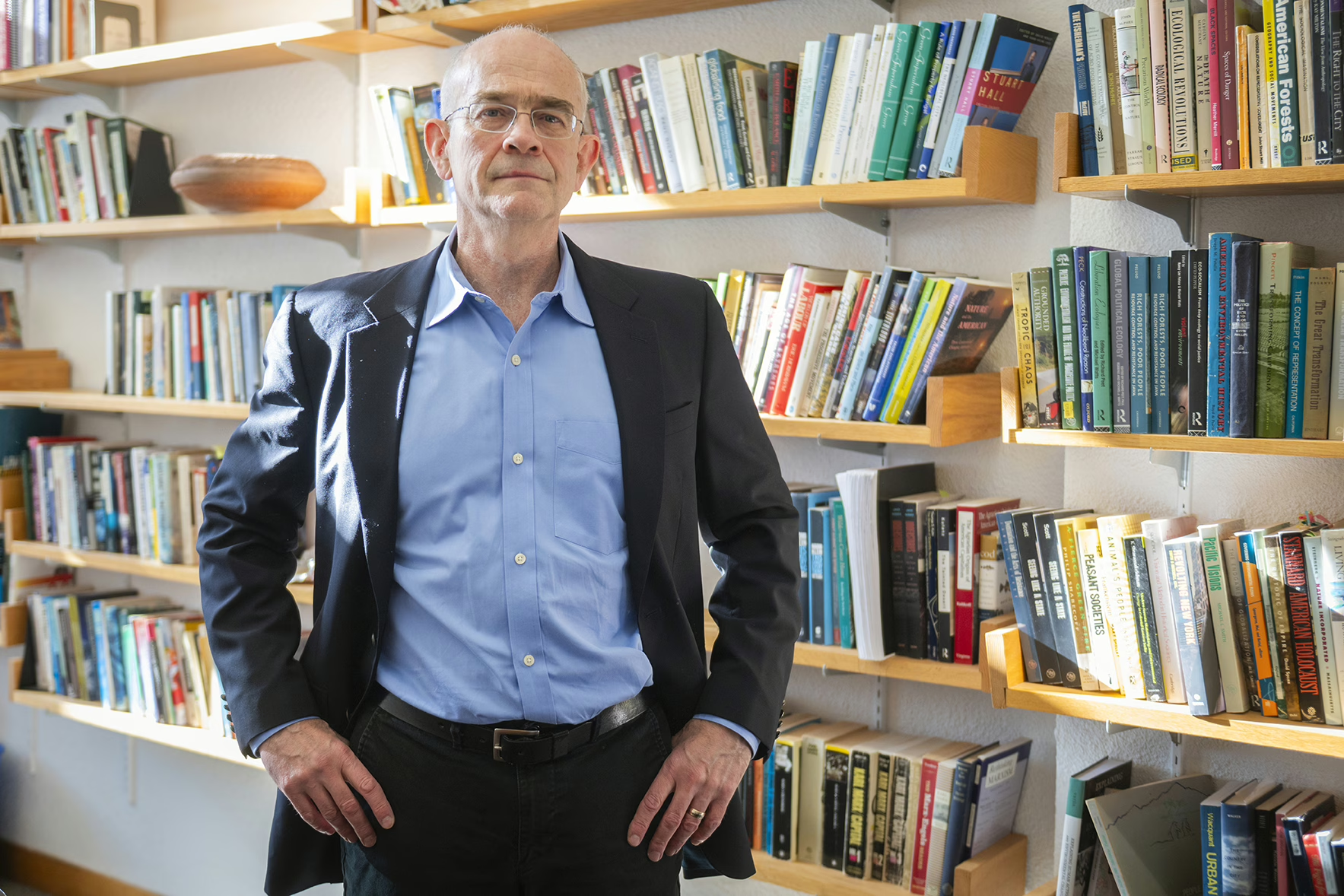
Henry “Harry” James Steward, professor emeritus of geography and renowned expert in cartography, passed away on November 29, 2025, two decades after retiring from Clark University in 2005.
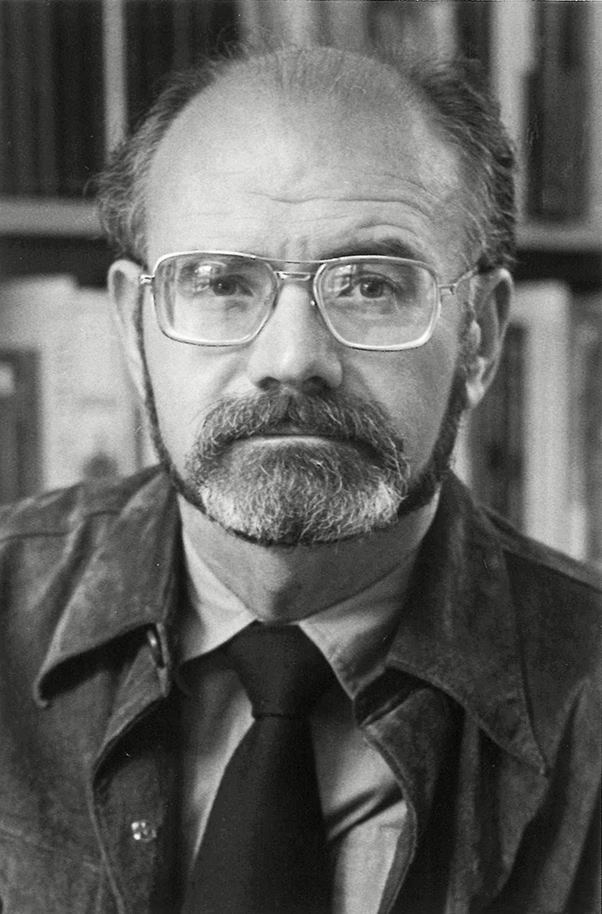
In his almost three decades at Clark, Steward taught graduate and undergraduate courses on a wide range of cartographic topics, including introduction to cartography, field mapping and remote sensing, map design, automated cartography, topographical mapping, the history of maps and map making, and mapping for international development.
In the early 1990s Steward introduced the course Philosophy of Cartography, described in the academic catalog as examining “the need, in the light of significant technological advances in the mapping sciences, to reconsider the fundamentals and the scope of cartography.” The digital age had arrived, and Steward’s career coincided with significant technological advances in the way data about the earth’s size, shape, and characteristics were collected, processed into map form, and analyzed — transitioning from labor-intensive surveying and drawing methods to satellite-based remote sensing, computer processing, design software and geographic information systems.
Born in London’s East End three years before the beginning of World War II, Steward would spend much of his childhood in a city ravaged by the Blitz and war-time deprivation. He earned a B.S. in geography and economics from the University of London, and a Ph.D. from the University of Wales, where he delivered a dissertation on cartographic generalization. Prior to joining Clark’s Graduate School of Geography in 1978, he held faculty appointments at Columbia University, Kent State University, and Ohio State University.
Fellow Londoner Simon Batterbury, who arrived at Clark in 1987 to begin his doctoral studies in geography, stayed for several days with Steward and his wife, Clark librarian Mary Hartmann, while getting settled in Worcester.
“Harry was what us Londoners would colloquially call a ‘geezer’ – solidly East London, he never lost his Cockney accent,” recalls Batterbury, who today is a professor of environmental studies at the University of Melbourne, Australia. Batterbury, like Steward the first in his family to leave the UK, recalls listening to his own father and Steward discuss their experiences in London during WWII.
“My memory [of Steward] was of a man solidly committed to Clark and to teaching, but most of all to maps,” Batterbury remembers.
Ute Dymon, Ph.D. ’85, emerita professor of geography at Kent State University,recalls Steward’s support and encouragement when she expressed concerns that her family obligations might impede her ability to complete her doctoral studies.
“Harry let me know that those feelings were not uncommon and that many students felt the same way at the beginning,” Dymon says. “He was right. My confidence grew, and I felt at home at Clark within a short period of time. During our advice sessions, I often brought my four-year-old daughter with me. Harry never minded it, and we were able to have some great discussions about maps and mapping.”
Anne Godlewska, emerita professor in the Department of Geography and Planning at Queen’s University, Canada, also completed her Clark Ph.D. in 1985.
“As a Ph.D. supervisor, Harry was very supportive of my somewhat arcane interests, providing me with an endless stream of references and many delightful conversations,” Geolewska says. “I shall forever remember his voice as he exclaimed about his most recent library find.”
He was solidly committed to Clark and to teaching, but most of all to maps.
Simon Batterbury, Ph.D. ’97
Shortly before Steward passed away he was delighted to learn that his former student, Margaret Wickens Pearce, M.A. ’95, Ph.D. ’98, had been named a 2025 MacArthur Foundation Fellow, a highly prestigious award recognizing exceptional individuals who have shown outstanding originality and dedication in creative fields.
Pearce, a Citizen Potawatomi Nation tribal member, focused her Clark dissertation on native and colonial mapping in western Connecticut land records. The fellowship grant will allow her to continue creating maps that tell the story of Indigenous peoples in North America.
Pearce recalled Steward’s efforts to keep her informed of scholarly articles and books related to her areas of interest.
“Almost every day,” she says, “he would hand me a slip of paper with a carefully penned citation to an article or book I should know. More often than not, these publications were international or obscure sources whose existence I definitely wouldn’t have known from my own studies. Harry found them through careful, omnivorous reading and note-taking, and I was absolutely grateful to receive them.”
Billie Lee Turner, the former director of the Graduate School of Geography whose time at Clark ran concurrent with Steward’s, remembers him as “an extremely kind individual who was always the gentleman” even at times when tensions might run high in the department.
Harry Steward was a valued and supportive colleague, notes Ron Eastman, emeritus professor of geography and an internationally recognized pioneer in the field of geographic information science.
“I first came to Clark in 1981 to replace Harry when he took a semester leave to do research in Hawaii,” Eastman says. “My focus on cartography was completely different from Harry’s. However, he took great interest in my work, and we had many long and rewarding discussions. Later that spring, Harry started lobbying for me to be rehired, and he continued to be my advocate until a tenure line opened up. I will always be indebted to him for that. He was a wonderful person and I very much enjoyed working with him.”
Read more about Professor Steward »